
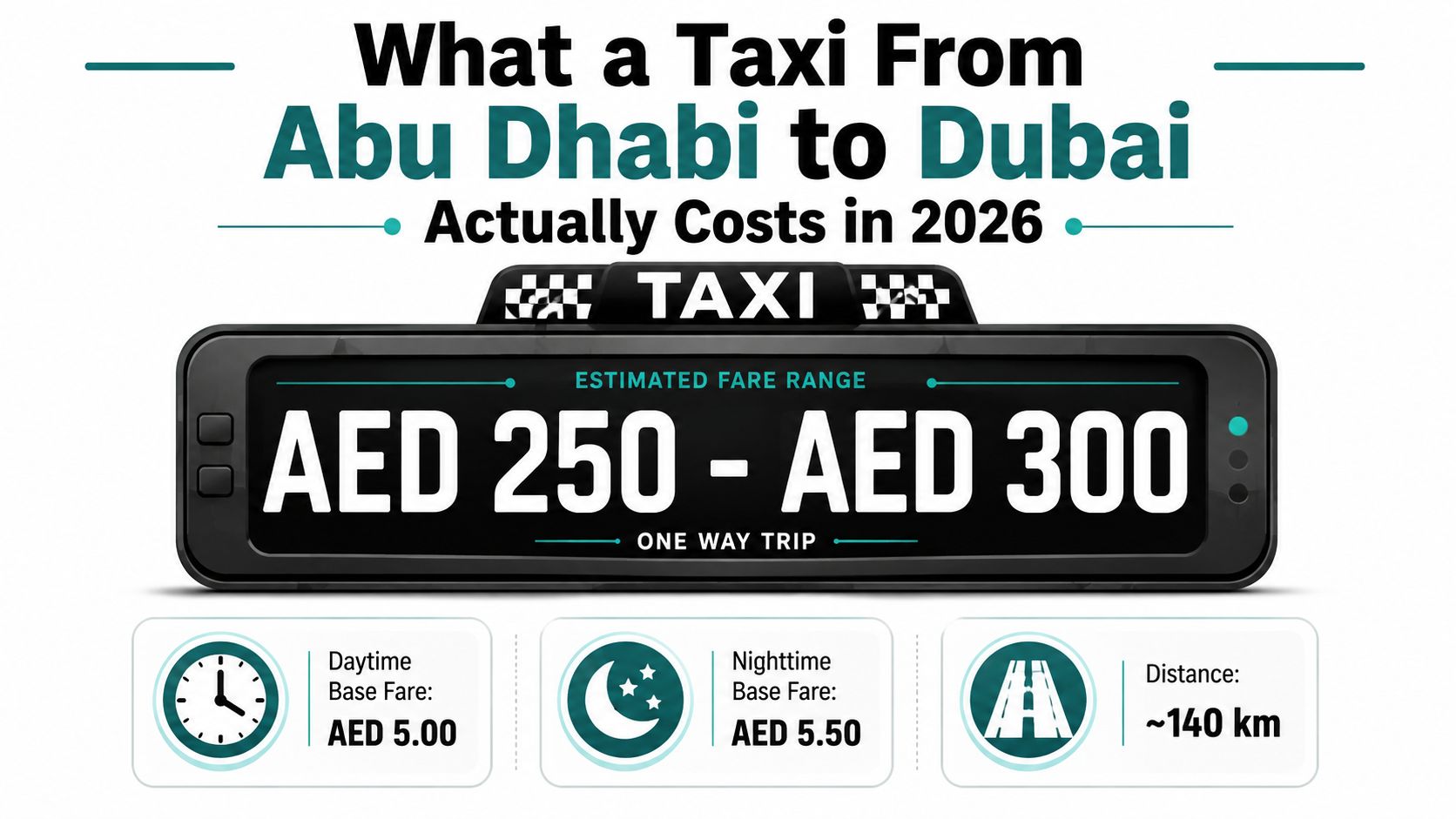
A one-way taxi from Abu Dhabi to Dubai typically costs AED 250 to AED 300, and airport pickups plus tolls can push it to AED 330+. The ride covers about 140 km to 160 km and usually takes 1 hour 15 minutes to 2 hours 30 minutes, so this is not a casual city hop, it's a proper inter-emirate transfer.
That's the number people want. The problem is that most articles stop there and never explain why the fare lands in that band, why one trip feels cheap and another gets ugly fast, or when a taxi is the wrong choice.
For a broader vehicle and booking comparison, the local transfer options at Uptown DXB are useful as a reference point, especially if you're trying to decide whether to book a taxi, a private car, or something more flexible.
Taxi Fare Breakdown for 2026
The taxi from Abu Dhabi to Dubai cost usually sits in a narrow band, not a guessing game. For a standard one-way trip, expect AED 250 to AED 300, and the total climbs when pickup location, traffic, tolls, or airport charges are added in (The National).
What “normal” really looks like
A metered taxi from a residential area in Abu Dhabi to a standard Dubai destination is the clean benchmark. The route is long enough for the meter to matter, but the regulated tariff stops the fare from turning into an open-ended bill. That is why this trip gets so much attention in the UAE. It is convenient, but only if you know what you are paying for.
The distance is the main reason. The ride spans about 140 km to 160 km, so it does not behave like an ordinary city taxi run. You are crossing emirates, using motorway routes, and often dealing with sections where the path you choose changes the final meter reading (Abu Dhabi Mobility).
Practical rule: if someone gives you a flat price that sounds much lower than the normal band, ask what is included before you get in.
The trip also takes time, usually 1 hour 15 minutes to 2 hours 30 minutes depending on traffic and pickup point (Abu Dhabi Mobility). That window is why airport transfers and peak-hour rides often end up costing more than travellers expect.
The clean takeaway is simple. A standard metered taxi is the fair benchmark, AED 250 to AED 300 is the normal band, and anything above that usually has a clear reason.
If you are comparing transfer options from Abu Dhabi, the local breakdown at Abu Dhabi Salik and taxi pricing helps show where taxi charges start to creep up, and the broader vehicle options at Uptown DXB are useful if you are weighing a taxi against a private car or another transfer type.
How the UAE Taxi Meter Builds the Fare
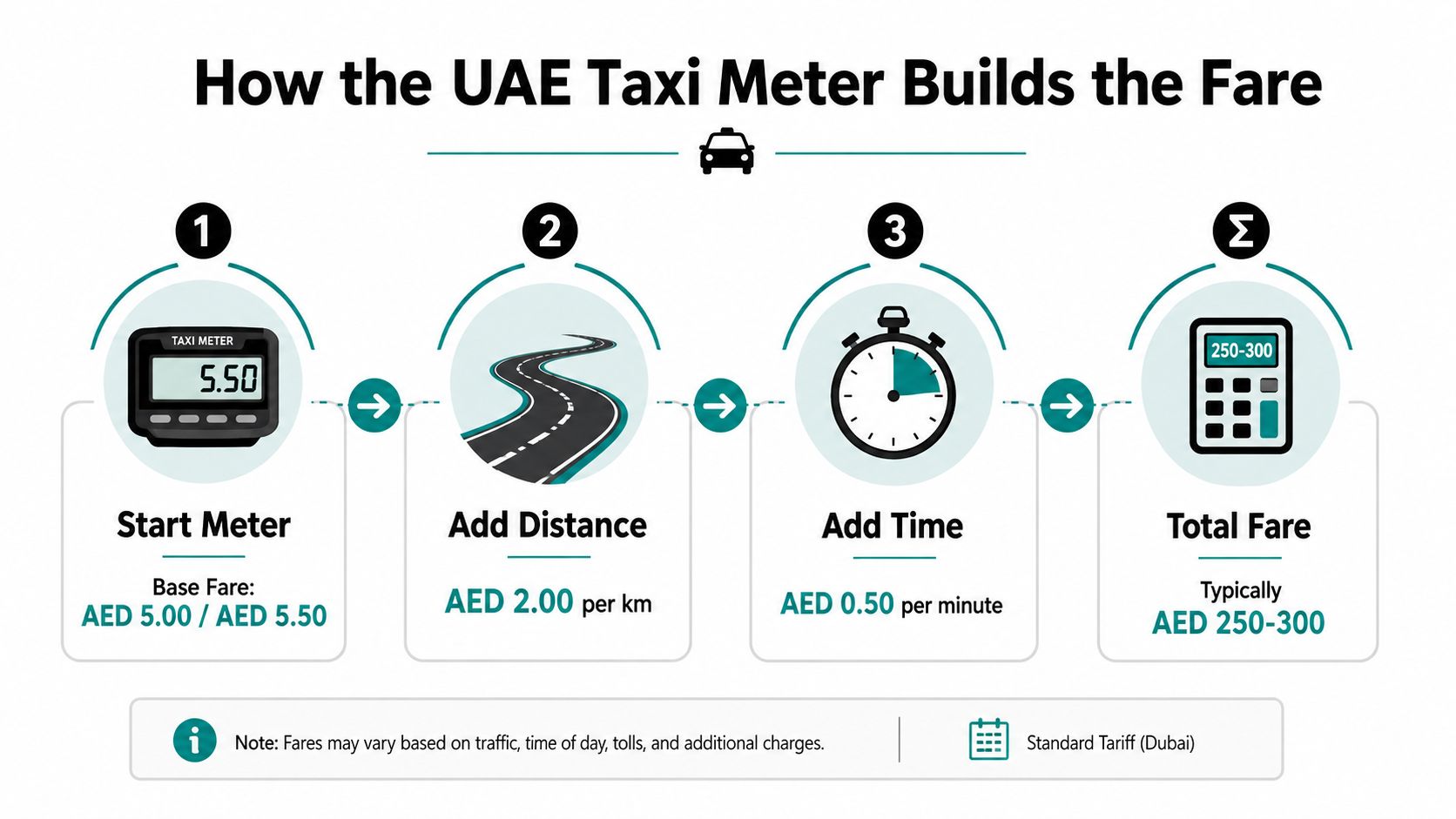
The fare starts with a regulated base amount, then rises with distance, and then keeps climbing if the driver is stuck in traffic. That is the engine behind the number you see on the meter.
The base fare and distance charge
Abu Dhabi taxis use a base fare of AED 5.00 in the day and AED 5.50 at night, with a per-kilometre rate of AED 1.82. On a route of roughly 150 km, the math lands around AED 278 before extras, which is why the market usually sits in the AED 250 to AED 300 band.
Memorise that structure. A long metered ride is mostly distance plus time, not a guessing game or a negotiation at the curb.
What happens in traffic
Slow traffic keeps the meter moving. On this route, that matters because two rides that look the same on a map can produce different totals once one driver spends longer crawling through congestion. The distance barely changes, but the fare still rises.
The meter does not care that you are frustrated. It only cares that the vehicle is still on the job.
That is why a regulated taxi is easier to trust than a verbal quote. You get a formula, not a free-form number.
If you want to see how tolls and route choice change the bill, the local breakdown at Abu Dhabi taxi pricing and tolls is a useful companion read.
The Four Cost Drivers That Move the Final Number
The headline fare is only the starting point. In real life, four things push the bill upward, and they're usually the reason one traveller pays a fair amount while another feels ripped off.
Distance route and waiting time
Route choice comes first. A clean motorway run is one thing, but detours, slower corridors, and city-edge pickup locations can lengthen the trip. Once the car spends extra time moving, the meter follows that time, and the bill grows even if you don't feel like you travelled much farther.
Waiting time matters just as much. Friday traffic, school holidays, and evening congestion can stretch the journey enough to turn a normal transfer into a noticeably pricier one. That's why the same route can feel painless one morning and expensive the next.
Salik and pickup charges
Dubai applies Salik at AED 4 per gate on tolled roads, while Abu Dhabi has no toll gates on the standard taxi tariff (Property Finder). If your route enters tolled corridors, those charges hit the final total directly.
Airport pickup is the other quiet money leak. UAE travel guides commonly note a fixed airport surcharge of about AED 20 to AED 25, which is why an airport-origin ride can jump from the normal band into the AED 330+ territory when you combine that surcharge with tolls and traffic.
| Scenario | Base + Distance | Salik Tolls | Airport Surcharge | Estimated Total |
|---|---|---|---|---|
| Residential Abu Dhabi to central Dubai | Standard metered fare | Minimal or none on the cleanest route | None | Around AED 250 |
| Residential Abu Dhabi to Dubai with tolled corridors | Standard metered fare | Added tolls | None | Higher than the baseline |
| Airport pickup to Dubai hotel | Standard metered fare | Added tolls | Added airport charge | AED 330+ |
| Slow evening transfer with airport pickup | Standard metered fare | Added tolls | Added airport charge | Highest of the common scenarios |
The blunt truth is this. Distance is not the main surprise, toll structure and pickup structure are. That's where the taxi earns its reputation for being fair on paper and annoying in practice.
For route planning, the live traffic context at Dubai traffic map is worth checking before you leave, because timing changes the meter more than most visitors expect.
Travel Time and the Best Times to Travel
The route is long enough that timing affects the fare as much as comfort. A smooth motorway run stays predictable, but once traffic thickens, the meter keeps climbing while your arrival slips back.
When the trip is fastest
The best window is early morning, especially 5am to 7am. Roads are calmer, waiting time stays low, and you are far less likely to pay for slow, stop-start traffic. If that timing does not work, weekday departures before 2pm are still the better choice, because they avoid the worst of the afternoon outbound rush.
When the trip gets ugly
Friday is the worst option if you have any flexibility. Afternoon traffic, family movement, and heavy intercity demand all slow the ride and push the final fare higher. Sunday evenings are another rough window, because commuters and weekend return traffic hit the roads at the same time.
A slower trip usually costs more. That is the part travellers miss, because they treat time as a convenience issue rather than a fare input. On a metered ride, delay is money.
Best habit: if the ride is for a flight, a meeting, or a hotel check-in, leave earlier than your first instinct says to. That extra cushion costs nothing compared with a missed schedule.
If you want to avoid the worst congestion patterns, check the Dubai traffic map before you book. For a quick outside comparison on how app-based pricing behaves in another market, the taxi app Portugal comparison shows the same basic pattern, app convenience is useful, but traffic still decides the final cost.
Taxi vs Ride-Hailing vs Private Transfer vs Rental
The best option isn't always the cheapest line item. It depends on how many people are travelling, how much luggage you have, and whether the ride is just transport or part of a larger plan.
Standard taxi and ride-hailing
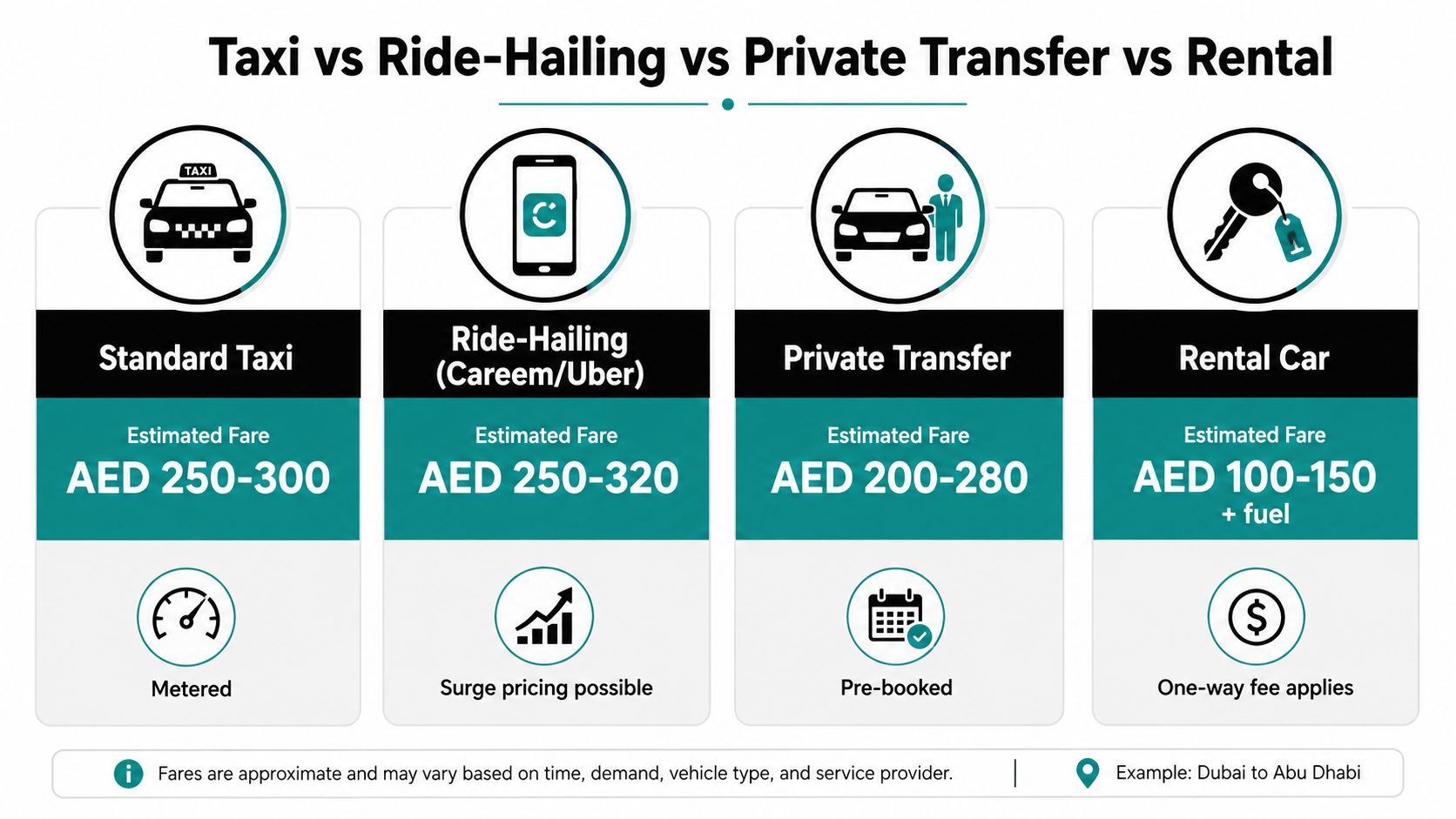
A metered taxi stays the benchmark at AED 250 to AED 300. Ride-hailing services like Careem and Uber usually sit in a similar band, and they can climb higher when demand spikes. If you want predictability, the app can feel cleaner. If you want the regulated meter and less pricing anxiety, the standard taxi is usually the safer bet.
Shared transfers and private cars
Shared transport is where solo travellers can save money, because the seat price is lower, but the trade-off is fixed timing and shared luggage space. Private transfers cost more than a taxi in many situations, but they buy you structure, meet-and-greet convenience, and usually a calmer trip if you're arriving with family or a business group.
A useful outside comparison comes from the taxi app Portugal comparison. The market is different, but the logic is familiar, app pricing is convenient, yet convenience can cost more when demand spikes.
Rental when the whole day matters
A rental car becomes interesting when the transfer is only one piece of your day. If you're making stops, carrying luggage, or planning to stay mobile after arrival, a car stops being a transfer expense and starts becoming transport flexibility.
| Option | Best for | Weak point |
|---|---|---|
| Standard taxi | Solo travellers, couples, direct transfers | Can climb with tolls and traffic |
| Ride-hailing | App-first users who want upfront booking | Surge pricing can sting |
| Shared transfer | Budget travellers with fixed plans | Less flexibility |
| Private transfer | Families and premium arrivals | Costs more upfront |
| Rental car | Multi-stop trips and extended use | Overkill for a simple point-to-point ride |
The smartest choice is not the one with the lowest sticker price. It's the one that fits your luggage, your schedule, and how many times you'll need the vehicle after landing.
When a Luxury Rental Beats the Taxi
A taxi is fine for a straight transfer. It's not the strongest option once the trip turns into a weekend, a business programme, or a celebration with moving parts.
When the rental wins
If you're doing a wedding weekend, a corporate visit with multiple meetings, or an anniversary trip with scenic stops, a luxury rental makes more sense than paying one metered fare after another. The value is not just the car. It's the freedom to stop, change plans, keep luggage in one place, and avoid waiting for another vehicle every time your schedule shifts.
That's where a day-based rental starts to look sensible. The car works for the entire stay, not just the road between Abu Dhabi and Dubai. For travellers who care about presentation, that matters more than shaving a bit off the transfer fare.
When it's overkill
If you're only doing one airport-to-hotel run, and nothing else, a luxury rental is too much car for the job. You'd be paying for flexibility you won't use. In that case, the taxi is the cleaner decision because the route is direct and the problem is solved in one move.
My view: don't rent luxury for a transfer. Rent luxury for a trip.
The right call depends on whether transportation is the whole experience or just one part of it. For a quick point-to-point journey, the taxi wins on simplicity. For a trip that needs mobility, image, and comfort all day, the rental is the better buy.
Practical Tips to Lower the Taxi Fare
You don't need tricks. You need discipline. Many travelers overpay because they get in the first available car and never check the basics.
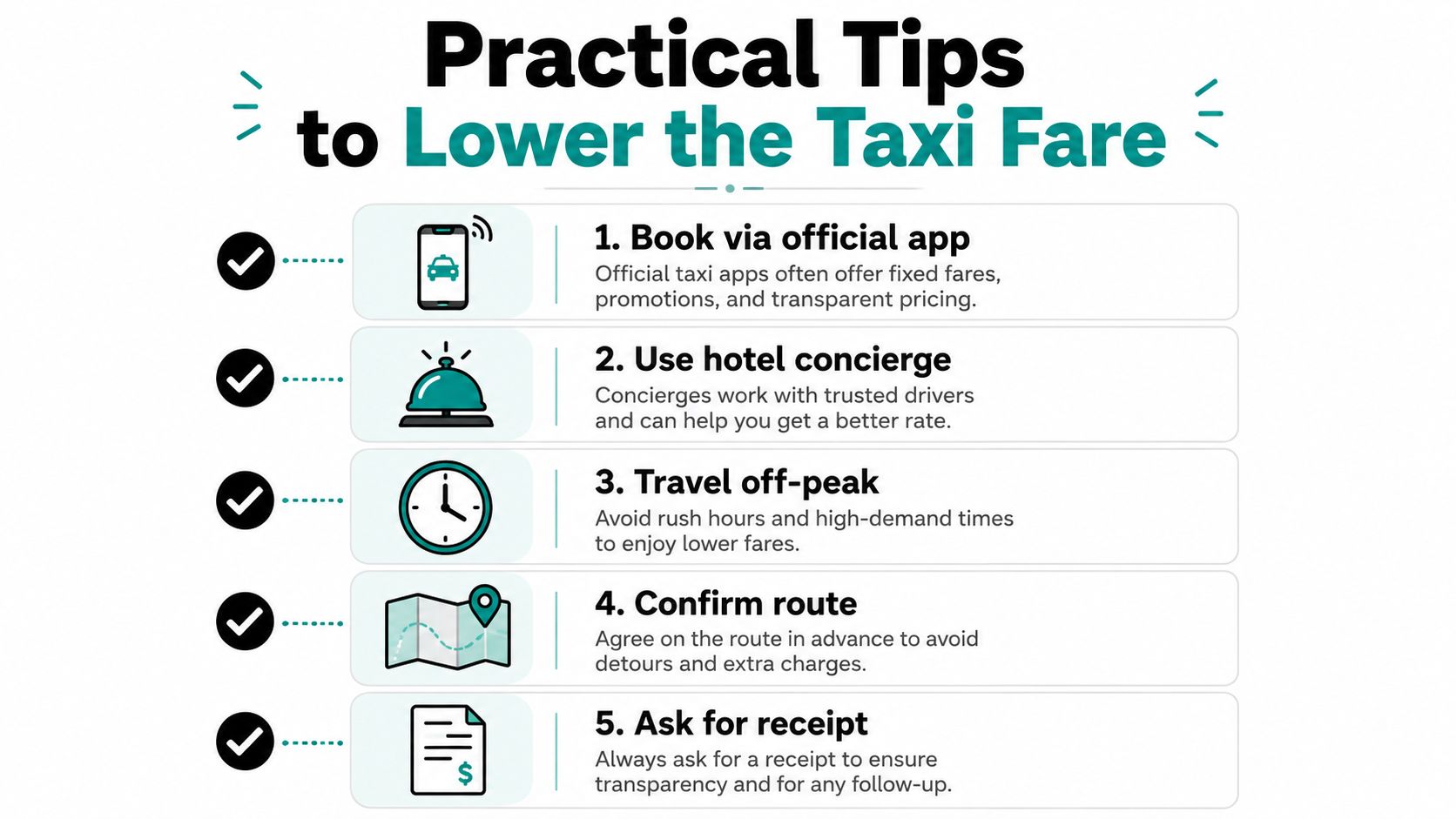
Do these five things
- Book via an official app. You get a proper booking trail and less room for games.
- Use a hotel concierge if you're unsure. Hotels deal with this route constantly and usually know which cars are legitimate.
- Travel off-peak. Less traffic means less meter creep.
- Confirm the meter starts at AED 5.00 or AED 5.50. If it doesn't, stop the ride before it starts.
- Ask for a receipt. It discourages nonsense and gives you a record if the fare looks wrong.
There are also three red flags you shouldn't ignore. A driver demanding a flat fare before starting, a meter that “forgets” to run, or a ride-hailing surge during a busy event can all turn a reasonable transfer into a bad deal.
A simple defence works in most cases. Ask to use the meter, get the route confirmed, and walk away if the driver won't play by the rules. The regulated tariff exists for a reason, and you should use it.
Choosing the Right Option for Your Trip
Choose based on passengers, luggage, and occasion. A solo traveller or couple with light bags should use a metered taxi or ride-hailing app. A family of three or four with proper luggage often gets better value from a private transfer or rental. If the trip includes meetings, multiple stops, or a celebration, a luxury vehicle is the smarter move.
The baseline fare is still AED 250 to AED 300, and the usual extras are clear once you know where the money comes from. The regulated tariff keeps the taxi honest, but airport pickups, tolls, and traffic can still push the bill higher than people expect.
For travellers who want to avoid on-the-day negotiation and get a vehicle that fits the whole plan, booking online is the cleaner route. If you want a luxury car for the transfer, the event, or the rest of your stay, visit Uptown Rent A Car and choose a car that matches the way you travel.