
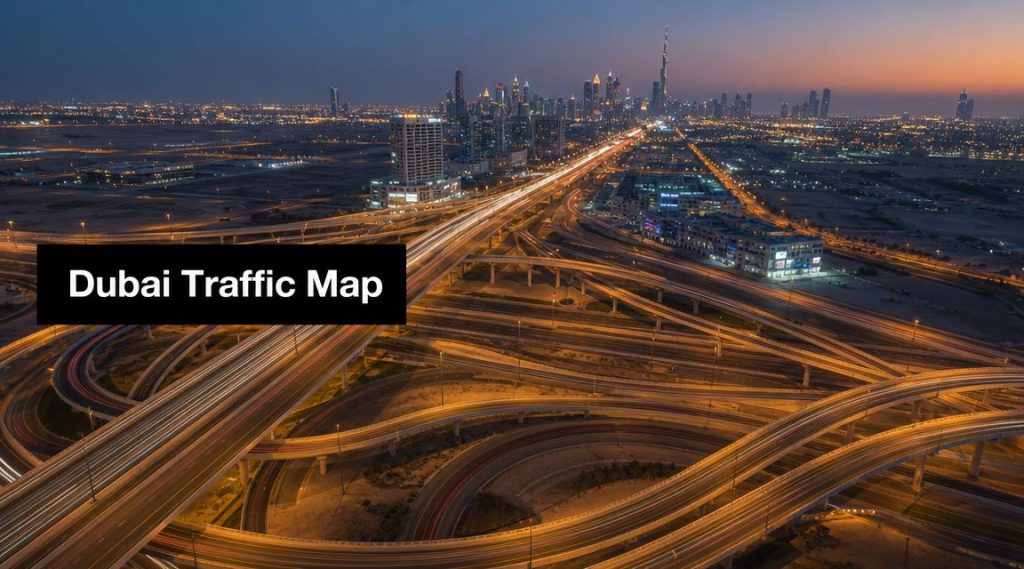
You've landed at DXB, cleared immigration quickly, and collected the keys to a luxury car that deserves better than stop-start frustration. Your dinner is in DIFC, your hotel is on Palm Jumeirah, and your meeting moved forward by half an hour. In that moment, a Dubai traffic map isn't a convenience. It's the difference between arriving composed or arriving apologetic.
Dubai rewards drivers who plan properly. The roads are modern, the signage is clear, and the city moves with more discipline than most global business hubs. But that doesn't mean you can wing it. It means you can get very good results if you read the network properly, choose the right corridor, and stop relying on instinct alone.
Your Essential Tool for Navigating Dubai
A lot of first-time visitors make the same mistake. They assume Dubai's wide roads mean easy driving at any hour. Then they leave the airport, point the car towards a key appointment, and discover that one badly timed merge or one poorly chosen interchange can cost them the calm they were paying for.
That's why I treat a Dubai traffic map as part of the vehicle, not an optional app.
The real luxury is control
Dubai is unusually efficient for a major city. Gulf News reported an average travel time per 10 km of 13.7 minutes, against a global average of 15.9 minutes, and a Travel Time Index of 1.23 compared with 1.3 globally in its report on Dubai's travel time rankings. That tells you something important. The city isn't slow by default. The problem is usually route choice, timing, and local bottlenecks.
If you're driving a premium sedan or SUV, you should use that advantage properly. Don't just ask, “How far is it?” Ask, “Which approach keeps me moving smoothly, avoids awkward lane changes, and gets me to a clean arrival point?”
Practical rule: In Dubai, the best route often isn't the shortest one. It's the one with the fewest stressful transitions.
Start before you start the engine
If you're coming straight from the airport, sort your orientation first. A lot of wasted time starts inside or around the terminal, not on the motorway. If you want a cleaner handoff from arrival to road, Waymap's guide to DXB is useful for understanding terminal layout before you leave the kerbside guessing where everything is.
Then do three things before departure:
- Check the live route once while parked. Don't pull out and “see how it goes”.
- Look at the destination approach. The last few minutes matter most in Business Bay, Downtown, Marina, and hotel zones.
- Decide your fallback corridor early. If Sheikh Zayed Road looks awkward, switch before you commit to it.
What seasoned drivers do differently
Experienced Dubai drivers don't rely on memory. They know the city changes by hour, by event, and by direction of travel. A route that feels effortless at one time can become irritating later for no dramatic reason visible from the driver's seat.
That's why the map matters. It gives you the one thing even local confidence can't guarantee. Current context. If you're in Dubai for business, a wedding, a client dinner, or a high-value airport transfer, that context is worth more than horsepower.
How Live Dubai Traffic Maps See the Roads
Most drivers treat the map as magic. Green means go, red means avoid, and that's the end of the thought process. That's too shallow. If you understand how a live Dubai traffic map works, you'll trust it more when it reroutes you, and you'll ignore it less when it warns you early.
Where the information comes from
Live traffic maps pull together several kinds of signals. Some come from phones and in-car navigation devices. Some come from roadside systems and official reports. Some come from patterns the system has already learned from repeated traffic behaviour.

The key point is simple. The map doesn't wait for you to see a jam. It detects slowing movement, unusual density, incidents, and corridor behaviour before the delay fully announces itself to the driver.
Why Dubai changes fast
Dubai's roads don't run on static timing alone. According to road-operations commentary from the Roads and Transport Authority ecosystem, the city uses real-time signal control at roughly 620 controlled intersections, and the AI-based upgrade is expected to improve traffic conditions around signals by 16% to 35% in that ecosystem discussion on Dubai's intelligent traffic control.
That matters because a route can improve or worsen dynamically. If signal timing changes in response to live demand, yesterday's “safe bet” may not be today's best path.
Don't drive Dubai on memory during a busy window. The road network is more adaptive than that.
What the colours actually mean for the drive
Treat map colours as a comfort signal as much as a speed signal.
- Green usually means clean flow and low friction. Good for executive transfers and relaxed driving.
- Orange often means movement with interruptions. Fine if the route is straightforward and your destination access is easy.
- Red usually means patience, close spacing, and more frequent braking. Not ideal if you want a polished arrival.
- Dark red means the route may still be technically moving, but the driving experience is already poor.
A luxury drive should feel composed. If the map shows a route that is only slightly faster but significantly more broken up, skip it. The better choice is often the corridor that preserves rhythm.
Use the map actively, not passively
A strong driver checks the map in stages:
- Before departure for the full route.
- At the first major decision point to confirm the chosen corridor still makes sense.
- Near the destination to avoid messy final access.
That's how you turn live data into a smoother journey, not just a shorter one.
Choosing Your Best Live Traffic Source
No single app does everything perfectly in Dubai. Use the wrong tool and you'll still get there, but you'll miss the small decisions that protect time, comfort, and confidence. For a luxury renter or business traveller, the right question isn't “Which app is most popular?” It's “Which app helps me make cleaner decisions for this exact trip?”
A useful starting point is this side-by-side visual.

My blunt ranking by use case
Here's how I'd use them.
| App | Use it for | Watch out for |
|---|---|---|
| Google Maps | Hotel, restaurant, office, and venue routing with strong place search | It can tempt you into routes that are technically efficient but irritating to drive |
| Waze | Fast incident awareness and aggressive rerouting | It can prioritise shaving time over preserving a premium driving experience |
| RTA Smart Drive | Official local orientation and Dubai-specific road context | Better as a supporting tool than your only live decision-maker |
| Here WeGo | Solid backup, especially if offline access matters | Less useful when you need the sharpest live tactical response |
Why Google Maps is still the main tool
For most visitors, Google Maps should be the default. A Dubai-focused IEEE study showed that a workflow combining Google Maps traffic-layer extraction with OpenStreetMap road geometry can convert live congestion colours into quantitative, georeferenced road-segment scores for hotspot identification and predictive modelling, as discussed in this Dubai traffic analysis study. That's a technical way of saying the consumer map in your hand is built on data detailed enough for serious analysis.
That makes it highly practical for drivers who need dependable live routing and strong destination search in one place.
If you want a broader orientation tool alongside your traffic app, Uptown also has a useful overview of Dubai maps and app options.
Where Waze earns its place
Waze is excellent when the city gets messy. If there's an unexpected obstruction, minor incident, or annoying delay point, the community-driven layer can be very helpful. I don't recommend it as your only app for a luxury itinerary, but I do recommend it when punctuality matters more than route elegance.
Use it for:
- Event nights
- Tight meeting schedules
- Unfamiliar corridors with active disruption
Use Google Maps when you care equally about search accuracy, smooth routing, and arrival planning.
A quick explainer can help if you want a visual on how drivers compare these tools in practice.
My recommendation
Don't be loyal to one app. Be disciplined.
- For airport to hotel or hotel to meeting: start with Google Maps.
- For high-pressure timing windows: cross-check with Waze.
- For local road context: keep RTA Smart Drive available.
- For backup navigation: Here WeGo is sensible.
That setup covers nearly every serious driving scenario in Dubai without overcomplicating the job.
Decoding Dubai's Unique Road System
A traffic app can guide you, but it won't teach you how Dubai thinks. If you don't understand the road logic, you'll still make clumsy decisions. The city is orderly, but it expects you to read signs early, choose lanes decisively, and respect systems like tolling and parking.

Read the roads like a local
Dubai's road naming logic is easier than many visitors expect. The major corridors are clearly structured, and the signage is usually strong in both English and Arabic. The problem isn't confusion. The problem is late commitment.
If a sign tells you your exit is approaching, believe it early. On multi-lane roads, hesitation creates bad driving.
For a cleaner sense of the network before you head out, this Dubai road map guide is a practical reference.
What matters most in daily driving
The biggest local habits to learn are straightforward:
- Commit to the correct lane early. Last-second diving for an exit makes a polished drive impossible.
- Respect parking rules closely. Premium districts often punish casual assumptions.
- Expect complex interchanges. They're manageable if you prepare before entering them, not during them.
- Watch speed changes. Limits and enforcement matter, and “keeping up with traffic” isn't a defence.
Salik changes route value
The toll system matters because it changes what “best route” means. Sometimes the smoothest route includes toll gates and is still worth taking. Sometimes an alternative corridor saves money but costs you calm, parking convenience, or arrival quality.
That trade-off matters more in a luxury itinerary than people admit. If you're heading to a client lunch, gala, hotel valet, or airport drop-off, the cheapest route isn't automatically the smart route.
The right route in Dubai is the one that matches the purpose of the trip. Not every journey should be optimised the same way.
Destination access matters more than map confidence
Some of the most annoying minutes in Dubai happen after the map says “arrived”. You still need to enter the correct hotel drive, valet loop, tower access road, or parking entrance. That's where a calm driver wins.
Before leaving, check:
- Which side of the building you enter from
- Whether valet is easier than self-parking
- Whether the final approach sits on a service road or main carriageway
That small habit saves far more stress than obsessing over one minute of motorway time.
Mastering Dubai's Peak Traffic Patterns
If you only use a Dubai traffic map reactively, you're already late. The smarter approach is pattern recognition. Certain corridors tighten up repeatedly, and not because of a dramatic crash every day. They slow because Dubai's business, retail, residential, and leisure flows converge in predictable ways.

Ask the right question
A common question is, “Where is traffic now?” That's useful, but it's incomplete. A better way to plan is to ask which routes are reliably awkward at the exact time you intend to travel. That gap in traffic advice is important, and Dubai's public incident mapping still doesn't fully answer it, as reflected in this public incident map context.
That's the difference between navigation and strategy.
Where pressure tends to build
Some areas routinely feel heavier because they pull in multiple trip types at once. Business districts combine office arrivals, service traffic, taxis, hotel access, and delivery movements. Leisure zones add restaurant, retail, and visitor circulation on top.
Watch these kinds of corridors closely:
- Business district approaches where office timing compresses demand
- Downtown and mixed-use zones where through-traffic meets destination traffic
- Marina and waterfront entries where the final access roads matter more than the main highway
- Mall and event precincts where parking inflow becomes part of the delay
Traffic isn't always blocked by an incident. Often, the corridor is simply doing too many jobs at once.
How to drive the pattern, not the panic
A disciplined driver plans around rhythm.
- For weekday business travel: leave earlier than your instincts suggest if the destination sits in a major commercial zone.
- For evening dining or events: check not just the main corridor but the final turn-in and parking approach.
- For weekend leisure drives: expect pressure to shift towards attractions, malls, beach areas, and hotel belts rather than pure office districts.
This is also why legal and operational traffic control matters more than people realise in complex urban settings. If you want a broader look at how organised road flow depends on formal process, this overview of legal traffic management obligations adds useful context.
My practical rule for peak periods
If a major corridor looks merely “busy”, don't assume it's acceptable. Busy in Dubai can still mean too many merges, too much braking, and an annoying final approach. During pressure windows, I'd rather take a slightly longer clean route than a nominally faster route that feels untidy.
That's especially true when you're carrying clients, arriving at a luxury venue, or trying to preserve the experience of the car itself.
Strategic Route Planning for Luxury Drivers
A luxury drive in Dubai is judged at the curb, not on the screenshot of the ETA. If your route saves four minutes but dumps you into a cramped service lane, a packed valet loop, or the wrong airport approach, it is a poor route. Plan the whole movement. Departure, road quality, final entry, parking, and exit.
A Dubai traffic map earns its keep before the engine starts. Use it to shape the drive around the occasion, not just the fastest blue line on the screen.
Airport transfers need a precision plan
DXB and Al Maktoum runs punish lazy planning. The motorway can be clear and the handoff can still go wrong because the terminal approach, lane choice, or drop-off flow was wrong.
For airport transfers, do this:
- Confirm the exact terminal first. Do not rely on a passenger saying “the airport.”
- Check live conditions before departure and again near the final approach. Airport access changes quickly.
- Choose the cleanest terminal entry, not only the fastest highway segment. A calm final five minutes matters more than a quick middle section.
- Decide the handoff in advance. Kerbside drop-off, short-stay parking, or meet-and-greet each needs a different approach.
If you want a broader framework for sequencing stops and building cleaner trip logic, OnRoute for route management insights is worth reading.
Event travel is about the arrival, not just the drive
Dubai punishes drivers who treat a gala, hotel dinner, wedding, or major business meeting like a standard point-to-point trip. The road may be fine. The final 300 metres may be chaos.
Check the destination like a concierge would:
- Valet location
- Frontage road access
- Whether the entrance sits on a slip road, internal driveway, or main corridor
- Backup parking nearby
- Your exit route after the event
Satellite view helps. So does checking a Dubai parking zones map before arrival. A polished arrival depends on knowing where the car will go once you reach the venue.
Match the route to the car and the client
A luxury SUV heading to a resort, a long-wheelbase saloon carrying executives, and a performance coupe for an evening reservation should not all be routed the same way. Cleaner tarmac, fewer abrupt merges, and an easier final approach preserve the feel of the car and the composure of everyone inside.
That matters even more if you are carrying clients. Hard braking, repeated lane dives, and a confused entrance kill the impression before the meeting starts.
My standard planning sequence
Use this five-step method for any premium journey in Dubai:
- Set the purpose. Airport transfer, investor meeting, beach club lunch, hotel dinner, event arrival.
- Choose for flow first. A tidy route often beats a nominally quicker one.
- Inspect the last kilometre closely. Entrances, ramps, gates, and valet loops decide the quality of the trip.
- Lock in parking or drop-off. Do not improvise on arrival.
- Recheck before you leave. If conditions changed, adjust early and stay composed.
That is how experienced Dubai drivers protect time, comfort, and presentation in one move.
Your Quick-Reference Dubai Navigation Checklist
Before every drive, run this mental checklist.
Five checks that save time
- Open your main app first. Google Maps is the safest default for most visitors.
- Cross-check if timing is tight. Use a second app when the journey matters.
- Study the final approach. Hotel drives, tower entrances, and valet loops matter.
- Watch the hour, not just the distance. Dubai traffic behaves by rhythm.
- Choose the route for the occasion. Business transfer, dinner arrival, and airport drop-off all need different priorities.
Two things drivers forget
Parking and toll logic. Both can turn a smooth journey into an irritating one if you leave them as afterthoughts. If you're unsure where to leave the car near your destination, a Dubai parking zones map is worth checking before you head out.
The best Dubai traffic map strategy is simple. Plan the drive, the arrival, and the fallback before you move.
Do that, and Dubai becomes what it should be for a luxury driver. Fast, composed, and easy to enjoy.
If you want the car and the route planning to feel equally polished, Uptown Rent A Car is a sensible place to start. You can choose a luxury vehicle for business travel, events, airport runs, or weekend driving, then build your Dubai traffic map strategy around the kind of journey you prefer.