
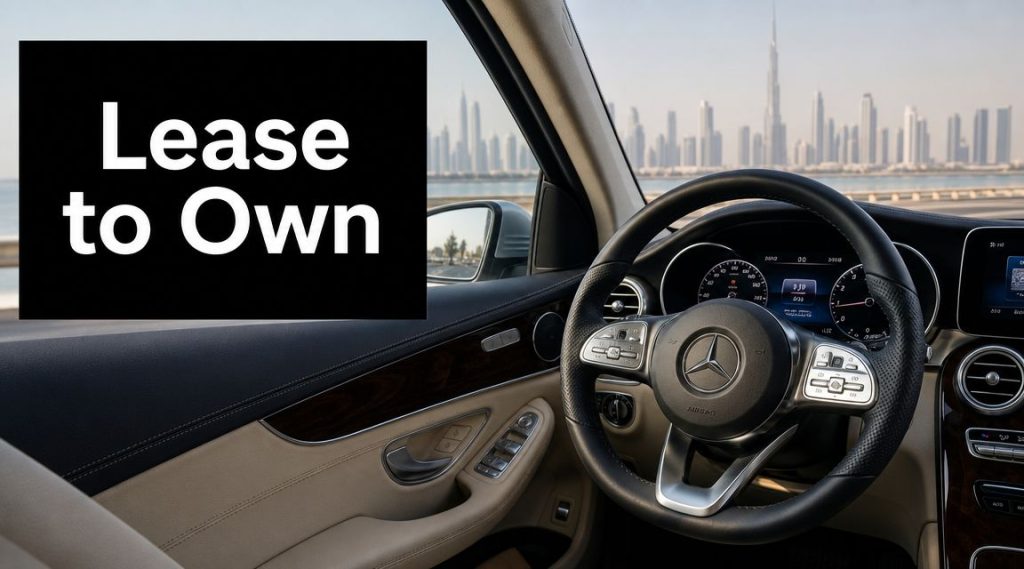
A familiar Dubai decision often starts with a very enjoyable problem. You've rented a superb car for a few days, perhaps for meetings in DIFC, a resort stay on Palm Jumeirah, or because driving along Sheikh Zayed Road feels better in something special. The experience is polished, convenient, and easy to justify for a short stay.
Then the stay gets longer.
You begin to ask a more strategic question. Should you keep renting, commit to buying, or choose something in between that preserves flexibility without giving up the possibility of ownership? For many high-income professionals and expats, that middle path is where the calculation begins.
Introduction The Path to Your Dream Car in Dubai
A consultant relocating to Dubai for a multi-year role might start with a luxury rental because it removes friction. No long-term commitment. No resale planning. No immediate concern about whether life in the UAE will remain stable for the next several years.

But after a few months, the logic changes. A pure rental is excellent for flexibility, yet every payment is a payment for access only. A direct purchase delivers full control, but it also ties up capital and places the depreciation question squarely on your shoulders. A standard lease can soften the monthly burden, though many people dislike reaching the end of the contract and returning the car without owning it.
That's where a vehicle lease to own arrangement attracts attention. It sits between temporary use and immediate ownership. You drive the car now, spread the cost over time, and move towards owning it under the terms of the agreement.
For many Dubai residents, the real appeal isn't “Can I get approved?” It's “Can I keep my options open without making a financially careless decision?”
That distinction matters. In Dubai, mobility is part lifestyle, part professional image, and part practical necessity. If you value freedom to adapt, but also want the possibility of ending up with the vehicle rather than handing it back, lease to own can be a rational structure.
It isn't automatically the cheapest route. It isn't automatically the most elegant one either. What it offers is a different balance of cash flow, optionality, and end-state ownership. For the right driver, that balance can be far more important than chasing the lowest monthly figure.
What Exactly Is a Vehicle Lease to Own Agreement
A vehicle lease to own agreement is easiest to understand as a hybrid. It borrows part of its logic from leasing and part from financing, but it isn't the same as either one.
In a UAE-style structure, your monthly payments are applied towards eventual ownership, while the title remains with the lender until the contract is fully paid. That makes it economically closer to instalment finance than to a conventional lease, where the vehicle is typically returned or bought out at a pre-determined residual value, as explained by CarsDirect's overview of lease-to-own programmes.

The simple way to think about it
Similar to a rent-to-own apartment arrangement, you get possession and use now. You make regular payments over a fixed term. If the contract is structured properly and you complete it, the asset moves into your ownership at the end, subject to the agreement's final steps.
That differs from a classic lease in one important way. In a classic lease, the contract often revolves around the car's expected value at the end of the term. In lease to own, the financial design usually aims to bring the balance down to zero by maturity rather than leaving you with a separate residual-style buyout as the main event.
Where people get confused
Most confusion comes from language. Providers sometimes use “lease”, “finance”, and “rent to own” loosely, even though they produce different obligations.
Check these points carefully:
- Who holds title: If the provider or lender keeps title until final payment, you're not the legal owner yet.
- What your payment is doing: In lease to own, the payment stream is usually meant to move you towards ownership, not merely pay for temporary use.
- What happens at the end: You need the contract to say plainly whether ownership transfers automatically, whether an extra payment is required, and what administrative steps follow.
Practical rule: If the agreement doesn't clearly explain title, end-of-term transfer, and early settlement, you don't yet understand the deal.
The contract matters more than the label
Two offers can sound identical in conversation and behave very differently in writing. One may function like a straightforward instalment plan. Another may include conditions that make early exit expensive or final transfer less clean than you expected.
Before reviewing any provider's paperwork, it can help to familiarise yourself with the structure of a formal rental agreement template, to train your eye to spot clauses on possession, payment obligations, default, return conditions, and transfer rights.
A refined lease-to-own arrangement should feel transparent. You should know who owns the car today, when that changes, what each payment accomplishes, and what your obligations are if your plans in Dubai shift.
Renting vs Buying vs Lease to Own in Dubai
For an expat executive or long-stay resident, the wrong comparison is often “Which option has the lowest monthly number?” The better question is “Which option matches how long I'll stay, how much flexibility I need, and how much depreciation risk I'm willing to carry?”
In the U.S. market, leasing remains a meaningful but minority route. Experian-based reporting cited by NGPF noted that about 20% of consumers with an auto credit file had an auto lease, while 61% had at least one auto loan tradeline. The same reporting listed average monthly payments of $659 for a lease and $682 for an auto loan in June 2025, with typical consumer lease terms of 24 to 36 months. That's useful context when comparing access models, even though Dubai buyers will make decisions under different local conditions and priorities, as outlined in NGPF's review of lease versus loan participation.
A practical comparison
| Feature | Short-Term Rental (e.g., Uptown) | Vehicle Lease to Own | Direct Purchase |
|---|---|---|---|
| Commitment level | Very low | Moderate to high | High |
| Ownership path | None | Built into the structure if terms are completed | Immediate |
| Flexibility to change cars | Strong | Limited by contract | Limited by resale or trade-in |
| Capital tied up upfront | Usually lighter | Often more manageable than buying outright | Highest |
| Depreciation exposure | Provider carries most of it during the rental period | You may absorb it through the pricing structure | You carry it directly |
| Exit complexity | Usually simple at contract end | Depends heavily on early termination terms | Sale or trade-in required |
| Best fit | Visitors, short stays, event use | Professionals who may want ownership later | Drivers with long holding plans |
For readers exploring a dedicated long-term access route, this Dubai car lease option is a useful reference point for how structured vehicle access differs from a short booking.
When renting is the smartest answer
Renting suits people whose timeline is uncertain. If you've just arrived, are on a project assignment, or may relocate again, flexibility has real value. A rental also spares you from worrying about disposal strategy when your stay ends.
The weakness is obvious. You gain convenience, not ownership.
When buying makes the most sense
Direct purchase is strongest when you're confident about your holding period and you want complete control. There's no contractual mileage framework in the same way there may be under lease products, and the car is yours to keep, modify, sell, or trade when you choose.
The trade-off is concentration of risk. You commit more capital and take full responsibility for resale timing and market value.
Where lease to own sits
Lease to own is most rational when you want three things at once:
- A premium vehicle now
- A path to ownership later
- Protection against overcommitting capital on day one
That combination appeals to many Dubai residents who are financially comfortable but still deliberate. They're not avoiding ownership because they can't buy. They're delaying a full ownership decision because mobility, career timing, and market conditions still matter.
The strongest reason to consider lease to own isn't lower prestige or lower ambition. It's preserving optionality while moving towards an asset you may ultimately want to keep.
The Lease to Own Process Step by Step
The process is not mysterious, but providers often explain it badly. The best way to approach it is as a sequence of decision points, each with a document trail.

Step one to step three
Choose the vehicle
Start with the exact car, specification, and expected usage pattern. A high-mileage commuter and a weekend performance car should not be evaluated the same way.Submit your details for review
The provider will usually assess identity, residence status, income profile, and ability to maintain the contract.Review the proposed terms
During this step, sophistication matters. Don't just look at the monthly figure. Look for fees, insurance treatment, maintenance obligations, and what happens if you want out early.
A visual overview can help before you read the paperwork in detail:
Step four during the contract
Once signed, you take possession and make the agreed payments over the contract period. During this time, the title usually remains with the lender or provider. Your rights and duties are governed by the written agreement, not by the sales pitch that came before it.
Keep every record. Payment receipts, maintenance history, inspection notes, and insurance confirmations all matter later if there's a dispute.
Step five and step six at the end
This is the point many glossy explanations skip. A key issue in the UAE is that providers are often unclear about transfer fees, balloon payments, or title-registration steps, even though ownership transfer is governed by local registration rules rather than marketing language, as noted in this discussion of end-of-term uncertainty in UAE lease-to-own arrangements.
Ask for the end-state in writing:
- Is there a final payment?
- Who pays transfer and registration-related charges?
- What documents will be needed for title transfer?
- What happens if there is minor wear or an unresolved fine?
Don't treat the final transfer as a formality. Treat it as part of the price.
A polished agreement should make the last stage feel procedural, not surprising. If the provider can't explain the exact final handover from contract completion to legal ownership, pause the deal until they can.
Financial and Legal Considerations for Dubai
For high-income professionals, the lease-to-own question is rarely about monthly affordability alone. It's about whether the structure is financially rational once you include mileage, wear, insurance, maintenance, depreciation, and the possibility that your UAE timeline changes.
Mileage and wear change the real cost
Mileage limits are one of the most overlooked parts of any vehicle access contract. Standard lease pricing models often assume annual mileage caps of about 10,000 to 15,000 miles, and excess-use penalties can materially distort the effective cost if you drive frequently between emirates or rely on the vehicle for business travel, according to Kelley Blue Book's leasing guidance.
That matters even more for premium vehicles. Performance saloons, luxury SUVs, and prestige coupes often look attractive on monthly payment alone, but their depreciation curve can move faster than many drivers expect. If the contract embeds an optimistic residual or weak wear assumptions, the deal can become poor value long before the term ends.
The correct way to judge the numbers
Use a full-cost lens, not a showroom lens.
Your comparison should include:
- Scheduled payments: The visible monthly cost over the term.
- Administrative charges: Any acquisition, processing, or contract fees.
- Insurance: Clarify whether full coverage is included or arranged separately. This explainer on comprehensive car insurance in the UAE is useful context if you want to understand what broad protection usually covers.
- Maintenance and repairs: Spell out routine servicing versus tyres, bodywork, and wear items.
- Exit risk: Early termination terms matter if your job, visa status, or travel pattern changes.
A lease-to-own contract should survive this question: if your circumstances change unexpectedly, is the cost of leaving the agreement tolerable or painful?
A stylish monthly figure can hide an expensive contract. The hidden cost usually sits in excess mileage, early exit, or end-of-term mechanics.
Premium vehicles require valuation discipline
Luxury-car decisions in Dubai often become emotional before they become analytical. That's understandable. The market is full of aspirational choices. But lease to own only works well when the asset's likely value at exit aligns with the contract's pricing logic.
If you want a sharper feel for how dealers and buyers think about used-vehicle pricing, this guide for lean dealerships offers useful perspective on valuation discipline. It's relevant because your financial outcome depends heavily on what the car is likely to be worth relative to what the agreement makes you pay over time.
The legal details expats should not gloss over
Expats should pay close attention to documentation continuity. Your driving eligibility, identification documents, and registration pathway need to remain clean throughout the contract and especially at transfer stage. If you're unsure about your current licence position, review UAE driving licence validity rules early rather than at the point of registration.
Also confirm these legal points in writing:
- Default clause: What exactly triggers default?
- Late payment treatment: Is there a grace period, and what rights does the provider gain?
- Modification restrictions: Can you tint, wrap, or accessorise the vehicle?
- Jurisdiction and dispute terms: Which law and forum control a disagreement?
For a Dubai-based professional, the smartest contract is not the one that sounds most luxurious. It's the one whose legal and financial consequences remain predictable under both normal and disrupted circumstances.
Your Pre-Agreement Checklist
A polished sales conversation doesn't protect you. A disciplined checklist does.
Before signing any vehicle lease to own contract, work through each point slowly and insist on documentary answers.

Questions to answer before you sign
What is the total cost, not just the monthly cost?
Ask for a complete written schedule including fees, insurance treatment, maintenance responsibility, and transfer-related charges.What happens at the end, exactly?
You want a written description of final payment requirements, ownership transfer steps, and the documents needed to complete registration.How is early exit handled?
If you leave Dubai, change employers, or want to end the contract, the consequences should already be clear.What condition standard applies?
“Fair wear and tear” can become subjective. Ask the provider to define it.
Documents and practical checks
Review the vehicle itself as carefully as the contract.
- Inspect the car thoroughly: Photograph body panels, wheels, interior trim, and odometer reading before taking delivery.
- Check service and warranty history: Premium cars can become expensive quickly if maintenance records are weak.
- Confirm who arranges insurance: Don't assume it's included.
- Verify your own eligibility documents: Licence status, ID, and residency paperwork should all align with the provider's requirements.
Ask the provider to walk you through the contract as if you were already at the end of the term. If they can't do that clearly, the agreement isn't ready to sign.
A refined agreement should leave very little to assumption. If a clause seems vague, it probably matters more than it appears.
Frequently Asked Questions
Is lease to own only useful for people with limited credit options
No. In Dubai, many affluent drivers consider it because they value flexibility with a path to ownership. The attraction is strategic, not necessarily credit-driven. If you expect to stay long enough to justify the structure but still want to preserve liquidity and avoid an immediate full purchase, it can be a sensible middle route.
Is it better than a short-term luxury rental
It depends on time horizon. A short-term luxury rental is stronger when your plans are fluid or you want clean, low-friction access without any ownership objective. Lease to own becomes more compelling when you already know the vehicle may stay with you for a meaningful period and you want your payments to move in the direction of possession rather than ending as pure access cost.
Is it better than buying outright
Sometimes, but not by default. Buying gives you immediate ownership and total control. Lease to own can be more rational if you want to preserve capital during the usage period and avoid making a final long-term commitment on day one. The right answer depends on your expected holding period, your tolerance for depreciation exposure, and the contract's fee structure.
Why do business users often like lease-oriented structures
Cash flow is one reason. A fleet-finance analysis from Hertz found that under a modelled 48-month use case, an open-ended TRAC lease produced a lifecycle present-value cost of $12,887 versus $16,423 for ownership, a per-vehicle advantage of $3,535. Scaled to 350 vehicles, the same model estimated $1,237,250 in savings. That business-oriented example doesn't map directly onto every consumer decision, but it does show why lease-style structures can appeal when balance-sheet flexibility matters, as shown in Hertz's lease-versus-ownership analysis.
What's the biggest mistake people make
They focus on the monthly payment and ignore the contract architecture. The expensive surprises usually appear at one of three moments: after heavy mileage use, when trying to exit early, or at the final ownership transfer stage.
What should a high-income expat prioritise
Prioritise fit over image. The smartest deal is the one aligned with your likely stay in the UAE, your actual driving pattern, and your willingness to keep the vehicle long enough for the structure to make sense. If those three don't align, even a beautiful car can become a poor financial decision.
If you want premium vehicle access in Dubai without rushing into the wrong long-term decision, Uptown Rent A Car is a practical place to start. Their luxury fleet lets you experience the car, the lifestyle, and the actual day-to-day fit before you decide whether renting, leasing, or eventually owning is the smarter move for your time in the UAE.