

Think of comprehensive car insurance as the ultimate peace of mind for your vehicle. It’s your all-access pass to protection, going way beyond just covering accidents where you're at fault. This is the financial safety net you need for all those unexpected "what ifs"—like theft, vandalism, fire, or even a classic UAE sandstorm.
What Comprehensive Car Insurance Really Means
When people ask, "what is comprehensive car insurance?", it's best to think past the dictionary definition and focus on what it actually does for you. At its heart, this type of policy is built on two key pillars that work together to shield you from a serious financial hit. It’s the broadest protection you can get, combining coverage for your own car with coverage for others.
The two main components are:
- Own Damage Cover: This is the part that protects your pride and joy. If your car gets damaged in a collision, stolen from a car park, or even catches fire, this is what covers the bill for repairs or replacement.
- Third-Party Liability (TPL) Cover: This is the absolute legal minimum required in the UAE. It takes care of the costs if you damage someone else's car or property, and it also covers their medical bills if they get hurt.
By bundling these two together, a comprehensive policy makes sure you’re not stuck paying out of pocket for your own repairs and the damage you might cause someone else. It just gives you a much more complete sense of security on the road.
A Look at Your Protection
To make this even clearer, let's walk through some real-world situations you might face. The table below gives a quick snapshot of how a comprehensive policy kicks in when you need it most.
Comprehensive Car Insurance At a Glance
Here’s a simple breakdown of the main protections offered by a typical comprehensive car insurance policy in the UAE.
| Coverage Type | What It Covers | Example Scenario |
|---|---|---|
| Own Vehicle Damage | Repairs to your car after an accident, regardless of who is at fault. | You accidentally reverse into a pillar in a mall car park, denting your bumper. |
| Theft and Vandalism | The cost to replace your car if it's stolen or repair damage from vandalism. | Your car is keyed while parked overnight, requiring a full repaint of the door. |
| Fire and Natural Events | Damage caused by fire, explosions, sandstorms, hail, or flooding. | A severe sandstorm causes paint damage and cracks your windscreen. |
| Third-Party Liability | Damage to another person's car and property, plus their injury costs. | You misjudge a turn and cause a collision, damaging another driver's vehicle. |
This multi-layered approach is exactly why so many drivers prefer this level of coverage. While third-party insurance only covers others, comprehensive car insurance in the UAE protects both your vehicle and third-party liabilities.
In fact, as of 2025, it's estimated that around 72% of UAE drivers choose comprehensive policies, showing just how much people value that extra financial protection. For more articles on vehicle ownership and rentals, you can explore our blog.
When you're sorting out car insurance in the UAE, you'll quickly find yourself at a crossroads with two main options: Comprehensive and Third-Party Liability (TPL). Now, TPL is the absolute bare minimum you need to legally get behind the wheel. But just because it's legal doesn't mean it's enough.
Think of it this way: TPL is like a flimsy umbrella in a sudden downpour. It'll keep the person you bumped into dry, but you're left completely soaked. A comprehensive policy, on the other hand, is a solid, all-weather shelter. It protects you, your car, and the other person. This difference becomes crystal clear the moment you're the one at fault in an accident.
This is what a real safety net for your car looks like.
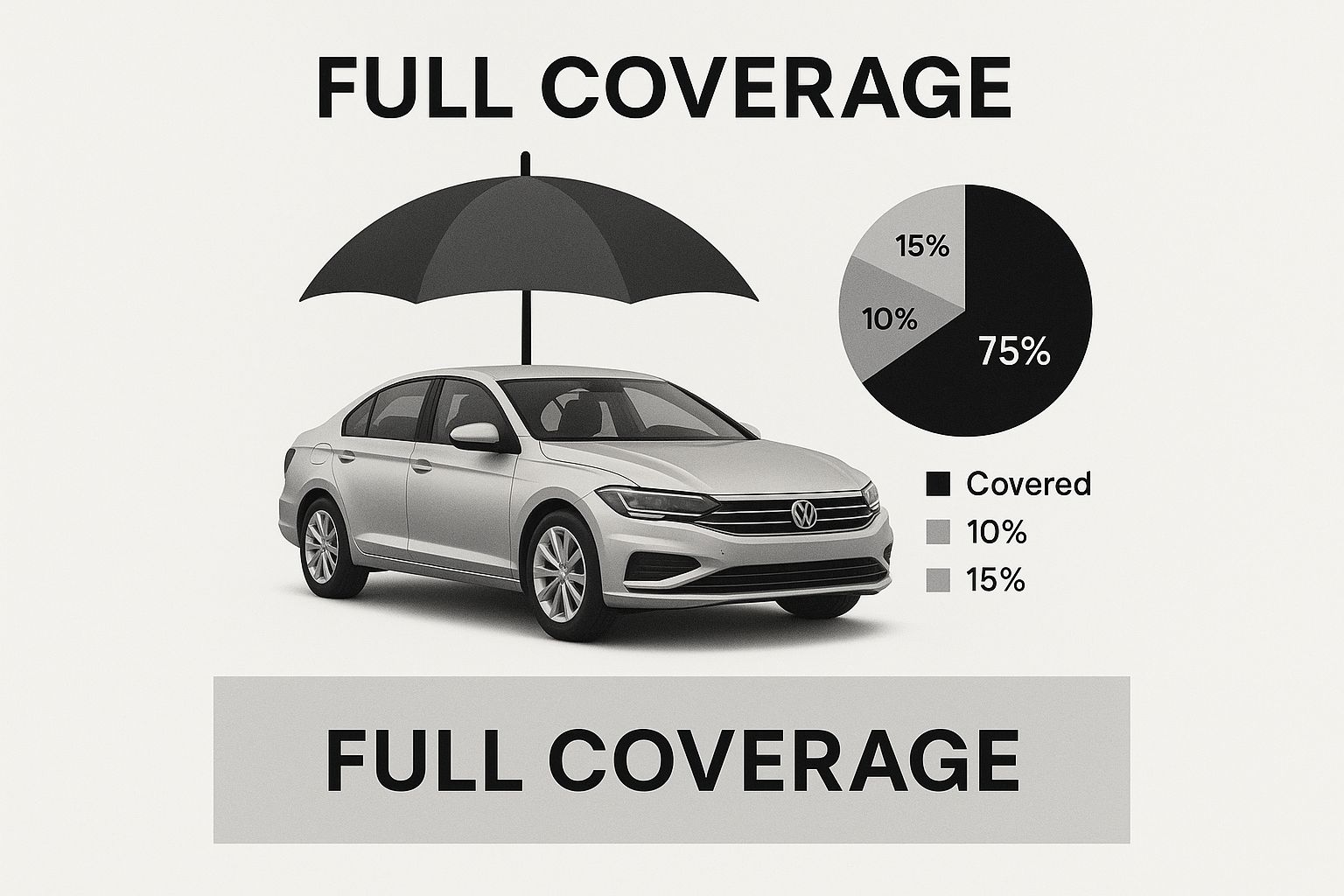
As you can see, comprehensive coverage is designed to be a complete shield for your vehicle, safeguarding your investment from all sorts of trouble, not just collisions.
A Tale of Two Policies
Let's walk through a scenario that happens every day in Dubai. You're navigating a busy roundabout and have a minor fender bender. It's your fault. Your front bumper is dented, and the other car has a damaged rear door. The total bill for repairs comes to AED 10,000—AED 4,000 for your car and AED 6,000 for the other one.
Here’s how that plays out depending on your insurance:
- With Third-Party Liability (TPL) Insurance: Your policy steps in and pays the AED 6,000 to fix the other driver's car. Great. But what about your bumper? That AED 4,000 repair bill is entirely on you. You'll be paying that straight out of your own pocket.
- With Comprehensive Insurance: Your insurer covers the AED 6,000 for the other car and the AED 4,000 for your repairs (you'll just have to pay your policy's excess). In a single incident, you've just avoided a major financial hit.
This simple example shows that while TPL ticks the legal box, only comprehensive insurance actually protects your personal investment. It takes the financial weight of your own repairs off your shoulders and puts it on the insurer.
The Clear Difference in Protection
The gap between these two policies goes way beyond at-fault accidents. Comprehensive insurance covers a whole list of non-collision events that TPL doesn't even glance at. We're talking about common risks here in the UAE, like damage from a sandstorm, falling debris on the motorway, or even theft.
To make it really simple, let's put them head-to-head. This comparison will show you exactly what you're paying for—and what you're missing out on—with each option.
Policy Showdown: Comprehensive vs. Third-Party Liability
The table below breaks down the key coverage features side-by-side. It’s a straightforward look at what each policy includes, helping you see which level of protection truly matches your needs and how much risk you're comfortable with.
| Coverage Feature | Comprehensive Insurance | Third-Party Liability Insurance |
|---|---|---|
| Damage to Your Own Car | ✅ Covered | ❌ Not Covered |
| Damage to Third-Party Property | ✅ Covered | ✅ Covered |
| Bodily Injury to Third Parties | ✅ Covered | ✅ Covered |
| Theft of Your Vehicle | ✅ Covered | ❌ Not Covered |
| Fire Damage to Your Vehicle | ✅ Covered | ❌ Not Covered |
| Natural Disasters (e.g., Storms) | ✅ Covered | ❌ Not Covered |
| Personal Accident Cover | ✅ Often included as standard | ❌ Not included |
| Emergency Roadside Assistance | ✅ Often included | ❌ Not included |
As you can see, the difference is stark. While TPL handles your legal responsibility to others, comprehensive insurance is the only option that truly protects you and your asset on the road.
Decoding Your Comprehensive Coverage Inclusions

While calling it an "all-access pass" for your car is a good start, understanding what comprehensive insurance really means involves looking at the specifics. The fine print is where you'll find the genuine financial security that kicks in when life throws a curveball. This type of coverage is built to handle a whole range of problems that go way beyond a simple fender bender.
Let's break down the core protections you can expect to see, using scenarios that are all too familiar for drivers here in the UAE. This will give you a practical, real-world feel for the value packed into this extensive cover.
Protection From Collisions And Accidents
First and foremost, you've got damage from a collision. This is the foundation of the policy, and it applies whether you hit another car or something stationary, like a lamp post or one of those pesky parking bollards.
Picture this: you're navigating the bustling car park at The Dubai Mall and misjudge a turn, scraping your door against a concrete pillar. Ouch. With comprehensive cover, the bill for fixing those scratches and dents on your own car is handled by your insurer, minus your policy's excess. This is the "own damage" part of your policy working its magic, saving you from a potentially massive repair bill.
Cover For Theft And Vandalism
Car theft and intentional damage are ugly realities we all hope to avoid. A comprehensive policy acts as your financial safety net in these incredibly stressful situations. Should your car be stolen and never seen again, your insurance will typically pay out its current market value.
It also steps in to cover acts of vandalism. Think of someone keying your paintwork in a fit of anger or smashing a window. This protection ensures that malicious acts committed by others don't leave you carrying the full financial weight of the repairs.
Beyond just having the right insurance, it’s always a smart move to brush up on modern car theft prevention strategies to give your vehicle an extra layer of security.
Non-Collision Incidents And Natural Events
Now this is where comprehensive insurance really proves its worth, especially given the UAE's unique climate. This part of your policy covers damage from events that are completely out of your hands.
These non-collision protections are what provide true, all-encompassing peace of mind.
- Fire Damage: This covers your vehicle if it catches fire, whether it’s from an internal mechanical fault or an external source.
- Weather Events: A huge benefit for UAE residents. This covers damage from sandstorms, hail, or even flash floods, protecting your car's paint, glass, and bodywork.
- Falling Objects: If debris from a construction site falls onto your parked car or a heavy branch comes down during a storm, your policy will cover the necessary repairs.
For instance, imagine your car gets caught in a severe sandstorm that pits the paint and cracks the windscreen. Your comprehensive insurance is designed specifically to cover the cost of getting it back to pristine condition. This is a level of protection you simply won't find with a basic third-party policy.
Understanding Policy Exclusions and Add-Ons

While comprehensive insurance casts a wide safety net, it's not a magical shield that covers absolutely everything. Getting to grips with what isn't covered—the exclusions—is just as vital as knowing what is. This helps you manage expectations and sidesteps any nasty surprises if you ever need to make a claim.
Insurers have a list of standard exclusions, which are pretty consistent across the board. These are in place to manage their risk and prevent clear misuse of the policy.
What Is Usually Not Covered
Knowing where the boundaries lie is a core part of understanding what is comprehensive car insurance. Don't expect your policy to pay out for:
- Intentional Damage: This one’s a no-brainer. If you damage your car on purpose, you're on your own.
- Driving Under the Influence: Any accident that happens while you're under the influence of alcohol or drugs will result in a rejected claim. Full stop.
- Illegal Activities: Using your car for street racing, as a getaway vehicle, or for any other criminal act will instantly void your insurance cover for any damage.
- Routine Wear and Tear: Insurance is there for sudden, unexpected events. It won't cover the gradual decline of parts like tyres, brakes, or engine components from everyday driving.
- Mechanical or Electrical Breakdown: If your engine or an electrical system simply gives up the ghost, that's not an insurance matter—unless the failure was a direct result of a covered accident.
It's also worth remembering that some vehicles have very specific needs. For instance, anyone owning a vintage car should look into specialized classic car insurance requirements, as the way these cars are valued and covered is a whole different ball game.
Customising Your Cover with Optional Add-Ons
Once you've got the standard exclusions down, you can start to really tailor your policy with add-ons. Think of these as optional extras that let you build a policy perfectly suited to your life, turning a generic plan into your own personalised shield.
Think of add-ons as upgrades for your financial safety net. They fill in the specific gaps that a standard policy might not address, giving you complete peace of mind tailored to how you actually use your vehicle.
Some of the most popular and genuinely useful add-ons include:
- Roadside Assistance: This is your 24/7 lifeline for flat tyres, dead batteries, or needing an emergency tow.
- Personal Accident Cover: Provides a financial payout for injury or death to the driver and any passengers.
- Agency Repair: A must-have for newer or high-end cars. This ensures repairs are done at the official dealership with genuine, original parts.
- Temporary Hire Car: If your car is stuck in the garage after an accident, this add-on gets you back on the road in a replacement vehicle.
How Insurers Calculate Your Car Insurance Premium
Ever filled out an insurance form and wondered exactly how your answers get crunched into a final price? An insurance premium isn't some number pulled out of thin air; it’s a meticulously calculated assessment of risk. Insurers essentially act like detectives, piecing together clues about you, your car, and your driving habits to figure out how likely you are to make a claim.
Think of it as your own personalised risk profile. A young, newly-licensed driver with a high-performance sports car is naturally seen as a higher risk than a seasoned driver with a decade of accident-free history in a reliable family saloon. As you'd expect, their premiums will reflect that difference.
The Key Factors Driving Your Quote
In the UAE, insurers zoom in on several core elements to determine what you'll pay. While each company has its own secret sauce, they all look at a similar set of ingredients. Getting familiar with these gives you the power to see how your own choices directly impact the price you pay for protection.
The main things they look at include:
- Your Driving History and Age: Experience is king. A driver with a spotless record and several years of a No-Claims Discount will always get a much better premium than someone who just got their license.
- The Vehicle's Details: The make, model, and age of your car are huge factors. A luxury SUV with expensive, imported parts will cost more to insure than a common hatchback that's easily serviced locally, simply because the repair bills are in different leagues.
- Vehicle Age and Value: It's simple logic, really. The newer and more valuable your car is, the higher the cost to replace it if the worst happens. This, in turn, pushes your premium up.
Broader Market Influences on Price
It's not all about you and your car, though. Wider economic factors play a massive role in setting insurance rates across the board. Things like the cost of spare parts, labour rates at garages, and even global supply chain hiccups can cause premiums to rise for everyone, no matter how good their individual driving record is.
For instance, the UAE motor insurance market has seen some big shifts lately. In 2024, many drivers saw their premiums jump by 25% to 35% for comprehensive plans. This was largely down to rising reinsurance costs that affected the entire industry. However, experts predict these prices should start to level out during 2025. You can get more details on UAE car insurance price stability on arabre.com.
Your premium is a blend of personal risk and market reality. While you can control factors like your driving record and choice of vehicle, you're also subject to the broader economic trends affecting the entire insurance industry.
At the end of the day, your premium is the price you pay to transfer the financial risk from your shoulders to your insurer's. By understanding how this price is put together, you're in a much better position to find that sweet spot between solid coverage and a policy that actually fits your budget.
Why Comprehensive Insurance Is a Smart Move in the UAE
Choosing car insurance in the UAE isn't just about ticking a legal box; it's a major financial decision. While basic third-party liability gets you on the road legally, comprehensive insurance is the smarter play for protecting your investment in a country with its own unique driving realities. This is about buying genuine peace of mind.
The UAE is home to a lot of high-value vehicles, and even a minor fender-bender can lead to surprisingly steep repair bills, especially with modern cars packed with sensors and complex tech. Think of comprehensive coverage as a financial shield, making sure one bad day on the road doesn't turn into a massive personal expense.
Tailored for Regional Risks
Beyond the usual risk of collisions, the UAE’s environment throws its own curveballs. Comprehensive insurance is specifically designed to handle these regional challenges that most people don't think about—until it's too late.
- Environmental Damage: The intense summer heat can put serious stress on car parts, while a sudden sandstorm can do a real number on your paint and glass.
- Costly Repairs: Cars are more sophisticated than ever, which means parts and labour costs in the UAE are high. Paying for repairs out of your own pocket can be a significant financial hit.
This level of protection isn't just for luxury cars. It's a wise financial safeguard for any driver who wants to steer clear of unexpected, high-cost repairs and protect their vehicle. If you're considering a rental for work, it's also worth learning about the flexibility offered by a business car hire in Dubai for your team.
Choosing comprehensive insurance is a forward-thinking way to manage risk. It elevates your policy from a simple legal requirement into a powerful financial safety net that covers you against accidents, theft, and even environmental damage.
The wider market trends show a clear preference for this stronger protection. The motor insurance market across the Middle East and Africa was valued at around USD 44.88 billion in 2024. It's projected to rocket to USD 66.47 billion by 2030, with the UAE playing a huge part thanks to a boom in high-value vehicle sales and strict regulations. You can find out more about the regional motor insurance market forecasts and see where the industry is headed.
Frequently Asked Questions
When you're digging into the details of car insurance, a few questions always seem to pop up. Let's tackle some of the most common ones that drivers in the UAE have, so you can choose your policy with complete confidence.
Is Comprehensive Car Insurance Legally Required In The UAE?
Not exactly. The only insurance that's legally mandatory in the UAE is Third-Party Liability (TPL). This is the absolute minimum you need to have to drive on the roads.
That said, while it's not a legal requirement, comprehensive cover is very strongly recommended for the simple reason that it offers far better financial protection. Plus, if you've financed your car through a bank, they will almost certainly require you to have a comprehensive policy as part of the loan agreement.
Does My Comprehensive Policy Cover Me If I Drive In Oman?
This is a classic "it depends" situation. Many insurance providers in the UAE do offer cover for driving in neighbouring GCC countries like Oman, but it's rarely included as standard. You'll usually need to ask for it as an add-on.
Look for something called an "Oman Extension" or "GCC Cover" in your policy documents. The crucial thing is to confirm this is active before you hit the road. Getting caught without the right extension could mean you're driving completely uninsured once you cross the border.
Will Making A Claim Increase My Future Insurance Premiums?
More often than not, yes. If you make a claim where you are deemed to be at fault, you'll likely lose your No-Claims Discount. This, in turn, will lead to a higher premium when it's time to renew your policy. However, it's worth remembering that the financial protection from a major claim is usually much, much greater than the increase in your premium.
Not all claims are treated the same, though. Simple things like windscreen repairs often don't affect your premium at all. And if you're visiting Dubai, it's also a good idea to familiarise yourself with the international driving permit requirements in the UAE to ensure every aspect of your drive is fully compliant.
For a seamless and stylish driving experience in Dubai, trust Uptown Rent A Car. Explore our curated fleet of luxury vehicles and book your perfect ride online today by visiting https://www.uptowndxb.com.