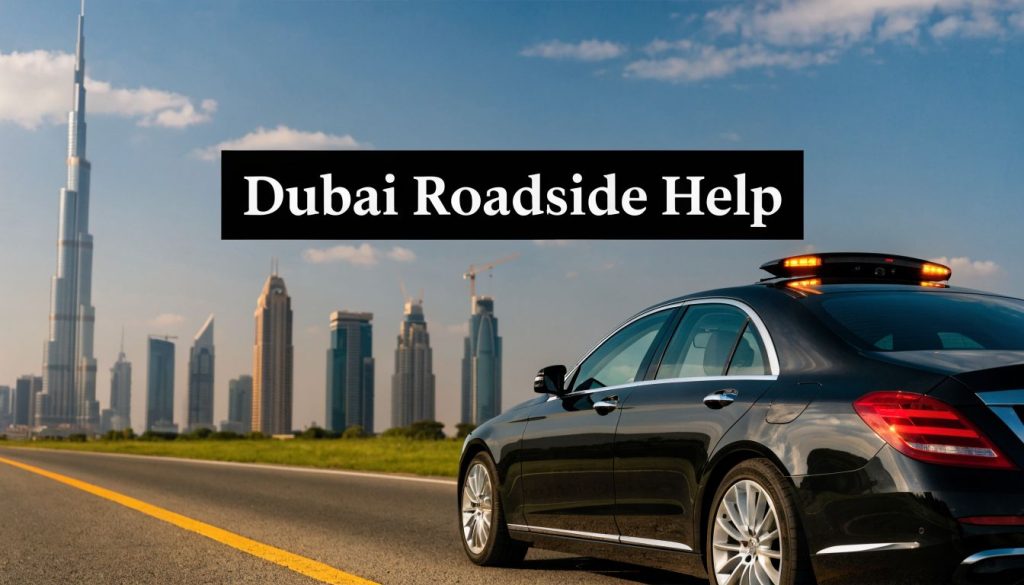
A breakdown in Dubai feels different when the car isn’t an ordinary runabout. If you’re in a performance SUV or executive saloon, the stress isn’t only about getting moving again. It’s also about avoiding the wrong tow method, the wrong technician, or a rushed roadside fix that creates a bigger problem later.
That usually happens in very ordinary moments. A warning light appears on Sheikh Zayed Road. The battery struggles after a long meeting with the air conditioning running. A tyre issue shows up just as you’re heading to a hotel, event, or airport transfer. In those moments, generic advice isn’t enough. Roadside assistance in dubai for luxury rentals needs proper handling, clear reporting, and strict attention to rental and insurance terms.
Navigating a Breakdown in Dubai
The first thing to know is that help in Dubai is organised. This isn’t a market where you’re left hoping someone eventually answers the phone. The UAE vehicle roadside assistance market generated USD 260.1 million in 2024 and is projected to reach USD 317.4 million by 2030, with a 3.3% CAGR over the forecast period, according to UAE vehicle roadside assistance market data. That matters because it tells you roadside support is not an afterthought. It’s a mature service category with established operators, dispatch systems, and defined service types.
For a luxury renter, though, the primary issue isn’t whether assistance exists. It’s whether the right assistance arrives.
A flatbed is safer than an improvised tow for low-clearance vehicles. A technician who understands modern battery systems is safer than a hurried jump-start from whoever is nearest. If the vehicle is rented, your first wrong call can create an argument later about damage responsibility, authorisation, or claim handling.
What usually goes wrong first
In practice, breakdowns in Dubai tend to fall into a few patterns:
- Electrical trouble: Warning lights, weak start, battery drain after heavy climate-control use.
- Tyre problems: Sharp debris, sidewall damage, or pressure loss that makes continued driving risky.
- Overheating or drivetrain alerts: Issues that require you to stop rather than “try to make it”.
- Lockout or key access problems: Annoying in any vehicle, more complicated in premium models.
Practical rule: If a luxury or high-performance rental shows a serious warning light, don’t experiment. Stop safely, report it, and wait for authorised instructions.
Drivers often lose time by doing the wrong thing early. They continue driving after a temperature warning. They accept a tow truck without confirming the recovery method. They call a random app before they check the rental agreement. Those decisions matter more than most tourists expect.
The calm approach works
Stay methodical. Confirm your location. Protect the occupants first. Then contact the approved assistance route for that vehicle.
That order keeps a minor incident from turning into body damage, wheel damage, or a dispute over who approved the recovery.
What Roadside Assistance Services Include
Most roadside packages in Dubai cover the same core categories, but the standard list doesn’t tell the whole story. With a luxury rental, the service itself may be common while the handling requirements are not.
One of the most frequent call-outs is battery support. Battery failures in Dubai’s luxury vehicles spike by 40% during peak summer months due to heat and air-conditioning load, making on-site battery boosting a highly requested service, according to battery assistance data for Dubai roadside support. In practical terms, that means a battery issue is not unusual, even in a well-kept premium car.
The standard services you’ll usually see
- Battery boosting or replacement: Useful when the vehicle won’t start, electrical systems become unstable, or the battery has discharged during a stop.
- Tyre change or tyre support: This may mean fitting the spare, assisting with mobility, or arranging towing if the vehicle uses specialised wheel and tyre setups.
- Fuel delivery: Relevant if the car runs dry and it isn’t safe to leave it where it stopped.
- Lockout assistance: Important for key access issues, though premium vehicles may need a more careful process than standard cars.
- Towing and vehicle recovery: Necessary when warning lights, drivetrain faults, overheating, or accident damage mean the car shouldn’t be driven.
What works and what doesn’t
What works is simple: report the symptom, not your guess. Say the engine warning came on, the steering felt heavy, the battery won’t crank, or the rear tyre is losing pressure. That gives dispatch a better chance of sending the right equipment.
What doesn’t work is asking for a quick fix before anyone understands the car’s condition. I’ve seen drivers insist on a jump-start when the underlying issue was a fault that needed transport, not roadside improvisation.
A luxury vehicle doesn’t need drama at the roadside. It needs the correct first diagnosis and the correct transport decision.
The hidden difference with premium vehicles
A standard roadside package might technically include towing, battery support, and tyre help. That doesn’t guarantee the crew is prepared for:
- Low front splitters and side skirts
- Large alloy wheels with delicate finishes
- Advanced driver-assistance systems
- Electronic parking systems
- Sensitive underbody panels
- Warranty and rental reporting requirements
That’s why the service list is only the beginning. The key question is whether the provider treats a luxury rental like a high-value asset or just another immobilised vehicle.
Comparing Your Four Routes to Roadside Help
When you need roadside assistance in dubai, you usually have four ways to get it: the rental company, your insurer, government-linked channels for immediate public-road support, or a private roadside app/provider. Each route has strengths. Each also has trade-offs.

Route one through the rental company
For a luxury renter, this is usually the cleanest option.
The rental company already knows the vehicle, its handover condition, and the support chain attached to the booking. If recovery is needed, this route is most likely to keep the process aligned with the rental agreement and any approved repair or replacement procedure. It also reduces the risk of an unauthorised tow that later creates questions about damage.
This is also where specialist handling is most likely to be specified in advance. Some operators, including Uptown Rent A Car, provide roadside support and can coordinate on-the-spot assistance or replacement depending on the fault and booking terms.
Route two through your motor insurer
Insurance-backed assistance can be useful, especially if your policy includes recovery. The difficulty for renters is that personal insurance and rental coverage don’t always line up neatly. The insurer may authorise help, but that doesn’t automatically mean the rental company accepts that route for a high-value vehicle.
Use this route if your agreement clearly allows it. If the contract is silent or restrictive, confirm first.
Route three through government or official highway channels
If you’re stopped in a dangerous position or traffic conditions are severe, official assistance channels matter because roadside safety comes before convenience. They can help stabilise the situation, manage the roadway, and get the vehicle moved out of immediate danger.
That’s different from saying they are your ideal long-term recovery partner for a luxury rental. Safety first. Specialist handling second.
Route four through private apps and local providers
Private operators are often quick to reach and widely available. They can be practical for basic incidents such as tyre support, battery service, or local towing. The risk is inconsistency. Some crews are excellent. Others are built for volume, not for low-clearance, high-value, or electronically complex vehicles.
A useful parallel exists in workshop operations. Shops that invest in structured communication systems, such as these solutions for auto repair shop call management, tend to handle dispatch and customer updates far better than businesses that rely on ad hoc phone handling. The same principle applies at roadside. Good communication is often the difference between a smooth recovery and a messy one.
A practical comparison
| Route | Best use case | Main advantage | Main risk for luxury renters |
|---|---|---|---|
| Rental company | Any mechanical, electrical, tyre, or warning-light issue | Contract alignment and controlled recovery | May feel slower if you try to bypass their process |
| Insurer | Covered incidents under a clear policy | Familiar policy route | Coverage and rental terms may not match |
| Government channels | Unsafe roadside position or urgent traffic risk | Immediate roadway safety support | Not designed around luxury-rental handling protocols |
| Private provider or app | Minor call-out when authorised | Fast local availability | Variable equipment, technique, and accountability |
If you remember one thing, make it this: the nearest truck isn’t always the right truck.
Your Immediate Action Plan After a Breakdown
When a car stops unexpectedly, your first job isn’t to diagnose it. Your first job is to protect people.
The UAE recorded 4,748 major traffic accidents in 2024, an 8% increase from 2023, and Dubai led in incidents, according to UAE road safety statistics for 2024. That’s why roadside behaviour matters. A safe stop is more important than a fast phone call.

Step one get out of danger if you can
If the vehicle still moves, guide it smoothly to the shoulder or another safer area. Turn on the hazard lights immediately. Don’t stop in a live lane unless the car gives you no choice.
If you’ve stopped in a risky position, focus on visibility and distance from traffic. Occupants should follow the safest option based on where the car is positioned and local conditions.
Step two make the scene easier to manage
Before you call anyone, get these details ready:
- Your location: Use a map pin, nearby exit, tower name, hotel, or landmark.
- Vehicle details: Registration, make, model, and colour.
- Problem description: Battery dead, tyre damage, warning light, overheating, lockout, or collision damage.
- Booking details: Rental agreement reference if you have it.
For repair follow-up after recovery, it helps to know where authorised work is normally handled. A useful local reference is this guide to luxury car repair shops in Dubai.
Don’t start with a long story when you call. Start with location, vehicle, hazard level, and whether the car can move.
Step three document before anyone touches the car
Take clear photos of:
- The car’s position
- Wheel condition
- Bumpers and lower bodywork
- Dashboard warning lights
- Any visible fluid leak or damage
That gives you a record of the vehicle before recovery begins.
A short visual refresher helps if you’re flustered and need to reset your thinking:
Step four wait for authorised help
Don’t allow anyone to hook up the vehicle until you know they’re the correct provider or have clear approval. With luxury cars, one rushed recovery can damage wheels, undertrays, or bodywork that were never part of the original fault.
Understanding Estimated Costs and Response Times
Cost questions usually come too early. The first concern should be authorisation and safe handling. After that, it’s reasonable to ask what’s included, what may be charged separately, and how long help is likely to take.
For timing, there is at least a formal benchmark. Roadside response standards and specialist recovery timing in Dubai note that RTA standards require response times under 45 minutes in urban areas, while specialist providers often target 20 to 30 minutes in key zones and desert missions. That gives you a realistic frame, not a promise.
What changes the final bill
The total depends on four factors:
- Your agreement: Some rentals include call-out support but not consumables or replacement parts.
- The fault itself: A tow is different from a battery, and a battery is different from tyre-only assistance.
- Distance and access: Basement recoveries, remote areas, and difficult access usually complicate the job.
- Vehicle type: Exotic wheels, low clearance, or special handling can change the equipment needed.
For comparison thinking, fuel contamination charges in other markets show how widely roadside bills can vary by job scope. If you’ve ever needed that benchmark, this article on compare RAC fuel drain costs is useful for understanding why “roadside assistance” is never one flat category.
Estimated Roadside Assistance Costs & Response Times in Dubai (2026)
| Service | Estimated Cost (AED) | Estimated Urban Response Time |
|---|---|---|
| Battery boosting | Often included in package or charged separately by provider | Often within the urban benchmark range |
| Tyre assistance | Often included for call-out, with tyre replacement separate | Often within the urban benchmark range |
| Fuel delivery | Service call may be separate from fuel cost | Often within the urban benchmark range |
| Lockout assistance | Varies by vehicle and access method | Often within the urban benchmark range |
| Standard towing | May be included or billed separately depending on agreement | Often within the urban benchmark range |
| Specialist recovery for premium vehicles | Usually assessed based on equipment and access | Can be faster in key zones with specialist fleets |
Because coverage varies so much, check the insurance side of your booking before you assume anything is free. This overview of comprehensive car insurance is a good starting point for understanding what a policy may or may not absorb.
Key point: Ask two separate questions. “Is the call-out covered?” and “Are parts, transport, or replacement vehicle costs covered?”
Essential Safety Tips for Tourists and Luxury Renters
Generic roadside advice often fails luxury renters because it assumes any recovery method will do. It won’t. Premium vehicles need deliberate handling, especially in heat, traffic, and desert conditions.

Tell dispatch what the car actually is
Don’t just say “SUV” or “saloon”. Say it’s a Range Rover, Mercedes S-Class, Porsche Cayenne, Bentley, Ferrari, or whatever you’re driving. Mention if the car has low ground clearance, large alloy wheels, or performance bodywork.
That changes the truck, the loading angle, and the recovery approach.
Insist on the right towing method
For many premium vehicles, a flatbed is the safest answer. It reduces the risk to bumpers, splitters, undertrays, wheel finishes, and suspension components. A casual wheel-lift approach may be acceptable for some ordinary cars, but it’s often the wrong choice for exotic or low-clearance rentals.
If the vehicle can’t be moved without dragging or scraping, stop the process and ask for the proper equipment.
A luxury recovery should look slow, controlled, and slightly overcautious. If it looks hurried, that’s the warning sign.
Desert driving needs a different mindset
Sand is not a minor inconvenience for premium SUVs. In Dubai’s desert climate, sand ingress causes 70% of luxury vehicle breakdowns, and specialist recovery teams use low-pressure winches and 4×4 hydraulic tow trucks to recover high-end SUVs from deep sand, as noted in the earlier source-backed guidance for this topic. That’s why desert trips should never rely on a generic urban towing assumption.
If you’re planning any tourist route outside the usual city pattern, it helps to review practical local guidance on driving in Dubai for tourists.
Protect the agreement as well as the vehicle
Tourists often focus on the immediate inconvenience and forget the paperwork risk. Keep these habits:
- Report first: Notify the approved contact before arranging independent transport if the agreement requires it.
- Photograph condition: Capture wheels, bumpers, warning lights, and the truck before loading.
- Keep names and times: Record who attended, when they arrived, and where the car was taken.
- Avoid roadside experimentation: No improvised jump-starts, no casual towing, no “my friend knows a garage”.
Know when not to drive on
Some faults look manageable and aren’t. If steering feels wrong, the engine temperature rises, the gearbox warns, or the tyre sidewall is damaged, don’t nurse the car to your destination. In a luxury rental, forcing the journey often turns a recoverable incident into workshop damage.
For Uptown Rent A Car Customers Your Direct Protocol
If you’re driving an Uptown rental and something goes wrong, keep the response simple. Contact the company’s assistance or sales support line immediately and follow their instructions. Don’t arrange an outside tow first unless you’re dealing with an immediate roadside danger and need urgent public-road safety support.
That protocol matters for three reasons.
First, it keeps the recovery aligned with the rental file for that specific vehicle. Second, it reduces the chance of unauthorised handling that could create damage or a dispute. Third, it allows the operations team to decide whether the issue should be fixed on site, recovered, or handled through a replacement process.
Have these details ready when you call
- Your full name
- Your exact location
- Vehicle make and model
- Registration number if visible
- A short fault description
- Whether the car is safe to remain where it is
What not to do
Don’t approve a random tow truck because it arrived first. Don’t continue driving a car with a serious warning light because you’re close to your destination. Don’t leave out small details such as scraping sounds, heat warnings, or recent tyre impact. Those details often determine whether roadside repair is appropriate or whether the car needs transport.
The right mindset
Treat the vehicle as if every handling step will be reviewed later. That keeps you calm and keeps the process clean.
A well-run roadside incident should produce four outcomes: everyone safe, the car properly documented, the correct provider authorised, and the next step recorded clearly.
If you want a luxury rental experience with clear support procedures when things don’t go to plan, browse the fleet and booking options at Uptown Rent A Car.