
A lot of people start in the same place. They see a Jaguar on Sheikh Zayed Road, picture the badge in their own parking space, then open a few UAE car portals and get three very different prices for what seems like the same car.
That confusion is normal. The Jaguar car price in UAE isn't one clean number. It's a moving target shaped by model, trim, stock age, aggregator pricing, depreciation, and the far more important question most listings ignore, what it costs to access and live with the car in Dubai or Abu Dhabi.
Your Guide to Jaguar Pricing in the UAE
A Jaguar suits the UAE well. The brand has the right mix of design, road presence, and long-distance comfort for Dubai commutes, Abu Dhabi motorway driving, hotel drop-offs, and weekend use. But the mistake many buyers make is treating the showroom tag as the decision point.
That works only if you're buying emotionally and sorting out the consequences later.
Most serious buyers and visitors need a broader view. A resident may be deciding between a new F-PACE, an older approved-used saloon, or keeping flexibility and avoiding long ownership exposure. A visitor may want the Jaguar experience for a few days without stepping into financing, registration, insurance, and resale risk.

What matters more than the list price
The first number tells you entry cost. It doesn't tell you whether the car makes financial sense for your usage.
For a UAE buyer, the key comparison usually comes down to these questions:
- How long will you keep it: A short ownership period usually hurts more because depreciation hits early.
- How much certainty do you want: Ownership adds unknowns around maintenance timing, insurance renewals, and resale.
- What kind of use do you need: Daily commuting, business hosting, wedding transport, and tourism all point to different choices.
- How much convenience matters: Some people want the car always available. Others want the badge only when the occasion justifies it.
Practical rule: If you're researching Jaguar purely from showroom listings, you're only seeing the first layer of the cost.
The useful way to approach the Jaguar car price in UAE is to split it into three lanes. New purchase. Pre-owned purchase. Flexible access through lease or rental. Once you do that, the decision becomes much clearer.
New Jaguar Showroom Prices Across the Emirates
A buyer walks into a Dubai showroom expecting one Jaguar price and leaves with a quote that is tens of thousands of dirhams higher. That usually comes down to trim, model year, option packs, and whether the advertised number was tied to actual dealer stock or just a market listing.
New Jaguar pricing in the UAE covers a wide spread. Entry models sit in premium territory, while better-specced SUVs and electric variants move into a bracket where many buyers also start comparing German rivals and asking a harder question. Is it smarter to buy, or just access the car when needed?

What a new Jaguar usually costs in the UAE
Recent UAE market listings place Jaguar new-car pricing roughly in these bands:
- Jaguar E-PACE: from around AED 161,700
- Jaguar XE: from around AED 174,600
- Jaguar F-PACE: from around AED 196,200
- Jaguar XF: from around AED 205,600
- Jaguar XJ: from around AED 316,400
- Jaguar I-PACE: from around AED 345,345
Use those as orientation numbers, not final transaction prices.
In Dubai and Abu Dhabi, the actual invoice often shifts once the dealer confirms exact stock. A headline price may reflect a base trim with limited options, while the car on the floor has larger wheels, upgraded interior trim, driver-assistance packs, or a different powertrain. Those changes move the price quickly.
Why pricing varies across the Emirates
The gap between an advertised Jaguar price and a signed purchase contract usually comes from a few practical factors:
- Trim strategy: Entry variants create the advertised starting point. Mid and upper trims are what many UAE buyers choose.
- Stock year: A previous-year unit can be priced more aggressively than a fresh allocation.
- Dealer inventory: Dubai and Abu Dhabi do not always hold the same specifications at the same time.
- Imported or market-listed units: Some listings reflect asking prices from the wider market, not a franchised showroom quote.
- EV positioning: I-PACE pricing can move sharply depending on battery spec, package level, and available stock.
That matters because Jaguar rarely sits in one simple price bracket. An E-PACE buyer is shopping one kind of budget. An I-PACE buyer is often comparing against far more expensive luxury EVs and should judge the full ownership cost, not just the badge.
A nearby benchmark helps. Buyers cross-shopping premium sedans and SUVs often compare Jaguar with German alternatives first, and this guide to BMW car price in Dubai gives a useful reference point for where Jaguar sits in the market.
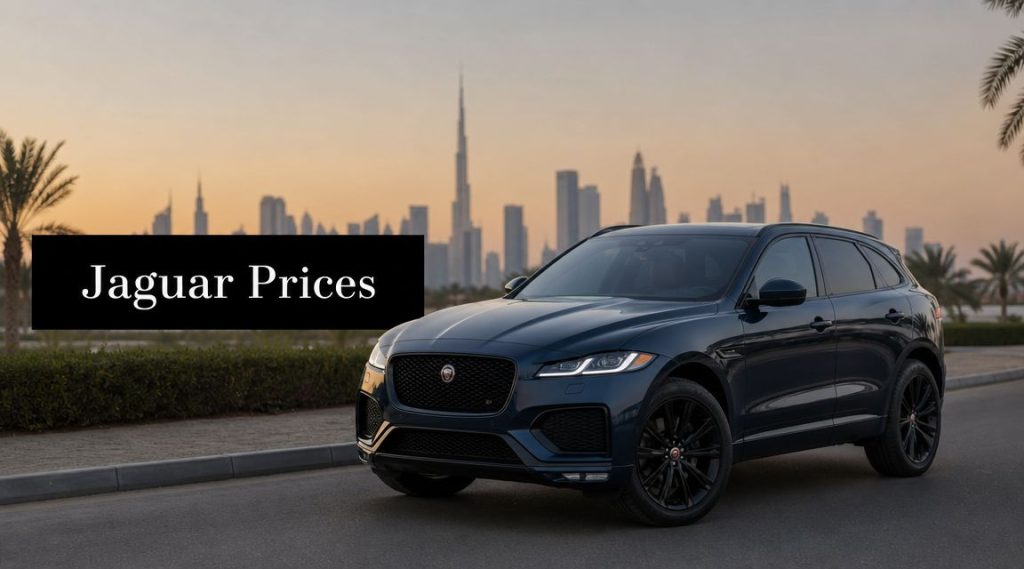
Before you go further, it's worth seeing one of the Jaguar models buyers often compare in this segment:
How to read showroom pricing properly
Buyers get better results when they ask for the exact car, not just the model name.
| What works | What creates confusion |
|---|---|
| Asking for the VIN-linked or stock-specific quote | Relying on a generic starting price |
| Confirming model year and warranty start date | Assuming all new units are current-year stock |
| Checking which options are already fitted | Comparing a base trim to a higher-spec car |
| Pricing insurance and registration alongside the car | Treating the showroom figure as the whole cost |
The useful number is the on-road cost for the exact Jaguar in stock. That is the figure you can compare against leasing, rental, or a competing brand.
The Pre-Owned Jaguar Market Value and Risks
A buyer in Dubai sees a Jaguar advertised at the price of a new economy car and assumes the hard part is over. In practice, the purchase price is only the filter. The key question is whether the car was maintained well enough to stay affordable after transfer, registration, insurance, and the first round of repairs.
Pre-owned Jaguars attract buyers for a valid reason. Entry pricing can sit far below the cost of a new model, and listings on DubiCars Jaguar market pages show how wide that gap can be across older sedans and SUVs in the UAE.
That spread creates opportunity. It also creates risk.
A used Jaguar can be strong value if you buy the right car at the right stage of its life. It can also become a costly shortcut if the previous owner delayed suspension work, ignored cooling issues, or traded the car just before major maintenance. In Dubai and Abu Dhabi, constant A/C use, heat stress, short urban trips, and occasional long highway runs all affect wear differently than they would in cooler markets.
Buy the car with the cleanest ownership story, not the cheapest asking price.
What separates a good deal from a bad one
The best pre-owned Jaguar is rarely the lowest-priced listing. It is usually the one with consistent dealer or specialist servicing, sensible mileage for its age, and evidence that consumables were replaced before they became problems.
Check these points before paying a deposit:
- Service history: Full records matter more than a glossy advert.
- Specialist inspection: Use a workshop that understands Jaguar electrical, suspension, and cooling systems.
- A/C performance: Weak cooling in a UAE summer is not a small issue.
- Suspension condition: Air suspension, bushes, and dampers can turn a bargain into a workshop project.
- Tyres and brakes: Premium replacements are expensive, and uneven tyre wear often points to alignment or suspension faults.
- Insurance reality: Get a quote before you buy, especially on older luxury cars. The terms on what comprehensive car insurance covers in the UAE can change the cost of a seemingly cheap Jaguar.
Approved used versus independent seller
Approved-used stock usually costs more up front, but some buyers are paying for lower uncertainty, better paperwork, and limited warranty support. That premium can make sense on newer cars or models with expensive electronics.
Independent dealers and private sellers often show better headline prices. The trade-off is simple. The buyer has to verify more, absorb more risk, and budget more carefully for the first year.
| Route | Main advantage | Main risk |
|---|---|---|
| Approved used | Better paperwork, clearer aftersales support, possible warranty cover | Higher purchase price |
| Independent dealer | More choice and more room to negotiate | Quality varies sharply between cars |
| Private seller | Lowest advertised entry price in some cases | Highest inspection and verification burden |
For many UAE residents, this is the point where the ownership math changes. If the goal is to drive a Jaguar for weekends, business meetings, or a short stay in Dubai, renting can cost less than buying a cheap used example and then fixing what the last owner postponed.
Beyond the Sticker Price The Total Cost of Jaguar Ownership
A buyer in Dubai sees a Jaguar advertised at an attractive price, runs the monthly finance number, and assumes the hard part is done. In practice, the purchase price is only the entry fee. The key question is what the car will cost you over the next 12 to 36 months.
As noted by Zigwheels UAE Jaguar listings, many listings and price guides stop at the showroom or asking price. That leaves out the costs that shape the ownership decision in the UAE: insurance, servicing, tyres, registration, fuel, and resale loss.

The ownership costs buyers underestimate
For a Jaguar, total cost of ownership usually comes down to six cost centres:
- Purchase price: Cash outlay or financed amount, plus any bank charges or deposit.
- Registration and licensing: Ongoing annual costs to keep the car legal on UAE roads.
- Insurance: Premiums are often higher on luxury models, especially newer or higher-output variants.
- Servicing and maintenance: Scheduled work is manageable. Age-related repairs and electronic faults are where budgets get stretched.
- Fuel use: This matters more on larger engines and city-heavy driving in Dubai or Abu Dhabi.
- Depreciation: Often the largest ownership cost over time, especially if you buy new or sell again quickly.
Depreciation catches buyers off guard because it does not arrive as a workshop invoice. You feel it when you trade in the car, list it for sale, or accept a lower number than you expected. On many luxury cars in the UAE, that resale gap is what separates a sensible purchase from an expensive experiment.
The UAE-specific costs that change the math
Owning a Jaguar in the Emirates is not just about premium fuel and annual servicing. Climate, road conditions, and usage patterns affect the bill. Tyres wear faster in hot conditions, batteries do not always age gracefully, and dealer servicing can be materially more expensive than specialist independent workshops.
Insurance also deserves attention before you commit. Policy wording, excess, agency repair terms, and off-road or flood-related exclusions can change your real exposure. Buyers comparing quotes should review what full-coverage car insurance typically includes in the UAE before treating insurance as a simple line item.
Parking and Salik may also matter more than expected if the car will be used regularly in Dubai. These are smaller costs, but they belong in the same worksheet because they add up over a year.
Build a practical TCO estimate before you buy
A workable Jaguar budget should answer four questions.
How long will you keep it?
A short ownership period usually makes depreciation more painful.How often will you drive it?
Daily use can justify ownership. Occasional use often does not.Who will maintain it?
Main dealer history supports resale, but independent specialists can lower running costs if you choose carefully.What is your exit plan?
If resale timing is uncertain, your cost projection should be more conservative.
I usually tell buyers to price the car twice. First at the advertised price. Then again with one year of insurance, registration, servicing, tyres, and a realistic resale assumption. The second number is the one that matters.
When ownership stops making financial sense
A Jaguar can make sense for a long-term resident who drives enough to spread those fixed costs across regular use. It is harder to justify for a visitor, a part-time resident, or a buyer who wants the car mainly for selected weekends, client meetings, or special occasions.
That is where the total-cost view becomes useful. If the goal is access to a luxury car rather than long-term possession, rental can be the cheaper and lower-risk decision. You avoid depreciation exposure, resale timing, and surprise repair bills, while still getting the car when you need it.
Renting vs Leasing A Flexible Alternative
Some people don't need a Jaguar in the garage. They need a Jaguar at the right time.
That difference matters. Buying gives full control but comes with the whole financial package. Leasing reduces some friction but still ties you into a fixed arrangement. Short-term rental strips the decision down to use case. You pay for access, not for depreciation exposure, registration tasks, resale stress, or workshop scheduling.
A side-by-side decision view
Here is the practical comparison most UAE shoppers should make before committing.
| Factor | Buying (New/Used) | Long-Term Lease | Short-Term Rental (e.g., Uptown Rent A Car) |
|---|---|---|---|
| Upfront commitment | Highest, especially on new stock or deposit-heavy financing | Moderate, depending on lease structure | Usually lowest commitment for occasional use |
| Flexibility | Lowest once you've bought the car | Limited by contract term and mileage conditions | Highest for tourists, events, and short stays |
| Maintenance responsibility | Owner manages servicing, repairs, and resale prep | Terms vary, but the contract dictates what is included | Provider handles servicing and vehicle readiness |
| Depreciation risk | Buyer carries it | Usually built into contract economics indirectly | No direct ownership exposure |
| Best suited to | Long-term residents with consistent use | Residents wanting a middle ground | Visitors, executives, weddings, trial use, weekend luxury |
When renting makes more sense than owning
Short-term rental is the cleanest option in several common UAE scenarios:
- Tourist travel: You want the luxury experience in Dubai without touching local ownership admin.
- Business visits: You need presence and comfort for a few days, not a multi-year asset.
- Event use: Weddings, photoshoots, anniversaries, and VIP transfers don't justify a purchase.
- Trial before commitment: Driving a Jaguar for real city and motorway use can tell you more than a short test drive.
One practical example is Jaguar rental in Dubai through Uptown Rent A Car, which gives visitors and residents a route into the Jaguar experience without taking on long-term ownership obligations.
Renting is often the smarter financial move when the car is part of an occasion, not part of your weekly routine.
Where leasing fits
Leasing sits in the middle. It can work for residents who want a more predictable structure than outright ownership but still need a car regularly enough to justify a fixed monthly commitment.
The weakness of leasing is rigidity. If your plans change, if you're posted elsewhere, or if you want to switch between vehicle types, leasing can feel restrictive. That's why many Dubai-based professionals prefer short-term luxury rental for bursts of use rather than a long-term obligation on a premium vehicle they won't drive every day.
What works and what doesn't
| Good use of each option | Poor use of each option |
|---|---|
| Buying for long-term, stable personal use | Buying a luxury car for occasional image-led use |
| Leasing when you need regular access and predictable structure | Leasing if your residency or driving needs may change soon |
| Renting for visits, events, and selective premium use | Renting as a substitute for daily commuting over a long horizon without reviewing total spend |
Financing and Negotiation Tips for UAE Buyers
If you're still buying, the main risk isn't only choosing the wrong car. It's agreeing to the wrong deal structure.
Jaguar prices in the UAE can vary sharply across listings. According to DriveArabia's 2021 Jaguar XF pricing page, the 2021 XF spans roughly AED 138,800 to AED 187,600 across trims on that platform, while broader marketplace pricing can place the XF around AED 284,600. That kind of spread is exactly why disciplined buyers compare stock properly before negotiating.
How to negotiate without wasting time
Walk in with a view on the exact car, not a generic model name.
Use this checklist:
- Match model year carefully: A prior-year car and a current-year car shouldn't be discussed as if they're the same asset.
- Confirm exact trim and specification: Seats, wheels, driver-assistance pack, and drivetrain all affect value.
- Ask whether the car is in stock now: Pipeline inventory and physical stock don't create the same negotiating room.
- Separate car price from add-ons: Tint, service packages, accessories, and finance products can blur the actual number.
The best negotiation tool is not aggression. It's precision.
Financing discipline matters more on luxury cars
A premium car magnifies weak financing decisions. Buyers often focus on whether the monthly instalment feels manageable, then ignore the full cost created by term length, deposit level, and resale position at the end.
A better approach is to test your deal against three questions:
- Would you still want this car if resale is weaker than expected?
- Can you carry insurance, service, and tyre costs without strain?
- Does the finance term fit your likely ownership period?
If the answer to any of those is uncertain, pause. A luxury purchase should feel deliberate, not stretched.
Smart buyer behaviour in Dubai and Abu Dhabi
The strongest buyers usually:
- compare dealer and aggregator listings before making enquiries
- negotiate on a specific VIN or stock unit when possible
- avoid being distracted by monthly-payment framing alone
- inspect all fees before signing anything
- stay willing to walk away
That last point matters most. The UAE market gives buyers options. Once you behave like someone who has alternatives, the conversation changes.
FAQs About Jaguar Costs in the UAE
Is Jaguar expensive to own in the UAE
It can be, especially if you focus only on purchase price and ignore insurance, servicing, and resale. The right way to judge affordability is through total cost of ownership, not showroom appeal.
Is a used Jaguar in the UAE a good idea
Yes, if the car has strong service history, passes inspection, and is priced according to its real condition. No, if you're buying purely because the badge became suddenly affordable.
Should tourists buy or rent a Jaguar in Dubai
For tourists and short-stay visitors, renting usually makes more sense. You avoid registration, insurance setup, resale planning, and maintenance responsibility.
Which matters more in UAE Jaguar shopping, dealer price or listing price
Neither on its own. What matters is the price of the exact car with the exact trim, year, and condition. Broad online listings are only a starting point.
Is leasing better than buying
Sometimes. Leasing suits people who want regular access with less ownership admin, but it still creates commitment. If your usage is occasional or tied to trips and events, rental is often the cleaner choice.
If you're weighing the cost of Jaguar ownership against a more flexible option, Uptown Rent A Car offers a practical way to access a luxury vehicle in Dubai without taking on long-term ownership commitments. For visitors, business travellers, and residents who want the experience only when it fits the occasion, that can be the more sensible answer than buying.