

Looking at a Dubai road map for the first time can feel a little overwhelming, but the city’s road system is one of the best in the world—designed from the ground up for logic and flow. Think of this guide as your co-pilot, here to give you the confidence to get behind the wheel and drive like you've been doing it for years. Let's get you ready for a smooth journey.
Why Driving Is the Best Way to See Dubai
Welcome to driving in Dubai. This is a city that has poured immense resources into creating a modern, well-organised road network that’s a pleasure to navigate once you understand its logic. Driving here isn't just about getting from A to B; it's about freedom. It’s hands-down the most practical way to explore everything Dubai offers, from the glittering skyscrapers of the city centre to the vast, open desert landscapes just beyond.
The sheer scale of Dubai's infrastructure investment is incredible. The road network has more than doubled, expanding from 8,715 lane-kilometres in 2006 to an impressive 18,990 lane-kilometres by 2024. That's a 117% increase, supported by a massive 729% rise in bridges and tunnels, all built to keep traffic moving smoothly. You can discover more about Dubai's RTA strategic plan and its impressive results.
What This Guide Covers
This is your all-in-one resource for mastering Dubai's roads. We’re going beyond just giving you directions; we want you to really understand the entire driving ecosystem here.
Here’s what you'll learn:
- Major Arteries: We'll break down the main highways like the famous Sheikh Zayed Road, explaining how they connect the city.
- Essential Systems: You’ll get the hang of the automated Salik toll system and learn how to handle parking like a pro.
- Practical Routes: We’ll walk you through common trips, like getting from the airport to Dubai Marina, step-by-step.
By the end of this guide, you won't just be a tourist with a rental car; you'll be a confident navigator. The goal is simple: to make driving in Dubai an enjoyable part of your adventure, not a source of stress.
This is just the beginning. We're about to dive deep into each topic, giving you actionable tips and clear explanations to make sure your time on the road is safe, efficient, and memorable.
Mastering Dubai's Major Highways
To really get to grips with any Dubai road map, you first need to understand the clever, layered design of the city's road system. Picture it like a massive river. You have a few huge arteries that carry the main flow of traffic over long distances, and then smaller roads branch off to serve local communities. Nailing these main highways is the secret to a confident, easy drive.
The heart of it all is the legendary Sheikh Zayed Road (E11). This is more than just a road; it's the very spine of the city. A twelve-lane superhighway that runs parallel to the coastline, it connects nearly all of Dubai’s most famous landmarks, from the World Trade Centre and Downtown Dubai all the way down to Dubai Marina and Jebel Ali. Driving its full length is like taking an architectural tour of modern Dubai.
But trying to use Sheikh Zayed Road exclusively during peak hours can be a lesson in patience. That’s where Dubai's other major highways come in, serving as crucial relief valves for traffic.
The Key Arterial Routes
Beyond the main artery of E11, two other highways are vital for getting around efficiently. Al Khail Road (E44) runs parallel to Sheikh Zayed Road, but a bit further inland. It's your best friend when you need to travel between areas like Business Bay and the newer communities, letting you dodge the worst of the coastal traffic.
Even further out, you'll find Emirates Road (E611), which was originally known as the "Dubai Bypass Road." This highway is your go-to for longer trips, especially if you're heading towards other emirates like Sharjah or Abu Dhabi and want to skip the city centre altogether. Using these alternatives is a pro move that can slash your journey time.
The table below breaks down these primary routes to help you plan your drives.
Dubai's Main Highway System at a Glance
| Highway Name | Route Number | Key Connections & Purpose |
|---|---|---|
| Sheikh Zayed Road | E11 | The city's main coastal spine, connecting major landmarks from Downtown to Jebel Ali. The scenic route. |
| Al Khail Road | E44 | An inland parallel route, perfect for bypassing central congestion between Business Bay and newer communities. |
| Emirates Road | E611 | The outermost bypass for inter-emirate travel, allowing drivers to avoid central Dubai traffic completely. |
With this layout in mind, you can start making smarter decisions about your route before you even turn the key.
This diagram shows how a little knowledge of the road system directly leads to a much more confident driving experience.
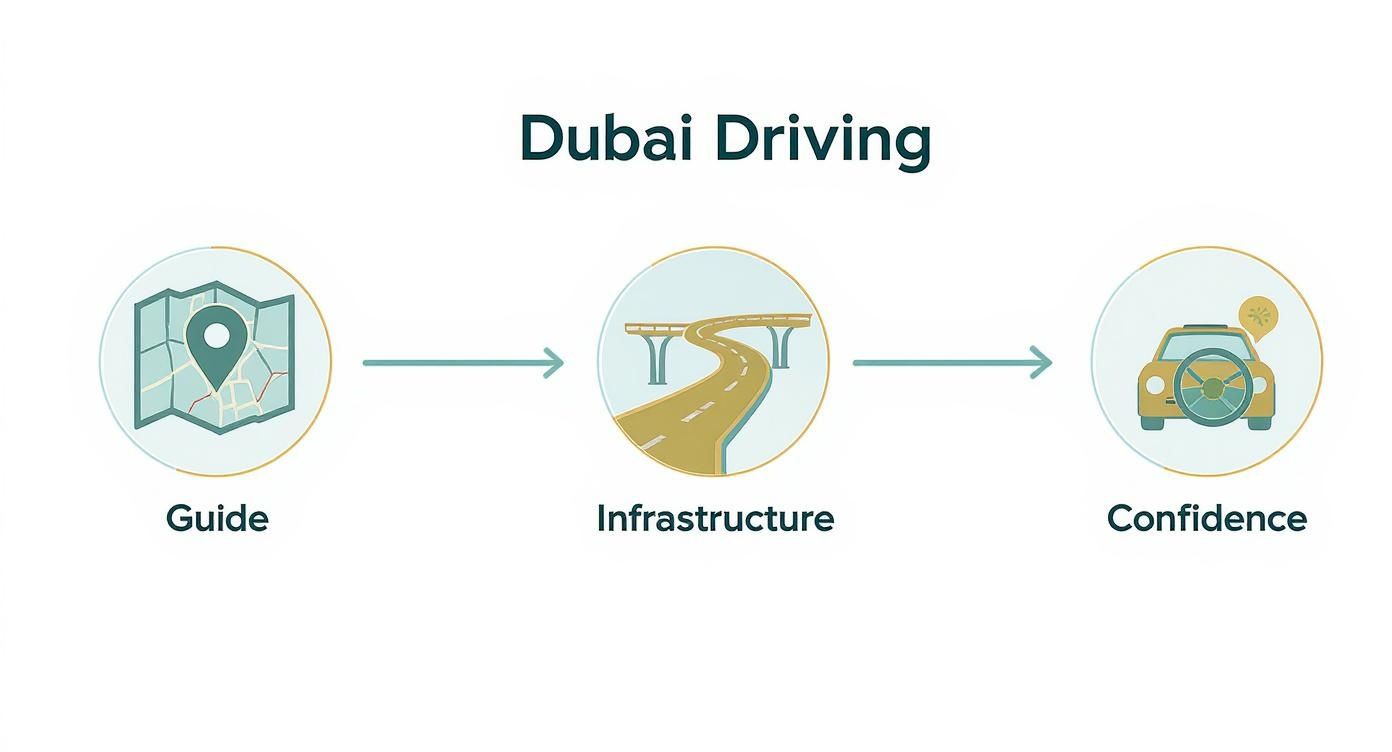
It's a simple journey: a good guide plus a solid understanding of the roads equals feeling completely at ease behind the wheel.
Making Sense of the System
Once you understand how these main roads interact, the city map stops looking like a confusing tangle of lines and starts to resemble a logical grid.
- E11 (Sheikh Zayed Road): Your primary corridor for tourist and business hubs along the coast.
- E44 (Al Khail Road): The first major inland parallel route, your best bet for avoiding downtown traffic jams.
- E611 (Emirates Road): The ultimate bypass, designed to move traffic between emirates without getting bogged down in the city.
Think of it this way: Sheikh Zayed Road is for sightseeing and direct access to prime spots. Al Khail and Emirates Roads are for getting from A to B as quickly as possible. Knowing which one to use, and when, is the key to outsmarting the traffic.
By building this simple mental map, you'll find that any GPS or app becomes much more intuitive. You'll start to anticipate turns and understand why it’s suggesting a particular route, turning what looks like a complicated interchange into a straightforward decision. This foundational knowledge is your first real step towards mastering Dubai's world-class road network.
Navigating Tolls, Parking and Road Signs
To really get the most out of your drive in Dubai, you'll need to get a handle on three key systems that quietly run in the background: Salik tolls, parking zones, and road signs. Once you see how they work, you’ll find the city’s roads are set up for total convenience, letting you focus on the amazing views instead of the logistics.
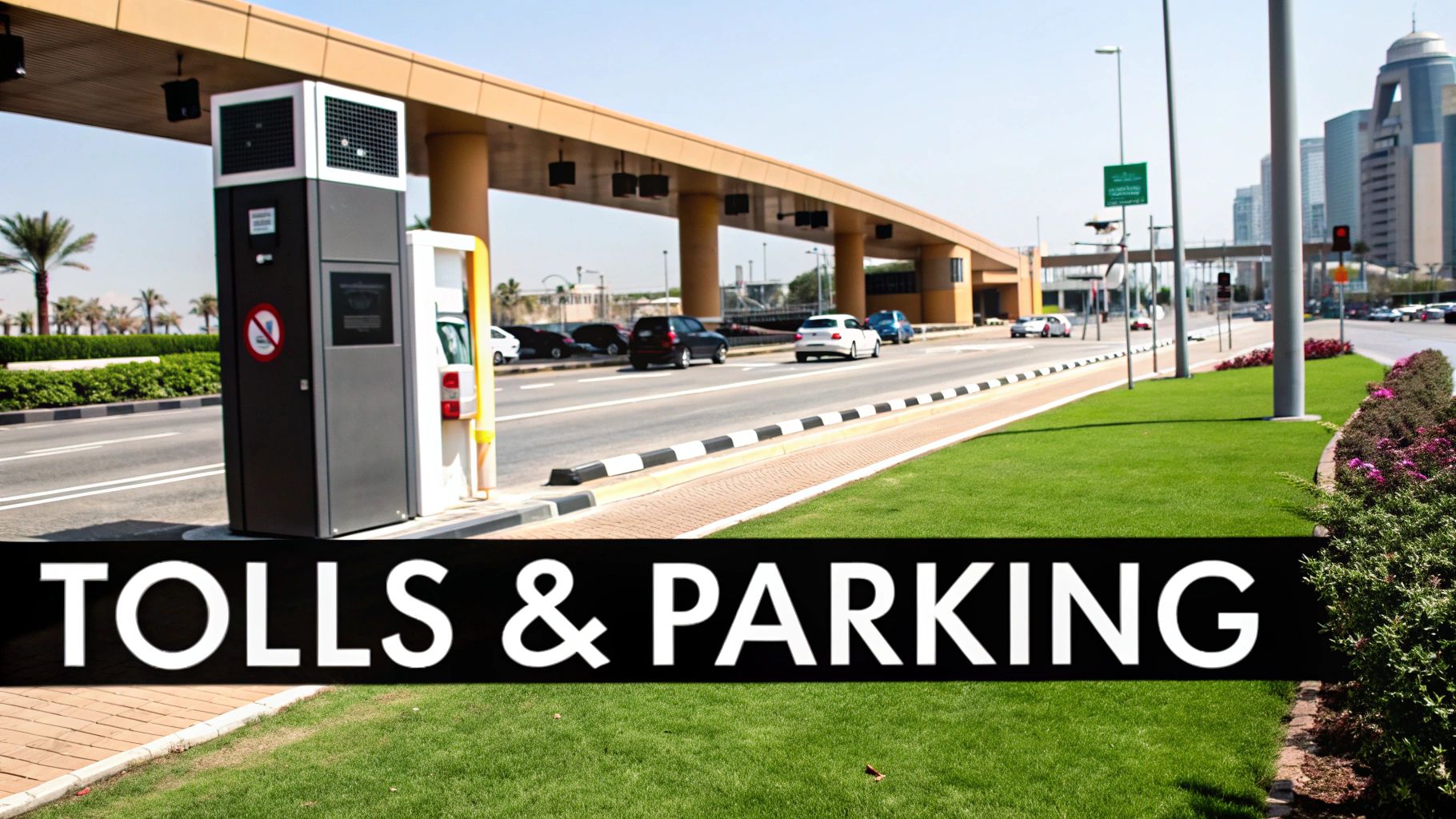
These systems are almost entirely automated and designed to make your journey feel effortless. Let's walk through each one so you can hit the road feeling like a local.
Understanding the Salik Toll System
Dubai uses a slick, barrier-free toll system called Salik, which is Arabic for "open" or "clear." Forget about toll booths, fumbling for change, or even slowing down. Instead, as you drive under a toll gate at full speed, an overhead scanner simply reads a small tag on your car's windscreen.
It's brilliantly simple. Every time you pass through a gate, a flat fee of AED 4 is logged. If you're in a rental, the car will already have a Salik tag installed. The rental company keeps a running tab of your toll charges and will simply add the total to your final bill. Easy.
You'll find these gates on the city's main arteries, including:
- Sheikh Zayed Road (E11): At key points like Al Barsha, Al Safa, and Jebel Ali.
- Al Garhoud Bridge: A vital link for crossing the Dubai Creek.
- Al Maktoum Bridge: Another major Creek crossing (it's actually free to use during certain off-peak hours).
- Airport Tunnel: Covering the route to and from Dubai International Airport.
The whole point of Salik is to keep traffic flowing. It's a system designed for a fluid driving experience, ensuring you can cruise along the major highways without interruption on your way to the city's iconic sights.
A Guide to Parking in Dubai
Parking in Dubai, managed by the Roads and Transport Authority (RTA), is surprisingly straightforward. The city is divided into different parking zones, all clearly marked with colour-coded signs that tell you the fees and how long you can stay.
Best of all, it's a cashless system with a few handy ways to pay:
- mParking (SMS): Just send a quick SMS to 7275 with your plate number, the zone code from the sign, and how long you need.
- RTA Dubai App: This is the go-to app for many residents. You can pay for parking, top up your balance, and it even sends reminders before your time runs out.
- Parking Metres: You'll still find traditional metres in most areas, which accept Nol cards (the city's public transport card) or good old-fashioned coins.
For a deeper dive into local road etiquette, our guide on https://www.uptowndxb.com/dubai-driving-tips/ is packed with advice on everything from parking to navigating roundabouts. And it's not just about local rules; managing road tolls efficiently is a smart skill for any driver, whether you're here for a week or running a business.
Decoding Dubai's Road Signs
You'll be relieved to know Dubai's road signs are some of the clearest you'll find anywhere in the world. They are completely bilingual, with everything written in both Arabic and English, so international visitors can navigate with total confidence. The colour-coding system is a massive help, giving you instant clues about where you're heading.
Here’s the simple breakdown:
- Blue Signs: These are your main arteries. Think major highways and routes like Sheikh Zayed Road (E11).
- Green Signs: These guide you along local roads inside Dubai's different districts and communities.
- Brown Signs: Your tourist compass. These signs point the way to landmarks, cultural sites, and key attractions.
Speed limits are always shown in a clear, universal format: black numbers inside a white circle with a red border. Take them seriously. Dubai has a huge network of speed cameras, so it pays to stay aware of the posted limit.
Driving Routes to Dubai's Top Destinations
You've got the basics of Dubai's main roads and systems down. Now it's time to put that knowledge into action. Think of this as your hands-on guide, turning what you know about the Dubai road map into real-world confidence for the most common trips you'll take.
Let's move from theory to practice with some clear, simple routes for reaching the city’s most famous spots. These itineraries are designed to be as straightforward as possible, helping you feel like you know the city from the moment you start the engine.
From Dubai Airport (DXB) to Key Hubs
One of the very first drives for any visitor is getting from Dubai International Airport (DXB) to their hotel. Whether you're staying in the glamorous Dubai Marina or the heart of the city in Downtown, the routes are surprisingly efficient and well-marked.
-
To Dubai Marina & JBR: Without crazy traffic, this is about a 30-minute drive. From the airport, just follow the signs pointing you to the E11 South towards Jebel Ali/Abu Dhabi. This gets you right onto Sheikh Zayed Road. You'll stay on this massive highway for about 25-30 kilometres, watching the city's landmarks fly by. Keep an eye out for exits 32 or 29—either will guide you straight into the Marina district.
-
To Downtown Dubai & Burj Khalifa: This trip is a bit shorter, usually taking 15-20 minutes. From DXB, you'll start the same way, following signs for the E11 (Sheikh Zayed Road) towards Jebel Ali/Abu Dhabi. After just a few minutes, you’ll see that iconic skyline coming into view. Take exit 50 for Financial Center Road (D71), which is your direct line into the heart of Downtown, with clear signs for The Dubai Mall and Burj Khalifa.
These airport runs are your first test, and they’re designed to be easy. The most important thing to remember is to follow the big blue signs for the E11. This highway is the main artery for both of these popular journeys.
Reaching Iconic Landmarks
Once you’re all settled in, you’ll want to get out and explore some of Dubai's world-famous attractions. Getting to a place like The Palm Jumeirah needs a little more specific direction, but it's still a very easy drive.
Driving to The Palm Jumeirah:
To get to this man-made wonder, you'll once again use Sheikh Zayed Road (E11) as your main road.
- Head south on the E11 as if you're driving towards Abu Dhabi.
- Once you pass the Mall of the Emirates (it'll be on your left), start moving into the right-hand lanes.
- Take exit 34, which is clearly marked for The Palm Jumeirah.
- Just follow the road as it loops around and puts you right onto the "trunk" of The Palm.
From there, the main road, Crescent Road, sweeps across the top of The Palm, giving you access to the Atlantis hotel and other stunning resorts. It's a beautiful drive in itself and really shows off the incredible scale of this engineering masterpiece.
Understanding Local Driving Rules and Etiquette
Having a good Dubai road map is one thing, but knowing how to navigate the roads safely and politely is a whole other ball game. To truly enjoy your drive, you need to get a feel for both the official laws and the unwritten rules of the road. Mastering this is your key to a smooth, stress-free time behind the wheel.
First things first: speed limits aren't just a suggestion here; they're strictly enforced. On the massive highways like Sheikh Zayed Road, you'll see limits around 100-120 km/h. Once you're on main city roads, that drops to 60-80 km/h, and in quiet residential zones, it can be as low as 40 km/h. Dubai is blanketed with speed cameras, so sticking to the limit is the only way to avoid a hefty fine.
Lane discipline is just as critical. On the multi-lane highways, think of the far-left lane as the unofficial express lane. It's for overtaking and for those moving at the fastest pace. If you're just cruising, it’s both customary and much safer to stick to the middle or right-hand lanes. This keeps you out of the way of faster traffic and helps you avoid aggressive tailgating.
Key Rules You Cannot Ignore
Beyond speed and lanes, there are a few absolute, non-negotiable rules. Break them, and you’re looking at serious penalties.
- Zero Tolerance for Alcohol: This is the big one. Dubai has a 0.0% legal blood alcohol limit. There is no room for interpretation here. The consequences are severe, including major fines, having your vehicle impounded, and even potential jail time.
- Mobile Phone Use: It's illegal to use a handheld mobile phone while driving. Getting caught will earn you a significant fine and demerit points on your licence.
- Navigating Roundabouts: When you get to a roundabout, you must give way to traffic that is already on it. It’s simple: the cars in the circle have the right of way. Use your indicators to show everyone where you plan on exiting.
The golden rule for driving in Dubai is to be predictable. Signal your intentions well in advance, keep a safe following distance, and just go with the flow of traffic. Sudden, jerky movements are a major hazard on these busy highways and are definitely not appreciated.
Unwritten Etiquette for a Smoother Drive
Finally, a couple of local customs will help you fit right in. If another driver is kind enough to let you merge into their lane, a quick flash of your hazard lights is the universal way to say "thank you." On the flip side, laying on the horn is considered quite rude and is really only used for genuine emergencies.
For a deeper dive, our specific guide on driving in Dubai for tourists covers even more of these essential tips. By mixing your knowledge of the law with a little local etiquette, you’ll be ready to handle Dubai’s roads like a pro.
Exploring Scenic Drives Beyond the City
That luxury rental isn't just for turning heads on Sheikh Zayed Road; it's your passport to an entirely different side of the Emirates. Sure, a Dubai road map is crucial for mastering the city, but it's also the key that unlocks the UAE's jaw-dropping natural landscapes waiting just beyond the urban sprawl. Trading skyscrapers for mountain passes offers a perspective many visitors completely miss.
Getting out of the city is where a simple trip becomes a real adventure. It's your chance to see the raw, wild beauty that underpins all of Dubai's modern marvels.
Mountain Adventures to Hatta and Jebel Jais
For a day trip you won't soon forget, point your car towards Hatta. The drive out on the Sharjah-Kalba Road (E102) is an experience in itself, taking you through rugged, rust-coloured mountains before revealing the stunning, turquoise waters of Hatta Dam. The twisting roads and dramatic views are a world away from the city's grid-like perfection.
Feeling even more ambitious? Head north into Ras Al Khaimah to tackle the legendary Jebel Jais mountain road. This is the highest peak in the UAE, and the drive up its masterfully engineered switchbacks is nothing short of breathtaking. It’s a genuine bucket-list journey for anyone who loves to drive. If you're looking for more inspiration, check out our guide on finding incredible scenic drives near me.
These mountain roads are incredible feats of engineering set against some seriously raw natural beauty. They're a powerful reminder of how the UAE blends cutting-edge infrastructure with its ancient, stunning landscapes.
Conquering the Desert Dunes
You can't come to Dubai and not experience the iconic desert. But before you even think about leaving the tarmac, know this: the golden sands are as treacherous as they are beautiful. You have to be prepared.
- Vehicle Choice: This is non-negotiable. A 4×4 is absolutely essential. A regular saloon car will be buried in the sand before you know it.
- Safety First: The golden rule of the desert is to never go alone. Always travel in a convoy with at least one other capable vehicle.
- Join a Guided Tour: If it's your first time, the smartest and most enjoyable way to experience the dunes is with a professional guided safari. Let the experts lead the way.
With the right 4×4, you unlock a world of true Emirati adventure. From thrilling dune bashing to finding that perfect, secluded spot for a sunset you'll never forget, this is the ultimate way to connect with the wild heart of the Emirates.
Your Dubai Driving Questions Answered
Driving in a new city always throws up a few questions. We get it. This section is all about giving you quick, clear answers to the most common queries we hear about driving in Dubai, so you can feel completely prepared before you even get behind the wheel.
Let's clear up those last few details.
Which Navigation App Is Best For Dubai?
For getting around Dubai, you can't go wrong with Google Maps or Waze. Both are fantastic for real-time traffic updates, giving you a heads-up on congestion and suggesting faster routes on the fly. They’re also great for flagging speed cameras.
Waze is a particular favourite among residents because it relies on community reports, meaning you get instant alerts about road hazards or police presence directly from other drivers. The RTA's own S'hail app is another brilliant tool, especially if you plan on mixing driving with public transport. It seamlessly integrates everything from metro schedules to driving directions.
Do I Need An International Driving Permit?
This really depends on where your driving licence was issued. If you're visiting from the UK, US, Canada, Australia, or most GCC and European countries, your home country's licence is typically all you need to rent a car here.
That said, our best advice is to always carry an International Driving Permit (IDP). Think of it as a safety net. Rules can change, and having one avoids any potential confusion. It's always a smart move to double-check the latest requirements with your car rental agency before you fly.
How Does Salik Work With A Rental Car?
It couldn't be simpler. Every rental car in Dubai is already fitted with a Salik tag, a small sticker on the windscreen. When you drive through a toll gate, the system automatically scans the tag and logs the AED 4 fee.
There's nothing you need to do at the time. The rental company keeps a running tally of all your toll charges, and they'll simply deduct the total from your security deposit when you return the car. It’s completely seamless.
While you're getting to grips with navigating Dubai, it's always smart to be ready for the unexpected. For instance, knowing what to do if you lose your car key can turn a potential holiday disaster into a minor inconvenience.
Ready to experience Dubai with the ultimate freedom and style? At Uptown Rent A Car, we offer an exclusive fleet of luxury vehicles to make your journey unforgettable. Book your dream car online today!