
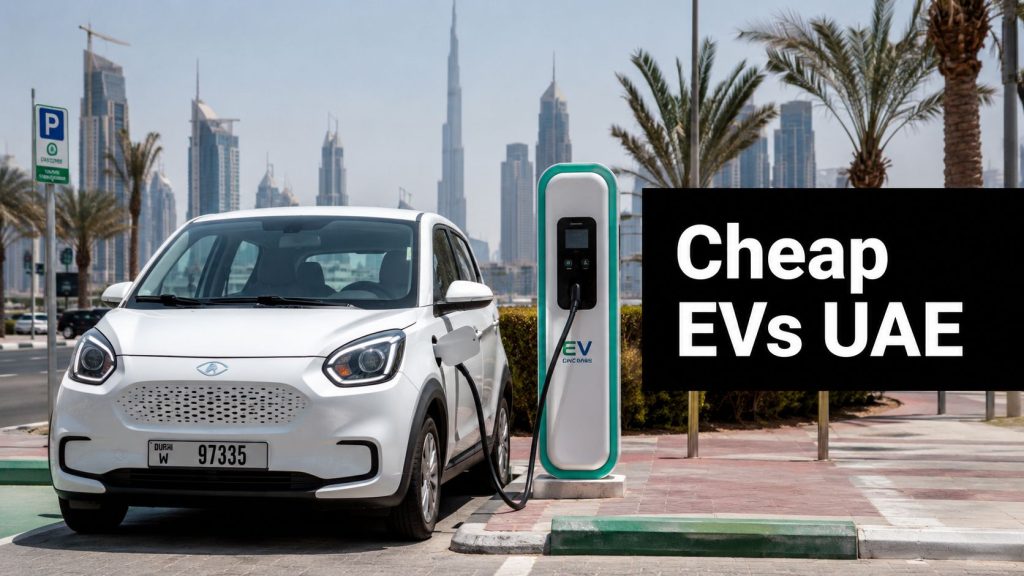
You're probably looking at the fuel bill, watching more EVs show up in Dubai traffic, and wondering if now's the time to stop paying for petrol. That instinct makes sense. Electric cars are no longer a novelty in the UAE, and they're no longer limited to people buying top-end tech toys.
But if you search for cheap electric cars in UAE, most lists make the same mistake. They treat cheap as a sticker price only. That's lazy advice.
In the UAE, a low purchase price can still lead to an annoying ownership experience if the battery is small, charging access is awkward, the car struggles on long highway runs, or you discover that some “savings” weren't real in the first place. For a lot of drivers, especially residents with changing schedules and visitors who want zero hassle, renting a better EV can be the smarter money move than buying a cheap one.
The Electric Dream in the Desert City
A Dubai resident sees an EV parked downstairs, checks a few listings at night, and starts doing the maths. No petrol stops. Quiet driving. Modern interiors. It all sounds like a clean upgrade.
That curiosity isn't random. The UAE EV market has already moved beyond niche status. One estimate values the market at US$3.83 billion in 2023, and Dubai EV numbers were reported at 7,331 in 2023 with a projection of 12,852 by 2025 in DEWA-linked reporting, according to UAE electric vehicle market analysis. The same market roundup also notes separate reporting that Dubai had 25,929 EVs by end-December 2023, which tells you one thing clearly: different trackers use different methods, but the direction is obvious. EVs are becoming normal.

Why this matters in Dubai
Dubai is the easiest place in the UAE to understand the appeal. Daily commutes are predictable for many people. The roads are modern. Plenty of drivers mostly move between home, office, school runs, mall parking, and weekend plans. That pattern suits electric driving well.
The mistake is assuming that growing adoption automatically means buying is the right move.
For some people, it is. If you have reliable charging, a stable routine, and you're choosing carefully, ownership can work. But if your life includes regular inter-emirate travel, apartment charging uncertainty, changing work routes, or you do not want depreciation and maintenance questions hanging over you, buying the cheapest EV on the market can feel cheap only on day one.
Practical rule: In the UAE, the smartest EV decision isn't “buy or don't buy”. It's “match the car to your real routine”.
The question most buyers ask too late
People usually start with price. They should start with usage.
Ask yourself these first:
- Where will you charge most often: Home, office, public charger, or a mix?
- How do you really drive: Mostly city loops, or regular Dubai to Abu Dhabi and back?
- How long will you keep it: A short phase, a trial period, or a long ownership cycle?
- What annoys you more: Paying more upfront, or dealing with uncertainty later?
That last point matters. A lot of UAE drivers don't want the cheapest EV. They want the cheapest stress-free EV experience. Those are not the same thing.
What Does a Cheap Electric Car in the UAE Look Like
In this market, “cheap” doesn't mean bargain-basement. It usually means entry-level electric ownership. That's a very different category from cheap petrol cars.
A clear reference point is the Smart range in the UAE. The Smart #1 starts at AED 99,900, while the Smart 5 goes up to AED 219,900, according to Smart electric car pricing in the UAE. The same market page also shows EV listings starting at an average of AED 69,600 across used and new inventory. That average sounds attractive, but it also mixes very different types of cars and conditions.
Cheap usually means city-first, not all-rounder
Here's the blunt version. Most lower-cost EVs make sense if your life is mostly local.
They tend to be stronger at:
- Urban commuting: Short daily drives, easier parking, lower charging pressure
- Controlled routines: Repeating the same route makes range planning easier
- Lower initial spend: That's the main attraction, and often the main compromise
They tend to be weaker at:
- Long highway runs: High-speed UAE driving drains range faster
- Heat-heavy usage: Constant cabin cooling affects efficiency
- Flexible lifestyles: If your schedule changes often, small-battery cars become less forgiving
That's why reading broad lists of budget electric car options can be useful for perspective, but UAE buyers need to be stricter. A car that looks affordable on paper can feel limited very quickly once you add Sheikh Zayed Road speeds, summer AC use, and occasional longer trips.
Sticker price is only the first filter
A cheap EV in the UAE usually signals a trade-off. Maybe the battery is smaller. Maybe charging speed is less convenient. Maybe the cabin and tech are fine for daily use but not something you'll enjoy on longer drives.
Cheap electric cars in UAE listings often answer only one question: “Can I afford to buy it?”
They don't answer the more important one: “Will I still like living with it six months later?”
If your driving is simple, a lower-cost EV can work well. If your needs are mixed, the cheapest purchase often becomes the wrong financial choice. Paying less to enter the market can mean paying more in inconvenience, compromise, and replacement pressure later.
That's why I don't tell people to chase the lowest price. I tell them to find the lowest-cost experience that still fits UAE reality.
The Real Cost of Owning a Budget EV in the UAE
Buying a budget EV sounds tidy. You pay once, charge cheaply, and enjoy lower running costs. In real UAE life, it's rarely that neat.
The hidden cost gap starts with one simple fact. Salik is not free for electric car owners in Dubai, as noted in this UAE EV ownership overview. That matters because a lot of drivers still assume EV ownership automatically strips away road-use costs. It doesn't.

The costs people skip in their first calculation
When buyers compare EVs with petrol cars, they often focus on charging versus fuel. That's too narrow.
A better ownership checklist includes:
- Charging access: If you can't charge conveniently at home or work, the cheap EV stops feeling convenient fast.
- Insurance: Some models can be more awkward or expensive to insure than buyers expect.
- Depreciation: Budget EVs don't all age equally in the used market.
- Battery behaviour in heat: The UAE climate makes thermal management more than a nice-to-have.
- Road tolls and daily route costs: EV ownership doesn't erase those.
- Time cost: Waiting, planning, rerouting, and charger dependency all count.
If you're also comparing the economics against petrol driving, it helps to understand the wider context around fuel prices in the UAE, because a lot of drivers switch to EVs based on rough assumptions instead of a realistic month-by-month driving pattern.
The battery question matters more here
A budget EV with a smaller battery can be absolutely fine for city life. It becomes less fine when your week includes motorway driving, heavy AC use, and last-minute plans.
That's where many cheap EV ownership stories go wrong. The buyer didn't choose a bad car. They chose a car built for a narrower use case than their real life.
For a useful non-UAE-specific primer on what ongoing EV ownership can involve, Punk Ride's EV cost guide is worth reading. The details vary by market, but the core lesson holds up well here: maintenance may be simpler in some ways, yet total ownership still depends on usage, support, and the quality of the vehicle you start with.
Owning the cheapest EV can be sensible. Owning the cheapest EV without a charging plan is expensive in all the ways that matter.
Where budget ownership makes sense
I'd only strongly back budget EV ownership if most of these are true:
- You have dependable charging: Not “probably”, but reliably.
- Your driving is repetitive: Home to office, office to home, mostly predictable.
- You don't need frequent inter-emirate flexibility: Especially on short notice.
- You're comfortable with compromise: Smaller battery, simpler features, and more planning.
If not, you're often better off delaying the purchase or using an EV through rental when it fits your schedule. That gives you the benefit of electric driving without locking yourself into a car that solves one problem and creates three more.
Renting an EV The Smart and Flexible Alternative
If ownership feels messy, that's because for many drivers it is. Renting solves the biggest weakness of cheap EV buying. It separates using the car from carrying the long-term risk.
That's why I often recommend renting first, and in some cases renting indefinitely in phases, instead of rushing into a budget purchase. You avoid depreciation, resale stress, battery ageing worries, and the regret of buying an entry-level EV that doesn't suit your real driving habits.
Why rental changes the equation
With a rental, you're paying for access and convenience. That sounds less glamorous than ownership, but financially it can be the sharper move when your needs aren't fixed.
You don't need to wonder about:
- Resale value later
- Battery condition years down the line
- Unexpected ownership admin
- Being stuck with the wrong model
You also get the chance to test whether electric driving even fits your week. A lot of people think they want the cheapest EV. After living with one, they realise they want a better EV occasionally, not a budget EV permanently.
For drivers comparing options, electric car rental in Dubai is worth considering because it lets you try the format without the usual ownership baggage. Uptown Rent A Car is one option in that category for people who want access to electric or hybrid rental choices without committing to a long-term purchase.
Ownership vs rental cost breakdown for an EV in UAE
| Cost Factor | Owning a Budget EV (Annual Estimate) | Renting a Premium EV (Annual Estimate) |
|---|---|---|
| Upfront commitment | High initial purchase commitment | No purchase commitment |
| Depreciation risk | You carry it | Rental provider carries it |
| Battery ageing concern | Your problem over time | Not your long-term problem |
| Insurance complexity | You arrange and manage it | Usually structured within rental terms |
| Maintenance planning | You handle servicing and downtime | Usually handled by provider |
| Flexibility | Low once purchased | High, especially if needs change |
| Model quality | Often compromise-led at entry price | Easier to access a better-equipped EV |
| Exit option | Requires sale or trade-in | Hand back at end of term |
Renting isn't only for tourists. For many residents, it's the cleanest way to avoid paying for the wrong car twice.
Who should rent instead of buy
Renting is the smarter call if you fall into any of these groups:
- Apartment residents with uncertain charging
- Business travellers in Dubai for extended but limited stays
- Residents testing EV life before committing
- Drivers who want a higher-quality EV without ownership headaches
- People whose weekly mileage changes a lot
If your routine is stable and your charging is sorted, ownership can still work. But if flexibility matters, rental often wins because it keeps your costs more predictable and your mistakes less expensive.
Must-Have Features for any UAE Electric Car
In the UAE, the spec sheet matters more than the badge. Don't get distracted by the word “electric” and assume every EV fits local conditions equally well. It doesn't.
The big issue is practicality in heat and on fast roads. Kia's UAE hybrid and electric overview makes the core point clearly: buyers here need vehicles suited to hot-climate battery management and mixed city-highway driving. That's exactly right.

Battery cooling is not optional
A proper thermal management system should be high on your list. In the UAE, heat isn't an occasional inconvenience. It's part of daily life for much of the year.
If you're choosing between EVs, I'd rank these factors above flashy interior tech:
- Battery thermal management: This protects performance and day-to-day consistency.
- Stable highway behaviour: UAE driving often means sustained speed, not just urban crawling.
- Usable charging speed: Slow charging becomes a lifestyle problem.
- Air conditioning performance: You'll use it constantly, so it needs to work without turning the car into a range-anxiety machine.
For context, the Kia EV6 feature page for the UAE shows why some EVs feel more relaxed to live with here. UAE-listed EV6 variants pair a 77.4 kWh battery with up to 528 km WLTP range, while a 58 kWh option is positioned for everyday needs. The point isn't that everyone should buy an EV6. The point is that battery size and range headroom matter in this country.
Learn to distrust perfect range expectations
WLTP figures are useful, but don't treat them like your guaranteed real-life outcome in UAE summer traffic and motorway use. AC load, speed, and route pattern all change the experience.
Watch for these signs that an EV may be too compromised for your lifestyle:
- You'd need to charge more often than you're comfortable with
- Your regular route includes long, high-speed sections
- You can't charge easily before the battery gets low
- The car feels designed for city errands, not full-day flexibility
If you're visiting or driving around the hotter months, this matters even more. A quick look at Dubai in the summer is enough to remind you that vehicle cooling and comfort aren't luxury concerns here. They're practical ones.
Here's a useful visual explainer on EV ownership and usage considerations:
My non-negotiables for UAE EV use
I'd avoid any EV in the UAE, bought or rented, unless it gives you confidence in these areas:
Heat management
If the car isn't built to stay consistent in hot conditions, move on.Enough range buffer
Not minimum possible range. Buffer. You want room for detours, traffic, and AC use.Fast-charging practicality
A car that takes too long to recover range becomes annoying, even if the sticker price looked good.Cabin comfort
If the cooling struggles, you'll hate the car no matter what you saved.
Your Go-Electric Checklist for the UAE
At this point, the smart move is simple. Stop asking “What's the cheapest EV?” and start asking “What's the lowest-risk way for me to drive electric in the UAE?”
That answer will be different for a resident in a villa, an apartment tenant in Dubai Marina, a consultant flying in for projects, and a family doing school and work runs across the city.

Questions to ask before buying
Use this list before you commit to any of the cheap electric cars in UAE listings you see online:
- Can I charge conveniently every week: If the answer is uncertain, pause the purchase.
- Does this car match my real driving pattern: Not your ideal routine. Your actual one.
- Am I buying based on price alone: That's where most bad EV decisions start.
- Is the car built for city use only: If yes, be honest about your highway needs.
- Will I still be comfortable with this choice in peak summer: If not, it's the wrong car.
- Do I understand the ownership burden: Insurance, servicing, charging habits, resale, and daily convenience all count.
Buying filter: If a cheap EV only works when everything goes perfectly, it isn't cheap enough.
Your smart rental checklist
If you're leaning towards rental, don't pick blindly. A better rental experience comes from checking the boring details first.
- Vehicle suitability: Choose an EV with enough range and comfort for your actual route.
- Charging clarity: Ask how charging expectations work during the rental period.
- Insurance terms: Make sure you understand coverage, excess, and what happens if plans change.
- Support access: You want responsive help if anything goes wrong.
- Car condition: A well-maintained EV drives better, charges more predictably, and saves hassle.
- Rental duration fit: Short stay, business trip, weekend test, or longer use all require different logic.
The direct recommendation
If you have stable charging and a repetitive urban routine, a budget EV can make sense. Buy carefully, and don't overestimate what an entry-level car can do.
If your routine changes, your charging is uncertain, or you want to avoid long-term headaches, rent. That's the cleaner choice. You get the EV experience, you keep your flexibility, and you don't tie your money to the weakest part of the market just because the sticker price looked attractive.
Cheap isn't about paying the least on day one. It's about making the decision you won't regret later.
If you want to try electric driving in Dubai without taking on ownership risk, Uptown Rent A Car is a practical place to start. It gives you a way to use a higher-quality vehicle for the time you need it, which is often the smarter financial decision than buying a budget EV and dealing with charging, depreciation, and long-term upkeep yourself.