
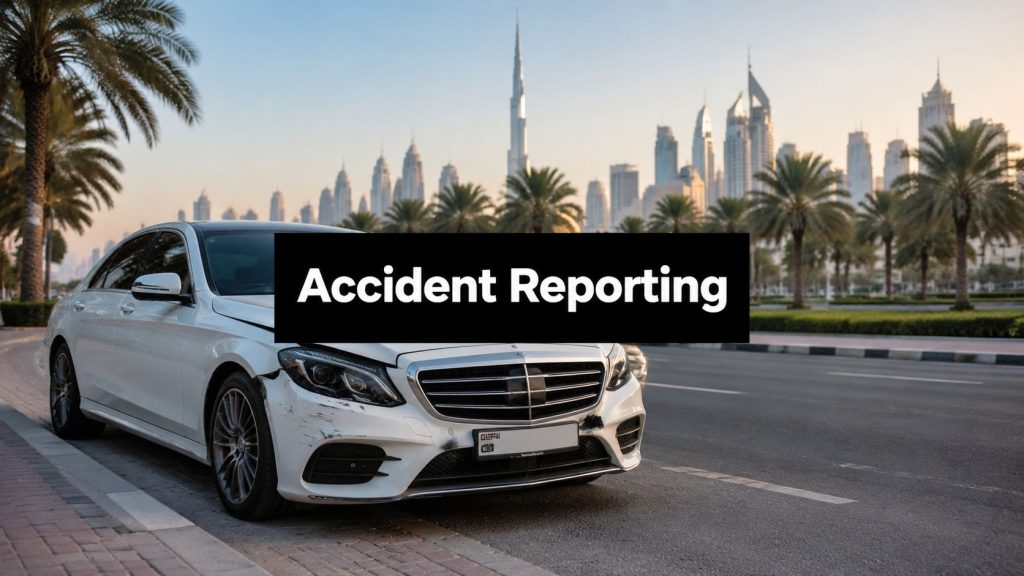
A collision in a rental car feels different when you're far from home. You're dealing with shock, a different road system, a premium vehicle, and the immediate worry that one wrong step could affect your insurance, your deposit, or your travel plans.
That's where most generic advice fails. It tells you to “report the accident” without explaining what a tourist or expatriate in Dubai needs to do, in what order, and which document matters most. For non-residents, the accident reporting procedure isn't just about safety and paperwork. It's about securing the correct police record quickly, protecting your insurance position, and avoiding preventable mistakes that are common under stress.
Your First Moments After a Car Accident in Dubai
If you've just had an accident, your first priority is simple. Make the situation safe, stay calm, and avoid making fast decisions that create slower problems later.
This matters especially for visitors. In Dubai, 15% of traffic accidents involve tourists, yet 80% of these visitors initially fail to secure the correct police report, which can lead to insurance claim denials, according to the cited context in the Oregon State University accident reporting page. That gap is exactly why a renter-specific accident reporting procedure matters.
What usually goes wrong for visitors
Most renters don't struggle with the driving. They struggle with the minutes after the impact.
A resident may already know when to contact police, what the app is used for, or why an informal agreement with another driver is risky. A tourist often doesn't. Add language pressure, unfamiliar road locations, and the presence of a luxury vehicle, and people start focusing on the wrong issue first, usually the car, the cost, or whether the other driver seems “reasonable”.
Practical rule: Your insurance and rental file depend far more on the official reporting sequence than on roadside promises.
For a non-resident, the key document is the Police Accident Certificate. Without the proper police record, even a minor incident can become harder to validate with the insurer or rental provider. That's why the right accident reporting procedure begins with control, not debate.
What to do mentally before you do anything else
Use a short internal checklist.
- Slow the pace: Take one breath before opening the door or calling anyone.
- Check people first: Injuries always outrank vehicle damage.
- Avoid roadside conclusions: Don't argue fault and don't accept private cash settlements on the spot.
- Think in sequence: Safety, police reporting, rental company notification, insurer support.
That order protects you.
If you remember only one thing in the first few minutes, remember this. In Dubai, a luxury car accident is manageable when the event is documented correctly from the beginning. Most serious problems come from missed reporting steps, not from the original impact itself.
On-Scene Safety and Documentation Checklist
The best response at the scene is calm, deliberate, and boring. That's good. A reliable accident reporting procedure should feel methodical because method beats panic every time.

A structured process works better than improvised reporting. Organisations using a structured 4-step documentation protocol achieve a 92% success rate in resolving incidents within 30 days, compared with 65% for informal methods (Source 4). While that benchmark comes from a broader reporting context, the practical lesson applies directly to car rental incidents. Order matters.
Secure the scene first
Before photographs, before calls, before explanations, make the area safer.
- Stop and assess the surroundings. If the car can be moved safely and local conditions allow it, get it out of active traffic.
- Turn on hazard lights. Make your vehicle visible immediately.
- Check every occupant. Ask clearly if anyone feels pain, dizziness, or distress.
- Call emergency services if there are injuries or danger. Don't try to “wait and see” if someone may be hurt.
If the vehicle isn't safe to move, leave it where it is and keep everyone clear of traffic.
Gather the right evidence
Once people are safe, document the incident while the details are fresh and the scene is unchanged.
Take photos that show:
- The full scene: Wide shots from several angles showing road position, lane markings, signals, kerbs, and nearby signs.
- Each vehicle: Front, rear, both sides, number plates, and all visible damage.
- Close damage detail: Scrapes, dents, broken lights, wheel damage, glass, and any detached parts.
- Context points: Weather, lighting, skid marks, debris, or obstructions if visible.
- Documents where appropriate: The other driver's licence, registration details, and insurance information, if shared.
Video can help, but still photographs are often easier to review later.
Don't photograph carelessly. Clear, time-ordered images are more useful than dozens of random shots.
Record information without arguing
You need facts, not a roadside verdict.
Collect:
- Other driver details: Name, mobile number, vehicle registration, and insurer if available.
- Witness contacts: Anyone who directly saw the event.
- Your exact location: Road name, landmark, building number, or map pin.
- Time and sequence: A short note on what happened while it's still fresh.
What doesn't work is discussing blame in emotional language. Don't say “I didn't see you” or “It was probably my fault” even if you're trying to be polite. Those statements can create confusion later.
A simple field template
Use this structure in your notes app:
| Item | What to record |
|---|---|
| Date and time | Exact time of collision |
| Location | Road, junction, landmark, pin |
| Vehicles involved | Make, model, registration |
| People involved | Driver and passenger names |
| Visible damage | Short factual description |
| Witnesses | Names and phone numbers |
| Immediate actions | Moved vehicle, called police, called emergency services |
That's enough to support the next step without overwhelming you.
How to Officially Report the Accident to Dubai Police
Official reporting is the point where a stressful event becomes a documented case. For rental drivers in Dubai, this is the administrative centre of the accident reporting procedure.

Dubai's systems increasingly favour digital reporting. In the UAE, the E-Safety portal introduced in 2013 reduced administrative delays by an average of 7 days and led to a 92% compliance rate in the transport sector (Source 2). The lesson for drivers is straightforward. Use official digital channels where appropriate, because they reduce friction and create cleaner records.
When to use the app and when to call 999
Not every accident is handled the same way.
Use the Dubai Police app for a minor collision when there are no injuries and the situation is stable. In those cases, the app is often the fastest route to creating the official record needed for insurance and repair handling.
Call 999 immediately if:
- Anyone is injured
- A vehicle is creating a dangerous obstruction
- There's major damage
- There's a dispute or aggressive behaviour
- You can't safely manage the scene yourself
If you're uncertain, choose the safer option and contact the authorities directly.
What to have ready before you file
Open the app or prepare for the call only after you've gathered the essentials.
Have these details ready:
- Your rental car registration
- Your driving licence details
- The exact accident location
- Photos of the vehicles and scene
- The other driver's details
- A short factual account of what happened
Keep your description neutral. State direction, lane position, signal status if known, and point of impact. Avoid guessing motive or blame.
For readers who want a broader reference on how accident report records are used after a collision, VekTracer instant vehicle history gives useful context on why report accuracy matters over the longer life of a vehicle.
A short visual walk-through can also help if you're trying to steady yourself before filing:
The document you need to obtain
The outcome of reporting is not just “letting police know”. It's obtaining the official police accident record that supports the insurance and rental process.
In practice, renters should focus on making sure the report is properly issued and referenced. Save screenshots, note the report number, and keep all related messages in one place on your phone. If you later speak to the rental company, repair coordinator, or insurer, this is the first identifier they'll ask for.
The best accident files are consistent. The photos, the report, and your written account all describe the same event in the same order.
If the other party suggests resolving it privately without a formal report, be cautious. That might sound convenient in the moment, but it often creates the most expensive type of delay: a preventable one.
Notifying Uptown Rent A Car and Your Insurer
Once the police report is underway or issued, contact the rental provider promptly. This isn't a courtesy call. It's part of the operational side of the accident reporting procedure, and it affects towing, vehicle handling, repairs, and insurer coordination.

Clearer digital procedures lead to better reporting behaviour. After enhanced digital accident reporting procedures were implemented, MOHRE recorded a 42% rise in reported incidents, showing that optimized company processes improve compliance and data accuracy (Source 1). The practical takeaway is simple. Notify the rental company early, with the right details, and the rest of the process usually moves more cleanly.
What to have in front of you before you call
Don't make the call while searching for documents one-handed at the roadside.
Prepare:
- Your rental agreement number
- The police report reference
- Your exact location
- A summary of the vehicle's condition
- Whether the car is drivable
- Whether anyone was injured
This lets the support team decide the next operational step quickly. That may involve recovery, replacement planning, repair intake, or insurer notification.
What the rental provider usually needs from you
The most useful client calls are short, factual, and complete.
A good update sounds like this in substance: where you are, what happened, whether police have been notified, whether the car can move safely, and what help you need now. A poor update is vague, emotional, and missing the report reference.
If you want a clearer understanding of what standard policy protection can and can't include after a collision, this guide to comprehensive car insurance is worth reviewing.
Client-side rule: Report first, explain second. The exact cause can be clarified later. The existence of a proper report cannot.
What not to do after the notification
Avoid these common mistakes:
- Don't authorise repairs yourself: Even minor cosmetic work should go through the rental and insurer process.
- Don't abandon the vehicle: Leave it only as instructed and only when the reporting trail is clear.
- Don't assume a minor scratch is exempt: Damage that looks small can still require formal handling.
- Don't delay because you feel embarrassed: Delay almost always creates more administrative trouble than the accident itself.
Good reporting protects both sides. It gives the renter a clean record of cooperation and gives the operator a reliable basis for insurer and workshop coordination.
The Claims Process Timelines and Potential Charges
Once the vehicle is reported and handed into the formal process, the pace changes. The roadside urgency drops, and administrative timing takes over.

Many renters become anxious because they can't see the sequence. In practice, the claims path is usually predictable even when the exact repair scope isn't.
What usually happens after the report
A typical file moves through these stages:
| Stage | What it involves |
|---|---|
| Accident reporting | Police record and rental notification |
| Vehicle assessment | Inspection of visible and underlying damage |
| Insurance review | Confirmation of cover, liability position, and required documents |
| Repair decision | Workshop allocation, parts review, or technical approval |
| Final settlement | Excess, uncovered items, and deposit-related adjustments if applicable |
The pre-uploaded timeline graphic reflects a common operating rhythm, but actual duration depends on damage severity, parts availability, and how complete the original paperwork was.
Why timing matters financially
Delays aren't harmless. In jurisdictions with strict reporting deadlines, failing to notify authorities within the mandated 48-hour window can lead to a 35% higher probability of escalated regulatory penalties and a 22% increase in litigation costs (Source 3). That benchmark comes from a stricter workplace-style reporting framework, but the business lesson carries over to vehicle incidents. Late reporting usually means a weaker file, more questions, and less room to resolve disputes smoothly.
The cost exposure for a renter often depends less on the word “accident” and more on the word “documentation”.
Summary of Potential Accident-Related Charges
Because the exact figures depend on your agreement, coverage level, and police finding, it's better to think in categories rather than promises.
| Charge Type | Typical Amount (AED) | Notes |
|---|---|---|
| Insurance excess | Depends on rental agreement | Often applies when the policy requires client contribution |
| Police report fee | Varies | Based on the applicable police process |
| Damage not covered by policy | Depends on circumstances | Can include excluded use or unsupported claims |
| Recovery or towing-related handling | Depends on incident | More likely if the car is not drivable |
| Loss-related administrative adjustment | Depends on agreement | Assessed according to contract terms |
If you're unclear on how deposits are handled when a file remains open after an incident, this explanation of the car rental security deposit helps set expectations.
A practical point often missed by renters is that the police determination influences the financial path, but it doesn't eliminate the need for complete paperwork. Even where fault seems obvious, insurers still need the file to line up.
Dubai Car Rental Accident FAQs
What if the accident was my fault
Report it properly anyway. Don't try to soften the event by leaving out details or delaying the call. Fault doesn't usually create the biggest problem. Missing documents, unsupported timelines, and incomplete reporting do.
Can I get a replacement vehicle
That depends on vehicle availability, the rental agreement, the condition of the damaged car, and where the claim sits operationally. If your trip is time-sensitive, ask the rental provider early whether a replacement can be arranged and under what conditions.
What if it's only a minor scratch and no other car is involved
Treat it as damage that still needs formal guidance. Single-vehicle incidents, kerb damage, parking scrapes, and low-speed cosmetic contact can still affect your coverage position. Don't assume “small” means “ignore”.
Should I settle privately with the other driver
That's rarely the safer choice in a rental context. Without the proper official record, you risk dispute later about damage, sequence, or responsibility. A friendly roadside agreement can unravel once repair costs become clear.
If you're driving a rental, your safest habit is simple. Keep every incident inside the documented process.
Does my rental insurance cover every type of driving
Not necessarily. Coverage depends on the contract and any exclusions tied to use, location, or driver status. If your plans involve unusual routes or activities, confirm them against the rental terms in advance.
What documents should I keep after the accident
Keep the police report reference, scene photos, the rental agreement, any contact log with the rental provider, and any messages related to towing, inspection, or claims handling. Put them in one folder on your phone and back them up.
What if I'm visiting Dubai and I'm unsure whether my documents are sufficient
Check the underlying eligibility requirements for renters before travel or as soon as practical after the incident. This guide to Dubai car rental requirements is a useful reference for licence and document basics.
Can I continue driving the car after the accident
Only if the vehicle is safe, legally reportable as handled, and the rental provider confirms that continued use is acceptable. If there's any doubt about tyres, steering, lights, leaks, or body interference, stop driving and ask for instructions.
If you want a luxury rental experience backed by clear support and well-maintained vehicles, Uptown Rent A Car offers a premium Dubai fleet with the kind of service that matters most when plans don't go exactly as expected.