
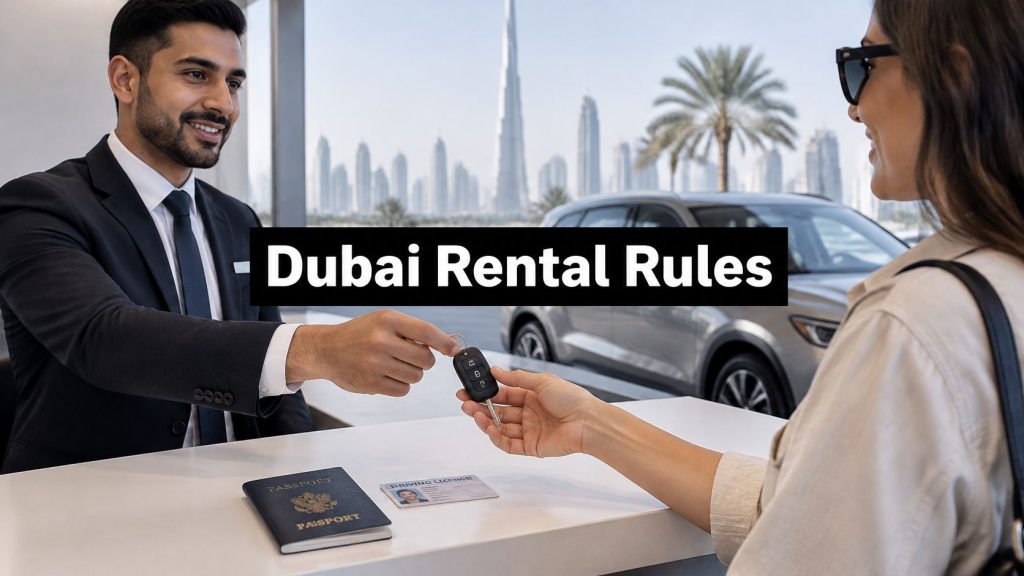
You're at a rental counter in Business Bay with a key fob in one hand and a two-page agreement in the other. The agent says the car is ready, the card machine is warm, and somewhere between the fuel gauge and the small print sits a set of rules that decides where you can drive, who is allowed behind the wheel, and what lands on your card three weeks after you hand the keys back.
Search for Dubai rental rules and you mostly get flats. Tenancy contracts, rent increases, eviction notices. All useful if you're renewing a lease. None of it tells you whether your UK licence needs an International Driving Permit, who pays the Salik tolls, or why a AED 400 hold turned into a AED 900 charge.
This guide covers the second case only. What to bring to collection, what the contract permits, what sits behind the insurance line, which charges can follow you home, and what to do in the first hour after a scrape in a mall car park.
Car Rental Requirements by Renter Type
A resident and a visitor arrive with different documents. Check your row before leaving for the rental branch.
| Renter type | Identity document | Driving licence | Payment and booking |
|---|---|---|---|
| UAE resident | Valid Emirates ID | Valid UAE driving licence | Valid credit card, full name exactly as shown on ID, current UAE address |
| Visitor to the UAE | Passport with visa page | Valid foreign licence and, where required, a valid International Driving Permit | Valid credit card, contact details |
UAE residents need a valid Emirates ID and UAE driving licence to rent. Visitors need a passport and visa, and both renter types need a valid credit card. Confirm which licence documents apply to your booking before you travel to the branch.
Prepare the file before collection. A booking application requires a copy of the passport with visa page, a copy of a valid UAE driving licence, a valid International Licence and a credit card. The reservation also requires your full name as shown on your ID and passport, contact details and a current UAE address. Check the requested documents with the rental company when booking, particularly if you are visiting.
Two renters, two different piles of paper
A UAE resident booking a weekend rental should have an Emirates ID, a valid UAE driving licence and a credit card. The reservation needs the renter's full name as shown on ID and passport, contact details and current UAE address. Check each detail against your documents before submitting the booking.
A visitor arriving from the UK on a tourist visa should have a passport with the visa page, a valid foreign licence and a credit card. Ask whether an International Driving Permit is required for your booking, and bring one if it is. Collect the car from the rental branch with the required documents ready.
Names must match. If your passport has three names but your reservation has two, ask for the booking to be corrected before collection. Check spelling across your documents too, especially if the name appears differently on your Emirates ID and passport.
Before leaving for the branch: have every required document with you, make sure it is valid, and check that the name matches your reservation.
Resolve missing documents or mismatches before collection. Confirm foreign-licence requirements when booking, since acceptance depends on the country that issued the licence.
Why Residential Tenancy Rules Do Not Cover Cars
The mismatch starts with the phrase itself. Much of what ranks for rental rules in Dubai describes residential tenancy law, where the Dubai Land Department tenancy guide sets out a framework built around registered leases and a rental index that governs certain residential rent increases. That framework answers questions about flats. It says nothing about the car you're about to drive.
Visitors and business travellers arrive with a different set of questions entirely. Which foreign licences are accepted. When an International Driving Permit is required. Who carries responsibility for Salik tolls and traffic fines. Which insurance exclusions apply. How and when a deposit is released. None of those are tenancy questions, and tenancy guidance cannot answer them.
The factors that really decide your position interact with each other: your nationality, the country that issued your licence, your visa status, the insurance on the vehicle, and the terms of the contract you sign. Change one and the answer can change. That's why "tourist versus resident" is too blunt a split to rely on.
Think of it as two rulebooks in one city. One covers homes and the people who lease them. The other covers cars and the people who drive them. You can be bound by both in the same week without the two ever overlapping.
Where to start: if you're hiring or driving a car, work through this guide. If you're renewing, disputing or ending a flat lease, the residential tenancy framework applies instead, and a car rental contract won't help you there.
This guide covers vehicle hire only. It doesn't address property tenancy, rent increases or eviction, and mixing the two is how people end up quoting the wrong rule at the wrong desk.
Licence and Driving Limits in Your Rental Contract
The agreement on the counter is a route permit as much as a payment document. It lists the roads you're allowed to use and the manoeuvres you're not.
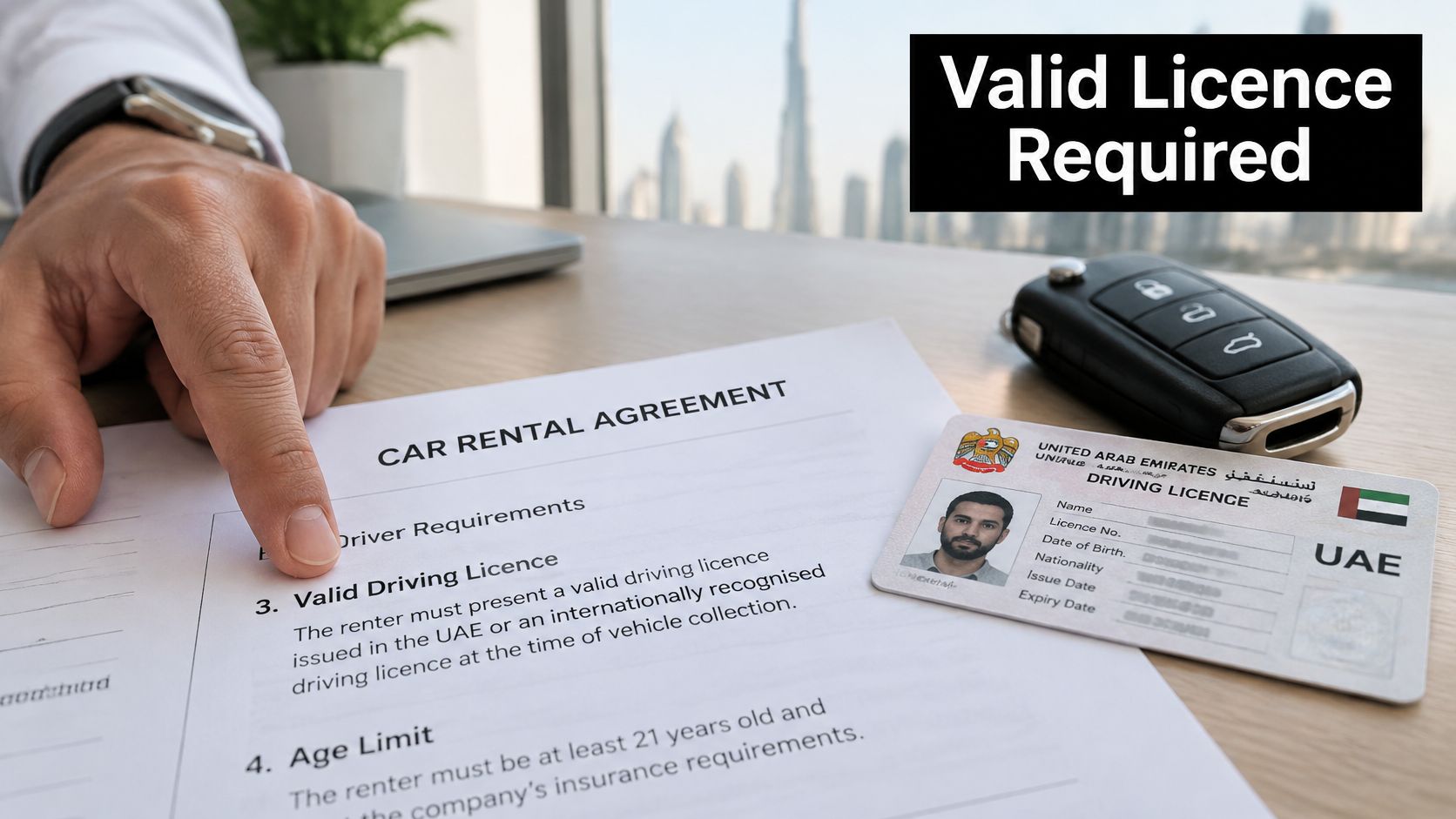
Start with the licence clause. You must hold a valid licence that matches the booking requirements, and where a foreign licence applies, it pairs with an International Licence if the booking asks for one. Our guide to International Driving Permit validity explains how the permit's dates need to sit against your visa and passport, which matters because a permit that expires mid-trip leaves you driving outside your own cover.
Where the contract stops you
Geography. Vehicles may only be used within the UAE unless prior written consent has been obtained. A weekend in Muscat or a drive to the Saudi border is not covered by a phone call on the morning of departure. Ask for written consent when you book, and keep the reply.
Purpose. Renters are prohibited from using vehicles for racing, off-road driving, towing or any unlawful activity. Taking a sedan onto desert dunes is the classic version of this mistake, and it usually ends with a recovery bill and a voided insurance claim rather than a warning.
Distance. Rentals carry a daily, weekly or monthly mileage limit, and exceeding it incurs additional charges. If your plan involves repeat trips to Abu Dhabi or a long loop through the emirates, work out the kilometres before you choose the package, not after.
Drivers. The contract defines who may drive the car. If a friend or colleague will take a turn at the wheel, confirm whether additional drivers must be named in the agreement. An unnamed driver behind the wheel is the fastest way to convert a valid rental into an unauthorised use.
Dubai treats permitted use as a regulated matter rather than a private arrangement. Operators must communicate the user's rights and obligations through the approved template and keep each vehicle authorised for the activity it's rented under, as set out in the implementing resolution for rental vehicles%20of%202018.html). That's the reason the permitted-use paragraph in your contract reads like a legal document. It is one.
Three questions to answer before you drive off: where will I drive, what will I drive on, and how far will I go. If any answer isn't in the contract, get it there in writing.
Insurance Cover Layers and How Excess Works
Basic cover is a legal floor. It is not full protection for the car you're driving.
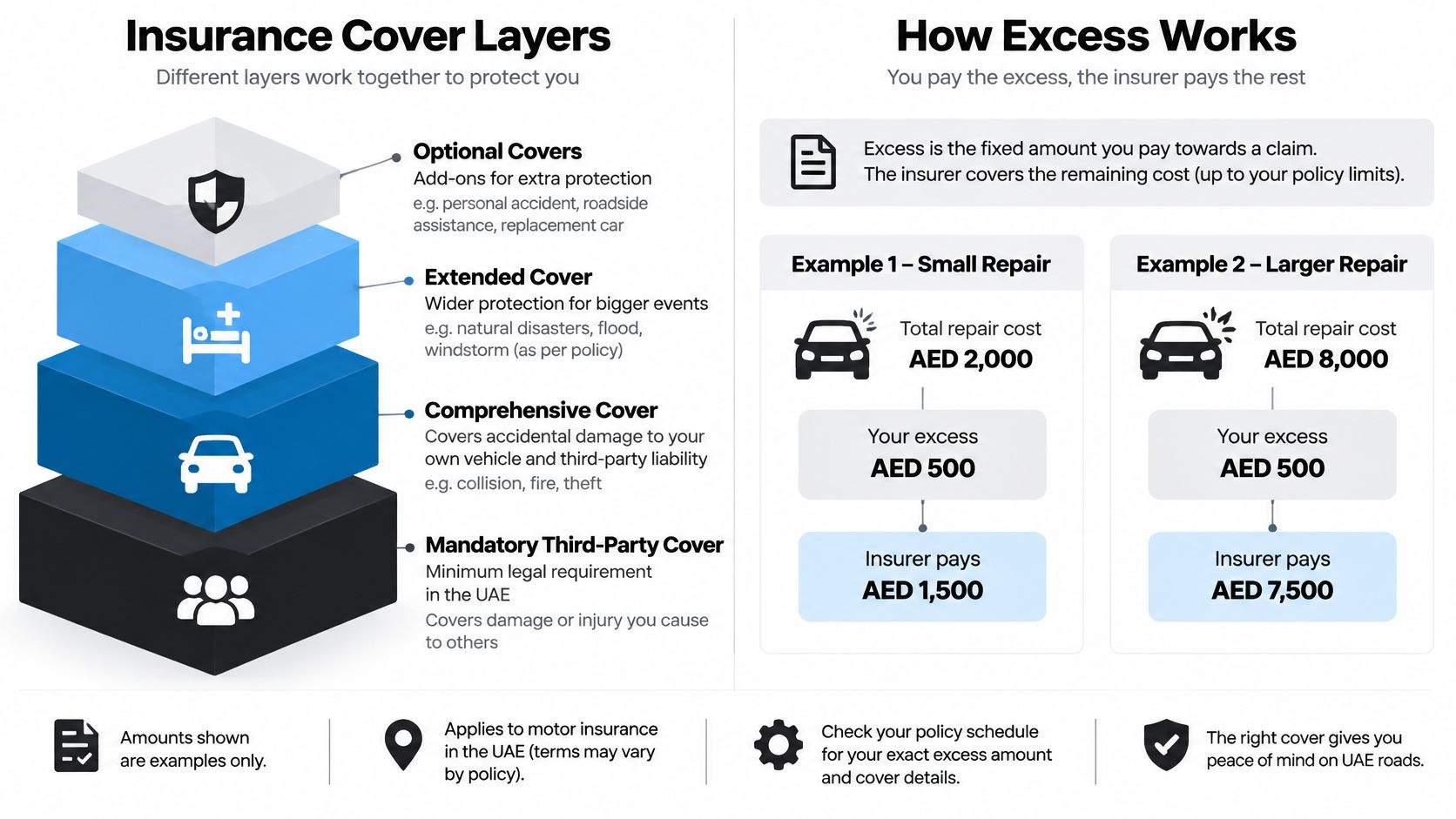
Every rental includes basic insurance required by UAE law, covering third-party liabilities. In plain terms, it pays for injury and damage you cause to other people and their property. It does not repair your rental car.
| Cover layer | Included in every rental | What it covers | What to check |
|---|---|---|---|
| Basic third-party liability | Yes, required by UAE law | Injury and damage to other people and property | Cover limit: the per-claim figure on your policy schedule, ask for it in writing |
| Damage to the rental car | Only where a damage waiver is included or bought | Own vehicle damage, subject to excess | Excess amount: the figure in the contract, before you sign |
| Optional damage cover | Optional, priced per day | Reduces or removes the excess, if offered | Cost and exclusions: the daily rate plus the list of what it won't cover |
| Personal policy from home | No, by default | Depends entirely on the policy wording | Confirm UAE use in writing |
Reading the excess line
The excess is the amount you pay before cover applies. It's a fixed figure, and it's the number that decides whether a small incident ruins a holiday.
Say a door gets scraped against a pillar in a hotel car park. On a policy with a high excess, you may pay that entire excess for a repair that costs less. Under reduced-excess cover, the same scrape costs a fraction of it. The repair doesn't change. The layer you bought does.
Exclusions decide claims, not the headline cover. Tyres, glass, the underside of the car, damage from off-road use and driving under the influence sit outside cover on many policies. Ask for the excluded items in writing. If a provider can't or won't list them, treat that as the answer.
Home insurance deserves its own check. A personal policy issued abroad may exclude a UAE rental, or cover it only up to a limit that a luxury car passes in the first repair. Confirm the position in writing before you rely on it.
Ask three questions of whoever hands you the keys: what is the third-party limit, what is the excess, and what is excluded. The answers tell you more about your exposure than any brochure. Our page on the collision damage waiver explains which layer you're buying when you add cover at the desk.
Deposits, Holds and Charges You Could Pay
You return the car, leave Dubai, then see a toll or traffic fine on your card statement. The rental contract determines which charges can still be passed on after drop-off, so check the fee schedule before signing.
| Charge | When it applies | Who pays | What to check |
|---|---|---|---|
| Security deposit or card hold | At pickup | Renter, held then released | Amount, release conditions and expected timing |
| Traffic fines | Offences during the rental period | Renter | Processing fee per fine |
| Salik road tolls | Each toll crossing during the rental | Renter | Processing fee per crossing or statement |
| Parking violations | Parking offences during the rental | Renter | Processing fee per ticket |
| Mileage overage | Beyond the daily, weekly or monthly limit | Renter | Charge per kilometre in the contract |
Renters are responsible for fines, Salik tolls, parking violations and other penalties incurred during the rental. Administrative fees may also apply. The penalty and the company's processing fee are separate charges, so ask for the fee schedule before you collect the car.
Charges that can arrive after drop-off
A toll crossing during the rental may appear on your statement later, along with a processing fee. A parking ticket issued shortly before return may also be processed after you have left the UAE. Ask how post-rental charges are handled and how long the card may remain open for them.
Confirm the deposit or pre-authorisation amount, its release conditions and the expected release timing in writing. A hold can affect how much credit you have available, so plan around the rental company's stated release process rather than assuming the funds will be available at drop-off.
A habit that settles arguments: photograph the odometer, fuel gauge and every panel at pickup, then repeat at drop-off. Timestamped photos help establish the car's condition and mileage at each handover.
If a key goes missing, report it to the rental company promptly and check the contract for the replacement procedure and charges. For general Top Motor Keys replacement key advice, follow the guidance on what to do when there is no spare.
For any charge raised after the rental, ask the company to identify the relevant contract clause and provide an itemised breakdown before you pay.
What to Do Step by Step After an Accident
Damage happens at low speed far more often than at high speed, and the first hour decides how the claim is treated. Here's the sequence, in order.
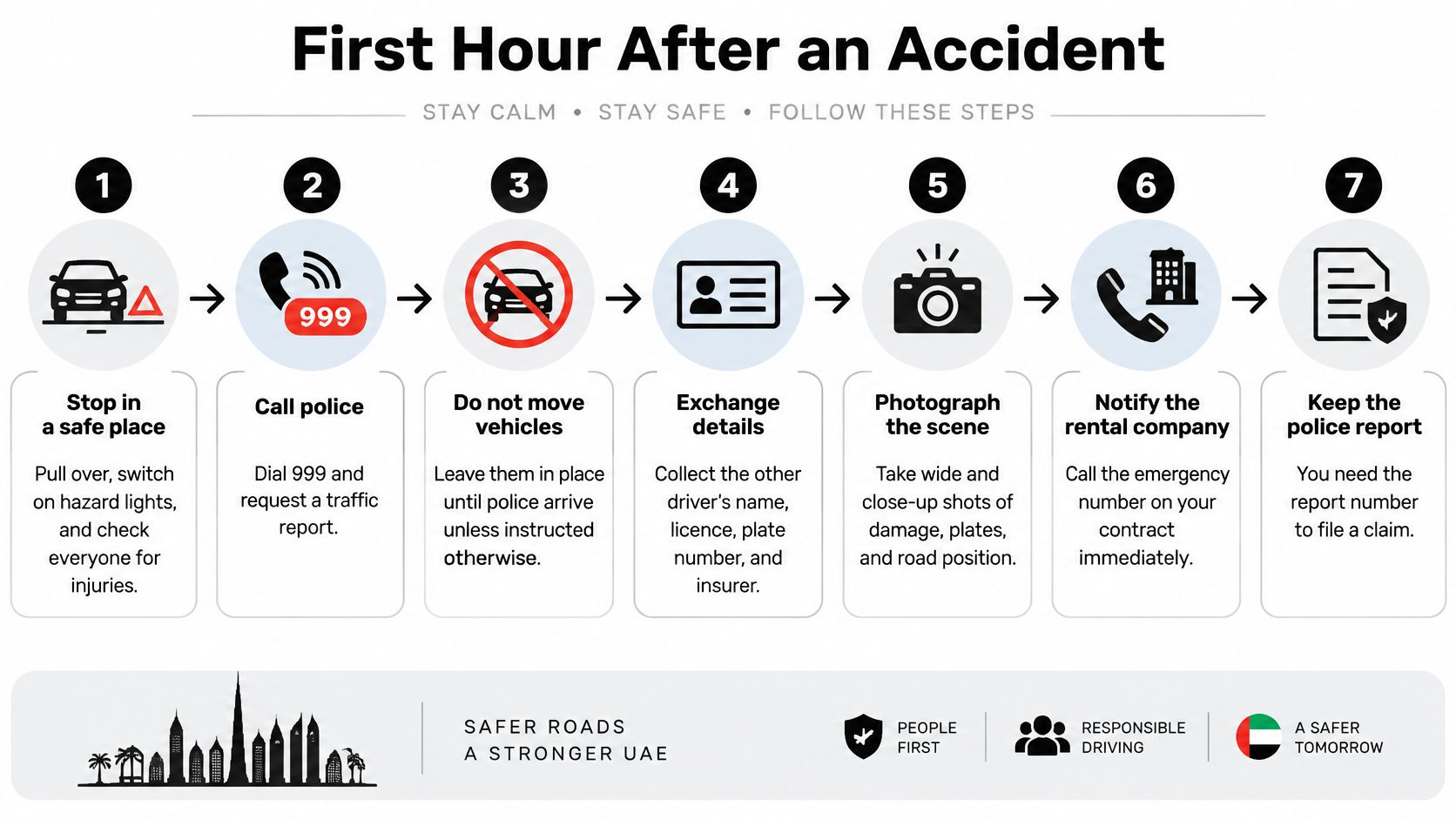
- Stop somewhere safe. Pull over, switch on the hazard lights and check everyone for injuries. Medical priority comes before paperwork, and a car stopped in a live lane creates a second incident.
- Contact the relevant UAE authorities so the incident is recorded. You need a report reference, not just a phone conversation. Our accident reporting procedure covers what that process asks of you at each stage.
- Notify us immediately. After an accident the renter must inform Uptown Rent A Car LLC and the relevant UAE authorities without delay. Early notice lets us log the incident, advise on the report and start the claim while memories are fresh.
- Photograph everything. Both vehicles, both number plates, close-ups of the damage, the road position and the surrounding signage. Photos taken in the first ten minutes carry weight that descriptions written the next day don't.
- Exchange details. Names, contact numbers, licence details and insurance information from the other party, plus the contact details of anyone who saw it happen. A witness who leaves the scene is a witness you no longer have.
- Don't accept fault on the spot. Decline to sign statements you haven't read, and don't agree to settle privately. Fault is determined through the proper process, and an admission at the roadside can undercut a claim later.
- Keep every document. Reports, reference numbers, photos and messages stay together in one place until the claim or excess dispute closes.
A low-speed contact in a mall car park shows why the order matters. Without photos and a report number, the excess comes out of your pocket with no route to challenge it. With both, there's a record the insurer can assess, which is the difference between paying and disputing.
Here's the same discipline demonstrated on video, from first response through to the report.
The documentation habit transfers across borders even when the law doesn't. A ten-step crash rights checklist from Lein Law Offices is written for a different legal system, but the underlying logic holds everywhere: the person with the clearest record keeps the strongest position.
Paperwork started in the first hour is easy. Paperwork reconstructed a week later rarely is.
Confirm the Terms Before You Book
Book only once the terms are confirmed in writing. Not described on a call. Written down, in the confirmation you keep.
Compare offers on the total, not the headline rate. Luxury car rental runs from AED 850 to AED 10,000 per day before VAT, and the tax adds 5% on top, so a daily rate needs the tax added before you can compare two quotes. Multiply by the number of days you'll keep the car, including the morning you fly out.
The pre-booking checklist
- Match the details exactly. Your reservation needs your full name as shown on your ID and passport, your contact details and a current address in the UAE. A missing middle name or a stale address is a counter delay waiting to happen.
- Compare the total, tax included, for every day of the rental. Add the excess, the deposit and any mileage overage you expect to incur.
- Ask for the money terms in writing. The insurance excess, the deposit amount, the release timing and the fee schedule for fines and tolls. Get them in your booking confirmation, not your memory.
- Check the driving limits. Travel outside the UAE needs prior written consent, so request it early if your itinerary crosses a border. Confirm the mileage cap for your package.
- Save the signed contract and contact details in one folder you can reach from your phone. That folder is what you'll open if a charge appears six weeks later.
One more check sits above all of them. Ask for the operator's permit to rent vehicles, not just a trade licence. Dubai treats vehicle rental as a regulated activity, an operator must obtain the relevant RTA permit before starting operations and renew it annually, and operating without it carries a listed fine of AED 5,000 under the implementing bylaw for the rental activity%20of%202022%20Issuing%20the%20Implementing%20Bylaw.html). A compliant operator answers that question without hesitation.
To put these questions to us before you book, call or WhatsApp +971 58 68 77777. Ask about the excess figure, the deposit release and the mileage cap in the same message, and keep the reply.
Why written beats verbal: a phone assurance is worth nothing during a dispute. A line in your booking confirmation is worth everything.
Clear terms before pickup prevent almost every surprise at drop-off. The counter conversation gets very short when the answers are already on paper.
Uptown Rent A Car puts the document list, the insurance terms and the deposit conditions in writing before you commit, so your collection is a signature rather than a negotiation. The fleet runs from executive sedans to the Rolls Royce Cullinan, with long-term rental rates starting from AED 250 per day and a clear breakdown of what sits inside the price. Send your dates, your licence details and the documents for your renter type through Uptown Rent A Car, and keep the confirmation that comes back.