
Forget the usual advice to rent the biggest, most powerful SUV you can afford in Dubai. That rule wastes money in the city and can still leave you stuck in soft sand. A heavy luxury crossover on road tyres isn't a desert vehicle, and a seven seater you don't fill just burns more fuel on Sheikh Zayed Road.
Choose SUV cars in Dubai by route first, then by passengers, luggage and total trip cost. Badge and horsepower come last. If the rental agreement bans driving off paved roads, that matters more than ground clearance, engine size or a premium interior.
SUV Classes in Dubai and Who Each One Suits
For most visitors, a mid-size or full-size SUV is the right starting point. SUVs aren't a niche luxury choice here. They're the default vehicle type.
Industry analysis reported by Truck and Fleet Middle East found SUVs typically represented about 40% to 45% of UAE passenger vehicle sales, while saloons and sedans accounted for roughly 35%. The same analysis estimated SUVs comprised 43% of approximately 3 million passenger cars less than 10 years old in operation in the UAE. Six SUVs appeared among the UAE's ten best-selling models, including five of the top five positions.
That dominance makes practical sense. You get passenger capacity and luggage space for airport transfers, a higher driving position for inter-emirate motorways, and enough clearance for desert-edge destinations on paved roads.
How to Read the Classes
Count passengers and large suitcases before you look at brands. Two adults with four hard-shell cases will usually outgrow a compact SUV, even if the seat count looks fine on paper. A family of five with a pushchair needs boot depth, not just a third row folded flat.
| Class | Typical seats | Best for |
|---|---|---|
| Compact SUV | 5 | Solo travellers and short city trips |
| Mid-size SUV | 5 | Couples, weekend coastal drives, light luggage |
| Full-size SUV | 7 | Families and airport transfers with large luggage |
| Full-size 4×4 | 7 | Desert excursions and mixed off-road routes |
| Luxury SUV | 5 | Events, executive travel and celebrations |
A compact SUV works for one or two people staying in the city, parking in malls and hotels, and carrying cabin bags. It's easier to place in tight basement car parks and usually cheaper to fuel.
A mid-size SUV suits couples who want more boot space for a coastal weekend without paying for unused seats. It's the class I'd start with for a short leisure stay.
Choose a full-size SUV when the third row or the luggage volume will really be used. Airport runs are the classic test. If everyone and every case must travel in one vehicle, don't gamble on a five seater.
Terrain and Occasion Classes
The full-size 4×4 class exists for terrain, not prestige. You choose it because the route includes firm tracks or, with the right specification and permission, sand. Size alone doesn't qualify a vehicle for that work.
Luxury SUVs suit executive arrivals, weddings, anniversaries and high-profile events where presentation matters. You're paying for cabin finish, ride comfort and presence. Don't assume that price buys off-road ability.
Match passengers and luggage to one row first. Then test that row against your route and your full trip budget.
Rates are indicative and rise in peak periods such as the cooler winter months, public holidays and major events. Always check the final quote for your exact dates, mileage allowance, deposit and delivery charges before you compare classes.
Renting Versus Buying an SUV in Dubai
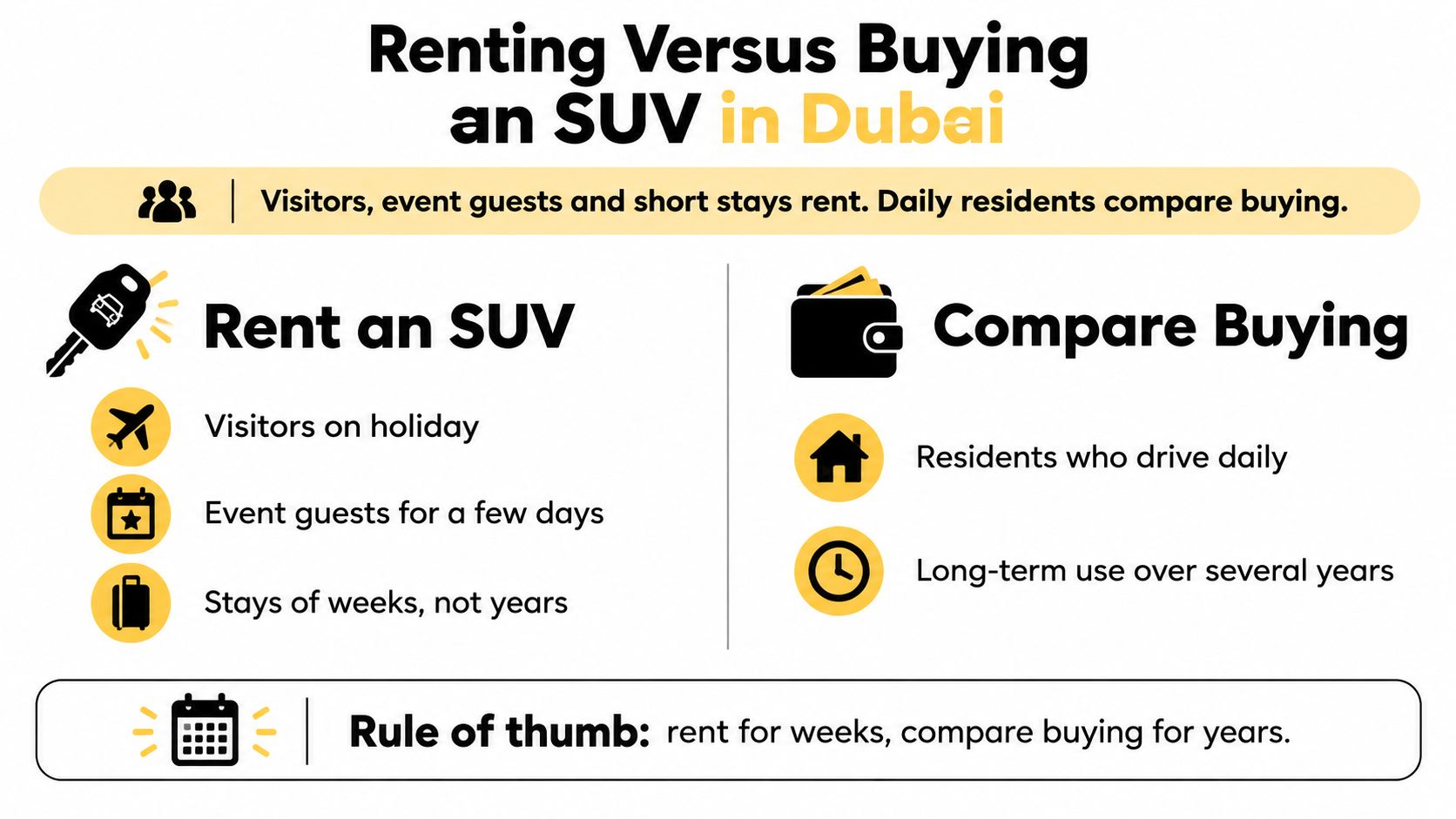
Use this decision rule. Visitors, event guests and anyone staying weeks rather than years should rent. Residents who need a car every day for a long period should compare buying.
Buying a used SUV is a mainstream route in Dubai, not an obscure bargain hunt. Mordor Intelligence's UAE used car market report reports SUVs held 37.78% of UAE used-car-market share by vehicle type in 2025, the largest category. It also reports Dubai represented approximately 56.84% of the UAE used-car market by value or market size.
That concentration means residents have real choice in full-size 4x4s, premium crossovers and luxury SUVs. It doesn't mean buying suits a short stay.
Side by Side
| Factor | Rent | Buy |
|---|---|---|
| Upfront cost | Low, pay per day | High, pay the vehicle price |
| Commitment length | Days to months | Months to years |
| Insurance and servicing | Covered under the rental terms | Your responsibility |
| Model flexibility | Change class or model for each trip | One car until you sell |
| Depreciation exposure | None for the renter | Value falls over time |
| Best fit | Visitors, events, short business stays | Residents needing daily use |
Upfront cost decides many short stays. Renting turns the vehicle into a daily expense. Buying ties up the full purchase price before insurance, registration and servicing.
Commitment is the second filter. A rental ends when you hand back the keys. An owned SUV still needs parking, maintenance and a buyer when you leave or change cars.
Insurance and servicing sit with the rental provider under the rental terms, although excesses and exclusions still apply. An owner arranges cover, schedules servicing, replaces tyres and handles repairs directly.
Flexibility favours renting. You can take a compact SUV for a solo business trip, then a seven seater when family visits. An owner lives with one compromise all year.
Depreciation doesn't touch the renter. It matters a lot to an owner, especially if the stay ends sooner than planned and the car must be sold quickly.
Practical rule: If the total rental cost for your stay approaches the cost of a used SUV plus its running costs, give buying a proper comparison. Below that point, renting is usually cleaner.
The same long-term maths applies in other big decisions, which is why tools that compare homebuying costs with The Money Maniac use total cost and time horizon rather than the monthly figure alone. Apply that thinking here. Add registration, insurance, servicing and resale effort to the purchase side.
Renting has its own trap. Daily costs accumulate over long stays, and mileage caps, deposits and fuel policies shape the true price. Residents who aren't ready to buy outright can also examine a lease to own SUV arrangement in Dubai and compare its full commitment with a standard rental.
For a short booking, book online, look for instant confirmation and current arrivals, then confirm deposit, mileage and insurance terms before paying.
Matching Your SUV to City Roads or Desert Sand
A large luxury SUV does not automatically make desert travel safe. That's the most expensive misunderstanding I see in SUV selection.
The SUV label, ground clearance and body size don't prove off-road capability. Dubai's official road safety guidance emphasises legal compliance and safe driving, while desert-driving guidance distinguishes genuine 4×4 capability from 2WD SUVs that can become stuck in soft sand. Road legality doesn't equal off-road suitability.
What Actually Creates Capability
All-wheel drive helps on loose but firm surfaces by sending power to all four wheels for grip. It suits graded tracks and wet or dusty paved roads. Many AWD crossovers still lack the gearing, underbody protection and tyre sidewalls for dunes.
Selectable 4WD with low-range gearing is different. Low range multiplies torque at low speed, so the driver can crawl through soft sand and climb without spinning the wheels excessively. That's the minimum mechanical basis for serious dune driving.
Tyres matter as much as the driveline. Low-profile road tyres on large alloy wheels have stiff, short sidewalls and limited ability to spread the contact patch when pressure is managed for sand. Proper off-road tyres tolerate that work better and resist damage.
Recovery points must be rated and accessible. A decorative tow eye or a bumper mount isn't a substitute. If another vehicle can't pull you out safely, you're not prepared.
Driver experience decides whether the hardware helps. Reading sand, choosing momentum, avoiding sharp turns on a slope and knowing when to stop are skills. A powerful engine can't replace them.
Minimum Vehicle by Terrain
| Terrain | Minimum vehicle | Extra requirements |
|---|---|---|
| City roads only | Any SUV on road tyres | Valid insurance and rental terms |
| Paved desert road | Any SUV with good clearance | Check the rental permits any road beyond pavement |
| Firm desert tracks | AWD or 4WD with suitable tyres | Written permission from the rental provider and a planned route |
| Soft sand and dunes | Selectable 4WD with low-range gearing and off-road tyres | Written permission, recovery kit, experienced driver, convoy, daylight only and working emergency communication |
City-only driving is straightforward. Any properly insured SUV on road tyres works, provided the size suits your parking and luggage.
A paved desert road is still a road trip. Good clearance helps with uneven access points and sand blown across the surface, but you don't need low-range gearing while you stay on pavement.
Firm desert tracks are the grey area. The surface can change after wind or traffic, so AWD or 4WD, suitable tyres and a planned route become the minimum. Families loading coolers, chairs and recovery boards can use gear hauling tips for family adventures to organise cargo so heavy items stay low and secured.
Soft sand and dunes require a different standard. You need tyre-pressure management, recovery equipment, convoy planning, daylight limits and emergency communication. Don't enter dunes alone, near sunset, or without telling someone your route.
A heavier, pricier road-focused crossover can be the worse desert choice. Extra weight sinks into sand, road tyres dig, and expensive bumpers reduce approach angles. A properly equipped 4×4 with suitable tyres and an experienced driver can be safer and more capable.
Before you leave paved roads, get written confirmation that the rental allows it and that insurance applies there. If you're unsure, choose from vehicles arranged for desert safari use or travel with an organised driver rather than testing a standard rental in sand.
Popular SUV Models Dubai Drivers Actually Choose
Pick the model by the job it has to do. Family transport, desert trips, executive arrivals and event presence lead to different shortlists, even when seat counts look similar.
Newer brands are also changing the market. According to AutoData Middle East's used-car market report, Jetour's UAE sales increased 163.9% in the first half of 2025, while its T2 SUV sales rose 212.2%. Familiar badges still dominate many rental fleets, but they no longer own the conversation.
Six Models to Shortlist
| Model | Class | Why drivers pick it | Rent or buy note |
|---|---|---|---|
| Toyota Land Cruiser | Full-size 4×4 | Desert capability and seating for seven | Check tyre condition and off-road permission before booking |
| Nissan Patrol | Full-size 4×4 | Large cabin and strong off-road reputation | Compare fuel policy, since big engines drink fuel |
| Toyota Fortuner | Full-size SUV | Seven seats for families at a practical price | Good value for longer rentals and family trips |
| Range Rover Sport | Luxury SUV | Event and executive presence | Expect a higher deposit and stricter insurance terms |
| Mercedes-Benz GLE | Luxury SUV | Comfort on long highway drives | Check mileage caps for inter-emirate trips |
| Jetour T2 | Mid-size SUV | Fast-growing choice among UAE buyers | Compare purchase price with rental rates for longer stays |
The Land Cruiser and Patrol earn their place when seven seats and genuine 4×4 hardware both matter. Even then, inspect the individual vehicle. Worn tyres or a rental ban on sand can remove the advantage.
The Fortuner is the practical family option. It gives seven seats without the deposit and daily rate often attached to luxury models, which helps on longer rentals.
The Range Rover Sport is bought with the eyes as much as the itinerary. For weddings, executive arrivals and celebrations, that presence can be the point. Budget for stricter terms and don't confuse its image with permission to dune drive.
The Mercedes-Benz GLE suits long, comfortable highway work between emirates. Mileage caps matter here. A low headline rate stops looking attractive if your Abu Dhabi return trip triggers excess distance charges.
The Jetour T2 shows why buyers now cross-shop newer brands against established names. For longer stays, compare purchase price, warranty and resale expectations with the rental total rather than judging by badge familiarity.
Fuel use should be part of that comparison, especially for big petrol models. The principles in this Jeep efficiency guide for DIY owners on driving style and maintenance apply broadly to heavy SUVs, even though your rental provider handles servicing.
Shortlist two or three models in your class, then test each one on terrain permission, deposit, mileage and fuel policy. A model name is a shortlist item, not a verdict. Trim, year, tyres and the exact agreement attached to that vehicle decide whether it's right.
What a Dubai SUV Trip Really Costs
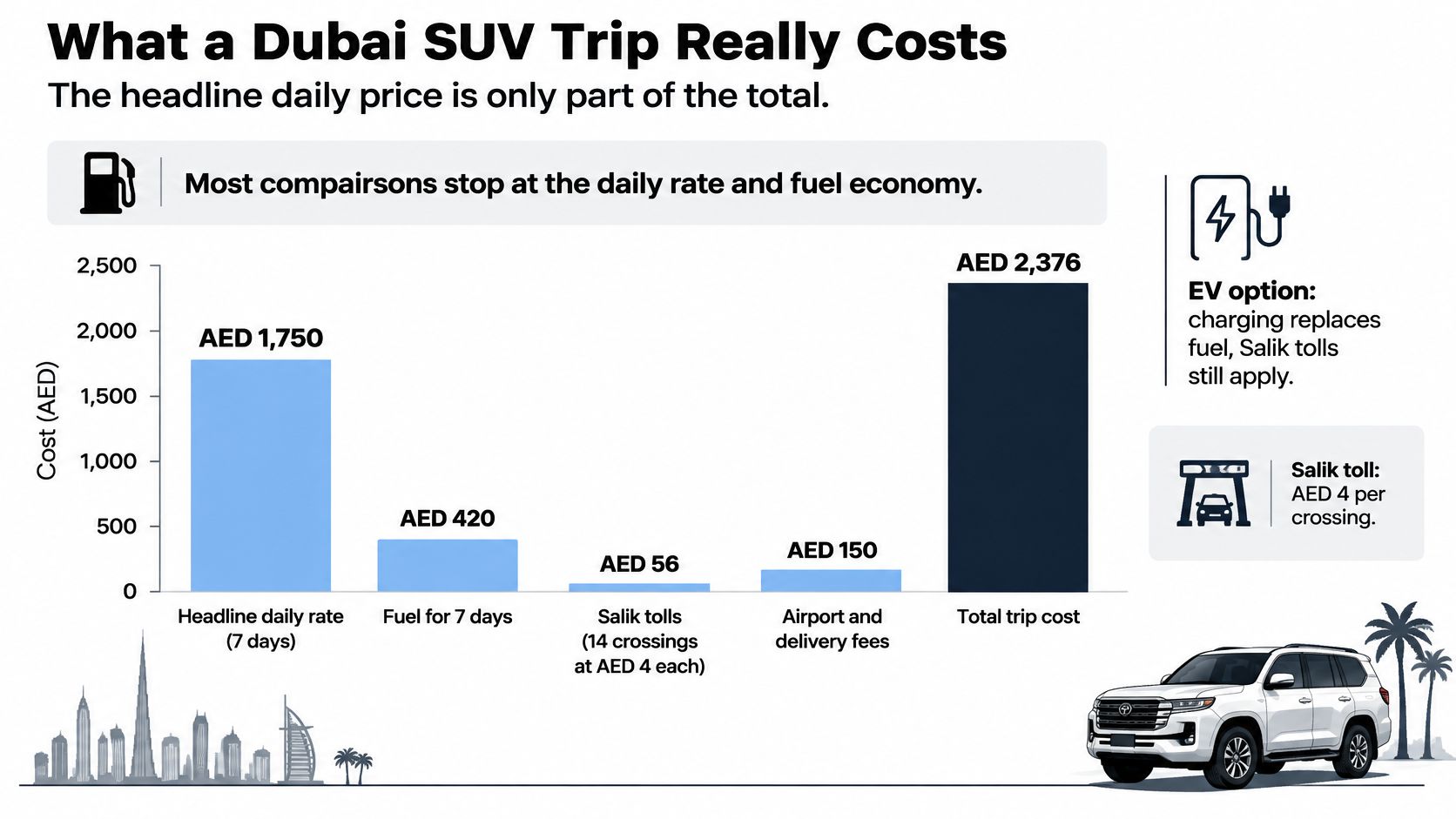
A low daily rate can still produce an expensive trip. Toll gates, parking, energy, luggage arrangements, cleaning and recovery all affect the final bill. Compare SUVs against the route you plan to drive, not just the rental price or badge.
The Four Itineraries to Price
Airport to hotel. Check delivery or collection fees, luggage capacity, parking and any Salik gates along the route. A smaller SUV may cost less per day, but that saving disappears if the group needs a second vehicle or separate luggage transfer.
Business meetings across toll gates. Count crossings, not just kilometres. UAE government roadway information states that Dubai's Salik system charges vehicles passing through toll gates, with charges varying by time. It also states that 5% VAT applies to toll transactions from 1 June 2026. Treat that as applying from the stated date, not as a current charge before then.
Weekend coastal travel. Budget for fuel or charging, hotel parking and mileage. Use the current petrol price in the UAE to estimate fuel for the planned distance, then check whether the rental's mileage limit could add a charge.
Desert excursion. Include post-trip cleaning and a recovery contingency, but only if the rental terms permit the planned driving. A large badge does not mean the SUV is suitable for sand, and a 4×4 is not enough if the rental agreement prohibits off-road use. If recovery is not covered or arranged, keeping the vehicle on paved roads may be the lower-risk choice.
Petrol Versus Electric on a Real Route
Public charging has expanded across Dubai, and SUVs and crossovers make up a large share of EV demand in the UAE. For a rental, the practical question is where the chargers are on your route, how long the vehicle will be parked, and whether charging fits the schedule.
A charger nearby is not automatically convenient. You need enough dwell time and a workable alternative if the station is busy. Petrol refuelling is quick and widely available, which can matter more than an EV's lower energy costs on a tight schedule with meetings across the city.
Remote desert travel changes the calculation. An electric SUV may suit hotels, offices and malls but be a poor match for a route far from charging and recovery support. Match the vehicle to both the terrain and the available infrastructure.
A Worked Two Day Example
Suppose a visitor lands in Dubai, transfers to a hotel, attends two business meetings that each involve crossing two toll gates per day, then takes a coastal drive. Count the Salik crossings each day and multiply them by the operator's rate for the relevant time band. Add hotel parking for both nights, fuel or charging for the planned distance, and cleaning or recovery costs if permitted sand driving is part of the itinerary.
Then price the same route in a smaller class. If it carries every passenger and bag, the lower rental cost is a genuine saving. If it means booking another airport car or leaves too little boot space, the larger SUV may cost less overall.
The cheapest SUV depends on the route, not the badge.
Calculate daily rate plus Salik plus parking plus energy plus contingency to compare the full trip cost across classes. Include off-road permission in the decision: a rental that cannot legally or contractually take your planned route is not a suitable bargain.
Book the Right SUV Step by Step
Choose an SUV by the route it must handle, then check whether the full trip fits your budget. A prestigious badge cannot compensate for insufficient seats, luggage room or off-road permission. Work through these checks before booking.
Three Questions Before You Book
- How many passengers and bags are travelling? Count adults, children, child seats and large cases. This determines the class you need. A third row used for passengers cannot also provide the same space for luggage.
- Where will the car actually drive? List city roads, paved desert roads, firm tracks or dunes. Match the vehicle to the toughest planned surface, and get written permission before driving off paved roads.
- How many days and what total budget? Include tolls, parking, energy, deposit and any possible cleaning costs. A low daily rate can still lead to a higher trip total.
Some requirements compete. If your family wants both dune trips and a luxury badge, first choose a vehicle that is suitable for the terrain and permitted for the route. Then select the most luxurious option within that capable group and your budget.
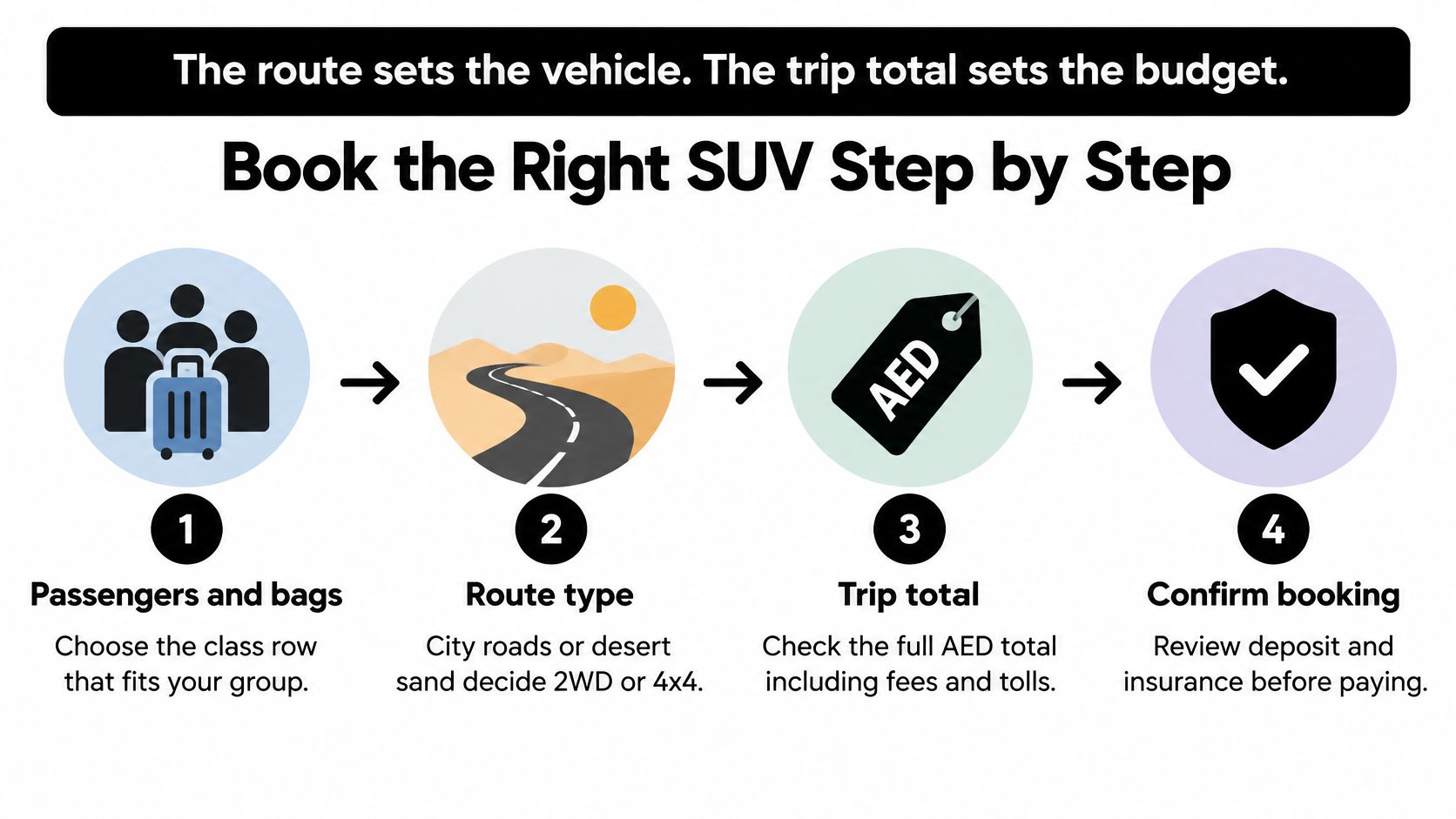
The Booking Routine
Choose the class based on passengers, luggage and terrain. Use the most demanding part of the itinerary, not an average day. If an airport transfer needs seven seats and an excursion needs low-range 4WD, the SUV must meet both requirements. Otherwise, change the plan.
Get the operating terms in writing. Confirm insurance cover and excess, mileage cap, fuel or charge policy, Salik handling, and whether off-road driving is allowed. A verbal approval may not protect you if the vehicle needs recovery.
Check driver requirements and upfront costs. Confirm licence acceptance, minimum age, deposit amount and release timing, and any additional-driver fees. Do this before paying, particularly when booking a premium SUV with stricter terms.
Book and save the confirmation. Uptown Rent A Car offers online booking with instant confirmation and quotes rates starting from AED 250 per day across its fleet, with the final price confirmed in the quote. Save the confirmation, terms and vehicle-class details offline so they are available at handover.
Inspect the SUV at handover. Photograph each panel, wheel and the windscreen in good light. Record the dashboard mileage and fuel or charge level, test the air conditioning, and make sure existing marks are noted on the inspection form before driving away.
Check tyres when cold. Driving and hot road surfaces raise tyre pressure, so check it before a journey and follow the manufacturer's door-placard specification. The RTA Driving Safely in Dubai handbook says tyres must be maintained at safe pressure and tread depth, with a minimum tread depth of 1.5 mm.
Under-inflation increases sidewall flex, rolling resistance and heat. Over-inflation reduces the contact patch and can affect braking and ride stability. Do not release air from hot tyres to reach the cold-pressure figure. Recheck before returning the vehicle, especially after extended highway driving or permitted desert use, when a loaded SUV puts added stress on its tyres.
Return the vehicle in the agreed condition. Match the fuel or charge level, remove sand and personal items, and photograph the SUV again. Get a signed return check recording mileage, fuel or charge, and condition before the deposit release process begins.
Reserve the right class early for holiday weeks and major events. Popular classes can sell out and prices can change, leaving fewer suitable options. Booking the right size and driveline early is better than upgrading later to a heavier SUV that still cannot handle the route.
Choose a class that fits your passengers and luggage, confirm off-road permission in writing, and compare the full itinerary cost before committing. Browse the SUV fleet and book online with Uptown Rent A Car, which offers instant confirmation for city travel, executive trips, celebrations and longer Dubai stays.