
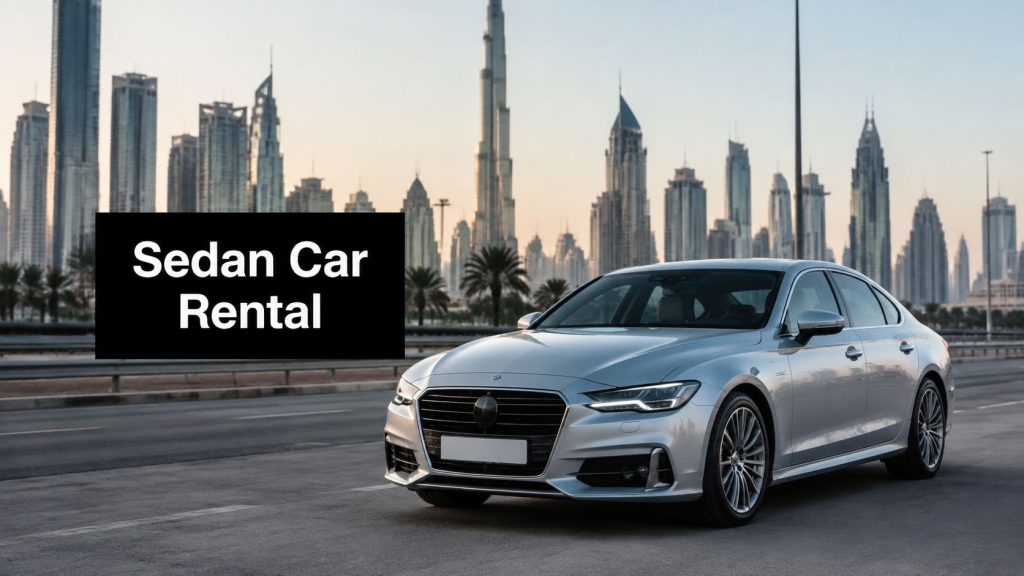
A quality sedan car rental in Dubai typically starts around AED 250 per day, while executive and hybrid sedans sit higher in the range. That price is the sensible benchmark for a clean, well-presented car, but the final deal depends on the vehicle tier, booking channel, deposit terms, insurance and mileage limits.
A regional manager landing at DXB on a Sunday morning may have a Jebel Ali meeting at 11, luggage in the boot and no interest in looking underprepared in front of a client. An SUV would work, but it can be unnecessary for one driver, one passenger and city roads. A small hatchback may save money, but it won't always deliver the comfort or presence expected for executive travel.
The practical decision is simpler than most rental pages make it. Choose the right body type, select the correct sedan tier, compare direct and marketplace booking terms, prepare the required documents, then inspect the car before accepting it. Dubai's rental market is large enough that a transparent contract matters as much as the daily rate.
Why a Sedan Makes Sense in Dubai Right Now
A sedan remains Dubai's most practical executive default because it balances appearance, comfort, fuel use and manoeuvrability. Quality sedan car rental in Dubai starts around AED 250 per day, with executive and hybrid models priced above that entry point. Uptown Rent A Car states that its luxury rental options start from AED 250 per day, which gives buyers a useful reference point when comparing a basic sedan with a more polished executive vehicle. You should also factor fuel costs into the budget, using a current UAE petrol price reference rather than judging the rental by the headline rate alone.
The market supports this choice. Dubai's total rental fleet reached 71,040 vehicles in 2024, up from 49,725 in 2023, while active rental companies rose to 3,494 from 2,627. The Roads and Transport Authority's announcement records 867 new companies registered in one year and describes a fleet increase of about 42.9% year over year. That expansion gives renters more choice, but it also makes careless comparisons easier. A low price may hide an older model, a restrictive mileage allowance or a large security hold. Dubai's RTA fleet and company figures show a market with real operating scale, not a small niche.
Make five decisions before you book
- Body type: Pick a sedan when your driving is mainly urban, airport-based or business focused.
- Tier: Economy works for solo travel, while executive models make more sense for client-facing journeys.
- Booking channel: Compare direct pricing with marketplace totals, including deposits, mileage and cancellation terms.
- Documentation: Confirm that your licence and identification are accepted before the vehicle is reserved.
- Final inspection: Photograph the car, test the air conditioning and record existing damage before departure.
Dubai's hybrid taxi transition reinforces the sedan's operational role. Toyota Camry hybrid sedans delivered about a 33% improvement in fuel efficiency and CO2 emissions, with approximately AED 12,000 in savings per vehicle, according to reporting on the Dubai taxi fleet. The Camry hybrid efficiency and saving figures are especially relevant to high-use rental operations, where stop-start city driving quickly exposes inefficient powertrains.
What Counts as a Sedan in the Dubai Rental Market
In Dubai rental language, a sedan normally means a four-door car with a separate boot and a low-to-mid ride height. It sits lower than an SUV, offers more conventional passenger access than a coupe and provides a more formal profile than a hatchback. Examples range from compact cars such as a Nissan Sunny or Toyota Corolla to larger cars such as a Nissan Altima or Toyota Camry.
The distinction matters because the body shape changes how the car behaves in daily Dubai use. A sedan's lower floor makes airport luggage loading straightforward, while its smaller height and footprint help in hotel, office and residential parking. An SUV offers more clearance and a taller seating position, but its extra bulk isn't useful for every city journey. A hatchback is convenient for short stays and light luggage, while a coupe prioritises style over rear-seat access.
Match the body to the job
For Sheikh Zayed Road commutes, airport transfers and DIFC meetings, a sedan is the cleanest default. It gives the driver a stable motorway feel and a separate boot for luggage, documents or samples. For family logistics, bulky shopping or routes near desert edges, an SUV becomes more sensible because its height and cargo opening are easier to use. A hatchback suits an intern or solo visitor making short urban trips. A coupe works for a weekend booking where image matters more than rear-seat practicality.
Practical rule: If you don't need extra ground clearance, a third seating row or a tall cargo opening, don't pay for an SUV.
| Body Type | Best Use Case | Parking Footprint | Typical Daily Range (AED) |
|---|---|---|---|
| Sedan | Airport runs, city driving and executive meetings | Compact to moderate | Varies by model and package |
| SUV | Families, larger luggage and routes requiring more clearance | Moderate to large | Usually above comparable compact sedans |
| Hatchback | Short urban stays and light luggage | Small | Often below mid-size sedans |
| Coupe | Style-led leisure and weekend driving | Small to moderate | Usually higher than practical compact cars |
The market is competitive, so labels can be loose. Ask whether the quoted car is a compact, mid-size or full-size sedan, and request the exact model or an equivalent category in writing. “Sedan” alone doesn't tell you whether you'll receive a basic commuter car, a comfortable business vehicle or a premium cabin.
The Real Benefits of Choosing a Sedan
Sedans work in Dubai because their strengths line up with the way many renters drive. They handle airport roads, office districts, hotel approaches and long motorway stretches without the footprint of a large SUV. Their separate boots also keep luggage and business materials out of the passenger cabin, which is a practical advantage when you move between meetings.
The market's fleet expansion supports availability. Dubai's rental fleet reached 71,040 vehicles in 2024, compared with 49,725 in 2023, according to the RTA's commercial vehicle update. The data covers the total rental fleet, not a sedan-only inventory, so don't treat it as proof that every operator holds a particular sedan model. It does show why sedans remain a foundational category in a deeper, more mature rental market.

Why hybrid sedans deserve attention
Dubai's taxi operators provide a useful real-world comparison. Toyota Camry hybrid sedans delivered about a 33% improvement in fuel efficiency and CO2 emissions, alongside roughly AED 12,000 in savings per vehicle, as reported in coverage of the taxi fleet transition. The Dubai Camry hybrid figures show why a hybrid can make operational sense when a car spends much of its time in stop-start urban traffic.
For a rental customer, the benefit isn't just environmental. Better efficiency can reduce fuel spending across a busy itinerary, while the sedan format remains easier to park and less imposing than many SUVs. A hybrid may also feel calmer in traffic, especially when the powertrain handles low-speed movement smoothly. Don't assume every hybrid automatically offers a lower total cost, though. A higher rental rate can offset fuel savings on a short booking.
Sedans also suit corporate travel. The boot separates client materials from passengers, the rear bench can accommodate a colleague comfortably, and the lower profile presents a professional image without the visual excess of a large luxury SUV. Those details matter when the car is part of a business itinerary rather than merely transport.
The trade-off you shouldn't ignore
A sedan has less ground clearance and a less versatile load opening than an SUV. Large suitcases can be harder to stack, and rough access roads are less comfortable. If your booking involves bulky equipment, several passengers or routes where clearance matters, choose an SUV instead. For normal Dubai road use, the sedan's lower footprint is usually the better trade.
Sedan Tiers and Typical Price Bands
A useful rental comparison starts with the car's job, not its badge. Economy sedans are built for efficient movement, executive sedans add cabin finish and presentation, and hybrids add powertrain efficiency at a higher rental position. Dubai market summaries commonly place sedan rentals around AED 90 to AED 150 per day, but that figure shouldn't be treated as a universal quote. A quality, professionally presented sedan from a premium-oriented operator may start around AED 250 per day, while executive models can sit substantially higher.
The difference comes from more than leather or a larger engine. Model year, insurance terms, deposit size, mileage allowance, availability, seasonality and booking channel all influence the final price. Compare the complete rental rather than selecting the smallest daily number.
Choose the tier that matches the itinerary
| Tier | Daily Price Range (AED) | Example Models | Comfort Level | Best For |
|---|---|---|---|---|
| Economy | From 250 at premium-oriented operators | Toyota Yaris, Hyundai Accent | Practical | City errands, solo travel and budget-conscious visitors |
| Mid-size | Varies by model and contract | Nissan Altima, Toyota Camry | More spacious | Airport transfers, longer drives and business travel |
| Executive | Higher than standard sedans | Mercedes C-Class, BMW 3 Series, Genesis G70 | Refined | Client meetings, corporate travel and special occasions |
| Hybrid | Premium position versus petrol equivalent | Toyota Camry Hybrid, Lexus ES Hybrid | Quiet and efficient | High-use city itineraries and efficiency-focused renters |
A Toyota Yaris or Hyundai Accent can be the right answer when you need straightforward transport and don't carry much luggage. A Nissan Altima or Toyota Camry earns its higher position through extra cabin space and a more settled motorway experience. Mercedes C-Class, BMW 3 Series and Genesis G70 models target a different brief, where presentation and cabin quality justify the spend.
Hybrid sedans deserve a separate comparison because they combine efficiency with a premium price position. Don't pay more because the word “hybrid” appears in the listing. Ask for the petrol equivalent, expected fuel policy and total booking price, then decide whether your driving pattern gives the efficiency advantage enough time to matter.
Weekly and monthly packages can change the calculation significantly, especially when a vehicle is needed for a work assignment or extended visit. Request both the daily and longer-term quote, and confirm whether mileage, servicing, insurance and replacement-vehicle provisions change with the package. Uptown Rent A Car lists sedan-specific options, including mid-size and luxury sedan monthly packages, so it can be one direct comparison point when reviewing longer bookings.
Booking Requirements and Inspection Standards
A smooth sedan car rental booking begins before you arrive at the desk. The operator should confirm the required driver's licence, passport or Emirates ID, payment card and insurance position before issuing the reservation. UAE residents generally need a valid UAE licence, while visitors must confirm whether their home licence or an accepted international driving permit is sufficient for the vehicle and rental provider.
Operators commonly apply an age threshold of 21, with additional conditions or surcharges for drivers below 25. Because eligibility and pricing policies vary, ask for the rule in writing rather than assuming that a valid licence guarantees the same rate. You should also understand how the security hold works. A card pre-authorisation may remain unavailable until the rental closes and the operator confirms that no damage, fines or additional usage charges apply.
Follow the booking workflow
- Upload documents: Provide the requested licence and identity documents through the operator's secure process.
- Confirm driver eligibility: Check age rules, additional-driver terms and any required permit.
- Review the payment hold: Ask how much will be pre-authorised, when it will be released and what can delay release. Review the provider's credit card requirements before collection.
- Select cover: Third-party liability is mandatory, while collision damage waiver and theft protection are common optional protections.
- Receive confirmation: Keep the digital booking record, price, vehicle category, collection details and contract conditions together.

Treat inspection as part of the rental
Dubai RTA technical inspection requirements affect vehicle availability and fleet planning. The RTA requires a booked technical inspection appointment at emirate testing centres, and the certificate is issued electronically after the vehicle passes. Booking became mandatory across Dubai technical testing centres from 2 June 2025, according to the RTA technical inspection service information.
At collection, photograph every existing mark, including wheels, bumpers, mirrors and glass. Test the air conditioning, check tyre condition and look for dashboard warning lights before you leave. If the car's actual condition differs from the handover record, ask the agent to amend the record immediately. A short inspection protects both sides and prevents an argument at return.
Best Use Cases for a Dubai Sedan Rental
A sedan earns its place when the route is clear, the passenger count is controlled and parking matters. In Dubai, these use cases justify the category. They also show when paying the AED 250-and-up Dubai price band makes sense, and when a smaller car or SUV is the better decision.
DIFC to Dubai Airport executive transfer
A typical executive transfer starts in DIFC, continues through Sheikh Zayed Road and ends at DXB. A mid-size or executive sedan gives a client a quiet cabin, a proper boot for luggage and a smaller footprint for office and hotel access. For one or two passengers, an SUV adds bulk without improving the transfer.
Set the departure around the meeting schedule, not the advertised journey time. Leave earlier during weekday business traffic and allow extra time for terminal access. At DIFC, confirm the building's designated pickup point before collection. Many towers use controlled entrances or valet areas, so stopping at the nearest road may create an avoidable delay.
At the airport, follow the terminal's designated drop-off lanes and do not treat kerbside waiting as free parking. If you must park at the office before the transfer, use the building's visitor or valet facility and keep the ticket. Dubai parking rules and building policies vary, so the rental company cannot absorb a charge caused by informal stopping.
For a simple cost comparison, compare the sedan's daily rental with the cost of separate private transfers for the meeting and airport journey. A sedan becomes more practical when it also covers hotel access, client movements and return travel during the same booking. A chauffeur service may suit a single transfer, while a self-drive sedan gives better value across a full business day.
Takeaway: Choose a sedan for DIFC to DXB when the booking combines executive presentation, luggage and several movements. Plan the pickup point and parking before collection.
Airport to hotel transfer
You arrive at DXB with a suitcase, a laptop bag and hotel check-in ahead. A sedan offers easy entry, a dedicated boot and a smaller parking footprint at the property. A compact model suits one or two passengers with moderate luggage. Choose a mid-size sedan when two business travellers need rear-seat space or the route continues directly to a meeting.
Takeaway: Use a sedan for a controlled airport transfer without paying for SUV bulk.
Client meetings in DIFC or Business Bay
An executive sedan gives a client-facing arrival a polished cabin and a more formal profile than an economy hatchback, while remaining easier to place in tight office parking than a large SUV. Confirm the exact model category, model year, colour availability and collection timing. “Luxury sedan” is too vague for a scheduled presentation.
Takeaway: Select an executive sedan when comfort and arrival impression matter.
Weekend drive towards Hatta or Jebel Jais
A sedan suits paved routes with two passengers and light luggage, provided the agreement permits the destination. Check inter-emirate insurance and restrictions on mountain or unpaved roads. Choose an SUV for rough tracks, heavy equipment or several passengers.
Takeaway: Keep the sedan on paved weekend routes.
Weddings and formal events
An executive sedan provides easy passenger access, a separate boot and a restrained profile outside hotels, venues and residences. Confirm exterior condition, interior cleanliness, collection timing and whether decoration is permitted. Book the executive tier when photographs and guest arrival form part of the occasion.
Takeaway: Choose an executive sedan when the vehicle contributes to the event, not merely the journey.
Five Final Checks Before You Sign the Agreement
A low daily price means little if the contract leaves the important charges vague. Before accepting a sedan, put these five points in writing and walk away from any operator that won't explain them clearly.
1. Check the daily and kilometre allowance
Look for the included mileage, excess-kilometre rate and any separate daily cap. A quote that appears attractive can become expensive when the itinerary includes airport transfers, business districts and inter-emirate driving.
Ask the agent to calculate the expected total for your planned use. Don't accept “unlimited” verbally. The contract should state whether unlimited mileage applies to the full rental period, a particular vehicle tier or a specific travel area.
2. Confirm insurance for the actual route
Third-party liability is mandatory, but that doesn't answer every risk question. Ask whether the quoted protection includes collision damage waiver, theft protection and inter-emirate travel to Abu Dhabi or Sharjah.
Demand clarity: The insurance section should identify exclusions, excess amounts, prohibited uses and the driver's responsibilities after an incident.
A sedan for a Dubai-only commute has a different risk profile from a vehicle travelling between emirates or heading towards mountain roads. Match the cover to the itinerary, not to the sales description.
3. Verify the exact model and model year
“Toyota Camry or similar” gives the operator flexibility, but it doesn't give you certainty about cabin condition, equipment or comfort. Request the confirmed model, model year and replacement category. A Toyota Corolla-style sedan and a Camry may both be sedans, yet they serve different executive needs.
If the booking is for a client, wedding or airport meet-and-greet, model substitution can affect the entire experience. Put the promised category in the reservation record and photograph the vehicle at collection.
4. Establish Salik and traffic-fine liability
Ask who pays Salik charges, how the operator records them and when they appear on the final invoice. The same applies to parking, traffic fines, administrative fees and any processing charge added to a violation.
Don't rely on a general “customer pays usage” clause. Request the fee schedule and the notification process. You should know whether charges are deducted from the deposit, billed to the card or invoiced after return.
5. Confirm the deposit release timeline
The security hold deserves the same attention as the rental price. Ask what triggers release, how the operator handles pending Salik or traffic charges and how long the card provider may take to restore the available balance.
Use a proper vehicle inspection checklist at collection and return. Match your photographs to the handover report, record fuel level and note the return time. These records make deposit discussions much easier.
The fair deal is not necessarily the cheapest sedan. It is the one where the AED 250 starting price band, vehicle condition, insurance, mileage, Salik treatment and deposit terms all make sense together. Compare the complete contract, then sign only when the operator's written terms match the promise made during booking.
Uptown Rent A Car offers online access to sedan options, including mid-size and luxury categories, with rental choices suited to city driving, executive travel and longer stays. Review the available vehicles and contract details, then visit Uptown Rent A Car to request a sedan that matches your route, passenger needs and budget.