
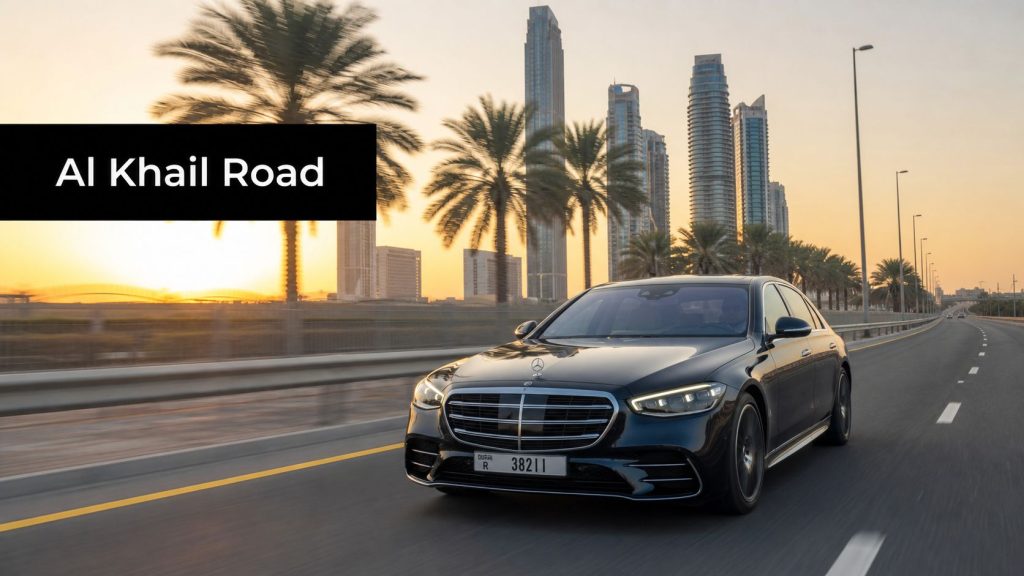
You can be sitting in a hotel car park in Dubai Marina, watching the map inch red, and still have a better option. That's the kind of moment where Al Khail Road Dubai stops being a line on a navigation app and becomes the smarter move, especially if you're heading to Business Bay, Meydan, Al Barsha, Al Quoz, or Jebel Ali with a clean vehicle and a tight schedule.
For visitors, the road matters less as a commuter corridor and more as a strategic inland shortcut. It sits behind the skyline routes most tourists know, which is why it can feel calmer, more direct, and less theatrical than the Sheikh Zayed Road strip when you're trying to get somewhere on time. The useful habit is simple: know when to use it, know which exit serves your destination, and don't treat every Dubai journey like a scenic drive.
Why Al Khail Road Matters to Dubai Visitors
A guest checks out of a Marina hotel, the chauffeur pulls out, and the obvious route looks easy until the traffic tightens. That's usually the point where an inland choice starts making more sense. Al Khail Road Dubai is the road people discover when the obvious route stops being useful.
The traveller's shortcut, not just a traffic road
In plain English, Al Khail Road is one of Dubai's major through-routes, but that description undersells it for visitors. It ties together business districts, hotel zones, event areas, and mixed-use neighbourhoods without forcing every trip onto the same overexposed skyline corridor. That matters because a luxury traveller usually wants three things at once, predictable timing, direct access, and a calm arrival.
The corridor also sits at the centre of ongoing infrastructure work, which tells you it isn't a road Dubai has finished with. Dubai's Roads and Transport Authority completed a development project in October 2024 that delivered five bridges totalling 3,300 metres and widening across 6,820 metres of the corridor, showing that this route is still being actively tuned for higher demand RTA completion announcement.
For a visitor, that kind of upgrade has a practical meaning. It's not about road trivia, it's about whether your hotel transfer, dinner booking, or event arrival feels smooth or rushed. If you're moving between Business Bay and Al Quoz, or Meydan and Al Barsha, Al Khail often behaves like the sensible middle path.
Practical rule: the best Dubai route is not always the fastest on the map at the moment you start, it's the one that still flows when the obvious roads clog.
Why luxury travellers should care
If you're renting something premium, you usually want the car to feel part of the trip, not trapped in it. Al Khail helps with that because it connects districts that matter to visitors without demanding constant lane-hopping through tourist congestion. It suits airport transfers, dinner runs, gallery visits, and hotel-to-hotel movement better than a route chosen purely for skyline views.
It also gives you room to think about the day in segments. A business lunch in Business Bay, a late-afternoon stop in Meydan, then a quiet ride to a residence or resort becomes easier when the road choice is deliberate. That's why locals who drive professionally don't talk about Al Khail as a backup road. They talk about it as the road you use when you care about arriving composed.
The Route and Its Major Interchanges

Drive Al Khail once with a map open and you'll realise the road works best when you know a few junction names, not every street in the city. For a visitor moving between hotels, business districts, and dinner reservations, that matters more than memorising the full corridor. The route cuts through the districts people use, and each interchange points you toward a different part of Dubai's stay-and-move pattern.
Read the road from north to south
Start near Business Bay and Downtown access points, where the road gives you a cleaner inland option for hotel transfers and evening bookings. From there, Meydan opens the door to racecourse areas, event spaces, and quieter hotel arrivals. Keep going and Al Quoz becomes the practical exit for warehouses, studios, galleries, and design-led addresses that do not sit neatly on the usual tourist grid.
Further along, Al Barsha matters for shopping runs and indoor attraction trips, especially when the weather makes short hops more sensible than long walks. Umm Suqeim and Al Wasl work well when you want to shift toward neighbourhoods on the western side of the city without getting pulled into the heaviest part of the main tourist roads. At the southern end, the road connects toward Jebel Ali, which gives direct access to logistics areas and outlying hospitality zones.
The value is in the logic of the exits. If your destination sits east of Sheikh Zayed Road, Al Khail often keeps you out of the most obvious choke points. If your destination is in one of the mixed-use districts above, the right junction usually feels less like a gamble and more like a clean decision.
Dubai's road upgrades back that up with hard infrastructure, not marketing language. The corridor now carries far more through movement than it used to, which is why it works better for high-end hotel transfers and business-day routing than a casual glance at the map would suggest. For a closer look at how the route sits inside the city's wider traffic flow, the Dubai traffic map is useful before you leave the hotel.
If you only learn three names before driving, learn Business Bay, Al Quoz, and Meydan. Those three get you close to most visitor destinations without GPS panic.
One simple way to think about it
Use the road as a sequence of district gateways, not as one continuous blur. That mindset helps when signage appears late, which happens more often than visitors expect in Dubai traffic. The driver who already knows the next district usually changes lanes earlier, stays calmer, and arrives cleaner.

Traffic Patterns and Best Times to Drive
Al Khail works best when the rest of Dubai is still waking up or already winding down. That matters here more than on many other corridors, because this road serves commuters, hotel transfers, and visitors moving between business districts and leisure stops. The pattern is plain enough. The quieter windows give you cleaner runs, and the busy periods punish anyone who assumes a quick hop across town will stay quick once the lanes tighten.
When the road breathes and when it clamps down
Weekday traffic usually builds in the morning and again in the late afternoon, which is exactly when hotel pickups and business appointments become harder to time well. Late evenings are generally easier, and Friday morning is often calmer than the workweek pace. For visitors, mid-morning is one of the better windows for crossing the city or shifting between districts without fighting the heaviest pressure.
The earlier bridge phase explains part of that better flow. The two main bridges at Zaa'beel and Al Quoz 1 were built with 1,350 metres of combined length and designed for roughly 8,000 vehicles per hour. That extra room helps the corridor absorb bursts of demand, even though it does not wipe out congestion when traffic stacks up near major interchanges.
For a live view before you leave the hotel, the Dubai traffic map is worth checking.
My rule for visitors
Use Al Khail for planned movement, not hopeful guessing. If you are moving from hotel to meeting, meeting to gallery, or dinner back to residence, choose the window that avoids the pressure points you already know will be busy. That is the difference between a clean inland run and sitting in traffic that feels expensive before the first full stop.
Check live conditions before you pull out. Dubai traffic can change quickly enough that yesterday's experience is a poor guide, and a clear map can still hide a tight spot near a major interchange. If the route already looks bad, it usually is. If it looks open, stay conservative anyway and avoid the last-second lane change that costs more time than it saves.
Do not chase a “faster” route after you have already left. On Al Khail, the driver who commits early usually gets back more time than the one who keeps changing plans.
The practical takeaway is simple. Weekday peaks are the times to avoid, and the cleanest drives usually come when you work with the road's quieter windows instead of fighting them.
Key Exits, Hotels and Attractions Nearby
For visitors, the best way to think about Al Khail is by purpose, not by road geometry. You don't need to memorise every ramp if you know which district you're trying to reach. That approach works especially well in Dubai, where a good exit can save you from unnecessary loops and awkward lane changes.
Choose the exit by the job you're doing
If you're heading into Business Bay, use the exits that keep you closest to Downtown and the hotel cluster around the core business and dining districts. For a chauffeur, these are the cleanest arrivals because they reduce the need for late lateral moves. They're also the most useful when you're meeting someone for lunch and don't want a complicated approach.
For Al Quoz, the value is different. You're usually going there for galleries, design studios, showrooms, or less formal business stops, so the best exit is the one that gets you in without overcommitting to the wrong internal road first. The signage can look busier than it is, which is why early lane choice matters more here than in the more obvious hotel districts.
Al Barsha is the straightforward one for visitors going to Mall of the Emirates or indoor attractions nearby. The arrival feels better when you avoid unnecessary detours and commit before the road starts compressing near the final approach. Meydan suits racecourse visits, grandstand hotels, and event-based itineraries, and it rewards drivers who understand that a tidy exit is better than a dramatic late move across traffic.
Here's the simple guide I'd give a guest in the front seat.
| Exit Cluster | District Served | Best Use for Visitors |
|---|---|---|
| Business Bay access | Business Bay, Downtown edge | Hotel transfers, meetings, dinner reservations |
| Al Quoz access | Al Quoz | Galleries, studios, design-led visits |
| Al Barsha access | Al Barsha | Mall of the Emirates, indoor attractions |
| Meydan access | Meydan, racecourse zone | Events, grandstand hotels, race-day movement |
| Southern connector | Jebel Ali direction | Outlying stays, logistics-linked journeys |
What experienced drivers prefer
A seasoned driver usually chooses the exit that reduces hesitation, not the one that looks closest on the map. That's why Business Bay and Meydan often feel easier than they first appear, while Al Quoz rewards a driver who reads signs early and ignores the urge to improvise. When in doubt, pick the ramp that gives you a clean final approach, not the shortest theoretical distance.
If you're planning a luxury transfer, that practical thinking matters more than road romance. A polished arrival starts with a decent exit, not with a heroic last-second weave.
Al Khail Road vs Other Dubai Routes
Some roads in Dubai are famous, and some are smarter. Al Khail belongs in the second group. It doesn't give you the postcard skyline feel of Sheikh Zayed Road, but it often gives you a better real-world journey if your destination sits in one of the districts it serves directly.
The route choice that actually fits the trip
Sheikh Zayed Road is the obvious default, especially if you want the iconic towers and the most recognisable city sequence. It's also the route most likely to feel congested when everyone else has chosen the same idea. Emirates Road is different, it works better as a heavy-distance and outer-connection road than as a visitor's district-to-district solution.
Dubai Bypass Road sits further away from the kind of trip most tourists and business travellers are making inside the city. It can be the right road for broader movement, but it's not the one I'd choose for hotel transfers, gallery visits, or dinner bookings in central districts. Al Khail is the middle option that matters most because it gives direct access without the spectacle-driven slowdown.
For a traveller optimising speed, scenery, and access, the decision is quite clean. Choose Sheikh Zayed Road when you want the skyline experience and accept slower movement. Choose Emirates Road when the journey is bigger and less urban. Choose Al Khail Road when the trip is about reaching specific districts efficiently and without unnecessary drama.
That logic matters even in small details, like what you wear for the day. If you're heading to a golf booking or an upscale casual stop after a drive across town, a guide such as Tattoo Golf's rebel dress code can be a useful style reference for travellers who like their day to feel coordinated from car to venue.
My straight recommendation
If you're staying in central Dubai and moving between mixed-use districts, Al Khail is the smarter default. It's the road I'd pick for most hotel-to-event, hotel-to-meeting, and hotel-to-residence trips when the aim is to arrive smoothly rather than impress people with the view out the window. Sheikh Zayed is better when the skyline itself is the point. Al Khail is better when the schedule is the point.
Speed Limits, Safety and Common Mistakes
On a road like this, the fastest-looking driver is rarely the one who gets there best. What visitors usually underestimate isn't just speed, it's lane discipline, merge timing, and how quickly a missed exit can turn into a messy correction. If you're in a high-performance rental car, the goal is to keep the drive calm enough that the car feels expensive for the right reasons.

What goes wrong most often
The biggest mistake is the sudden multi-lane change after a missed exit. That move creates risk for everyone around you and usually saves less time than drivers hope. Hard braking near merging zones is another common one, especially when a visitor realises the lane ahead is ending or the exit came up sooner than expected.
Tailgating is the third problem, and it's the one that turns a routine transfer into a tense one very quickly. Dubai traffic can compress without warning, so the driver who leaves space usually has more options when flow changes. If you want the road to feel like a luxury route, that buffer matters.
Stay in the middle lane when you don't need to exit soon. It gives you room to correct calmly, and it keeps the trip from turning into a last-minute scramble.
For radar awareness and local enforcement habits, it helps to read a dedicated Dubai resource before you drive, especially if you're unfamiliar with how quickly fines can follow sloppy speed discipline: Dubai radar locations and habits.
Three habits that work
Commit early to an exit.
The driver who decides too late ends up weaving.
Keep your speed steady.
Smooth progress beats bursts of acceleration and sudden braking.
Never stop on the shoulder for photos.
The road is not a viewing platform, and the shoulder isn't a safe place for a quick luxury-shot stop.
Those habits are boring, which is exactly why they work. On Al Khail, boring often looks like competence.
Luxury Car Rental Itineraries Along the Corridor
Al Khail makes the most sense when the car is part of an itinerary rather than a single point-to-point transfer. That's where a luxury rental starts to earn its keep, the road links hotel, meeting, leisure, and evening plans without forcing the day onto one crowded corridor. The right vehicle just makes that structure feel smoother.
A Business Bay to Meydan day that stays elegant
Start with a sedan or a discreet executive SUV if you've got meetings in Business Bay and a later booking around Meydan. The first stretch works well because Al Khail helps you avoid the most obvious bottlenecks when you're moving between business towers, hotel drop-offs, and event areas. After the meeting, the same corridor keeps the drive to Meydan neat enough that you're not arriving flustered.
That matters for dinner too. A calm route means the handover from work mode to evening mode feels deliberate instead of rushed. If the plan includes a Downtown table afterwards, the corridor gives you a practical spine for the day, not just a way to move metal between addresses.
A leisure loop from Al Barsha through Al Quoz
For a slower day, a coupe or stylish SUV suits a route that starts with Al Barsha, continues to Al Quoz, and then heads out to whatever the next booking is. This is the kind of run where Al Khail's exits do the heavy lifting, because you can move from a mall stop to a gallery visit without wasting the afternoon in awkward cross-town traffic. The road is especially useful if your schedule mixes shopping, design, and a later departure.
Dubai's approved First Al Khail Street Development Plan adds a 15-kilometre elevated roadway with three lanes in each direction and an estimated throughput of about 9,000 vehicles per hour project plan summary, which tells you the corridor is being built for exactly this kind of mixed movement. For travellers, that means the road's usefulness will only deepen as the city keeps reshaping it.
If you're keeping the car looking sharp after a full day out, it's also worth using a sensible guide to washing your car safely rather than rushing the job and marking the paint.
Why the route and the car should match
A relaxed route wants a car that feels composed, not frantic. A business day suits a sedan because it reads cleanly at hotel entrances and office frontages. A leisure day with multiple stops usually works better in an SUV because luggage, shopping bags, and an extra passenger don't complicate the cabin. The point is simple, choose the vehicle for the route you're driving, not the one you wish the day would become.
Quick Checklist Before You Drive Al Khail Road
Before you leave, check the route window, not just the destination. Al Khail is at its best when you pick the right time, choose the right exit early, and stay disciplined in the lane you've already committed to. That's what separates a smooth luxury transfer from a crawl that ruins the mood before you reach the venue.
- Pick the timing carefully. Use calmer windows rather than weekday rush periods.
- Know your exit before you start. Business Bay, Meydan, Al Barsha, and Al Quoz are the names worth remembering first.
- Stay out of last-second weaving. Multi-lane changes near your exit are where trips go wrong.
- Keep the middle lane when unsure. It gives you options without forcing panic decisions.
- Avoid shoulder stops. No photo is worth the risk or the disruption.
- Refresh your mental map often. Ongoing upgrades keep changing how the corridor flows, so the road you drove last month may feel different on your next visit.
For a final pre-drive check, keep this handy: vehicle inspection checklist. A clean start makes the whole route feel better.
If you're planning a Dubai drive and want the trip to feel as polished as the car, book with Uptown Rent A Car and choose a vehicle that fits the corridor, the timing, and the day you have.