
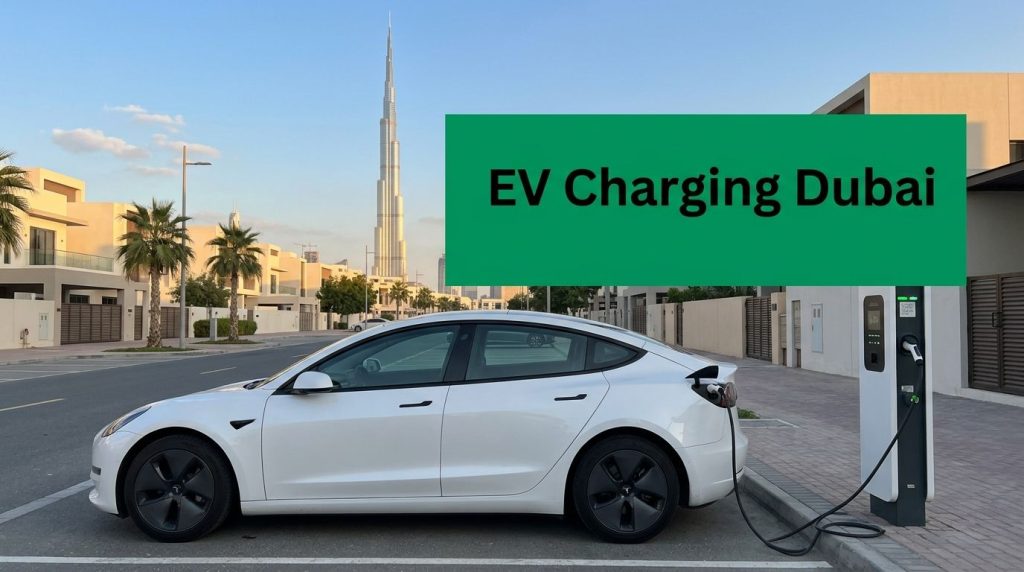
You've just collected the keys to a luxury EV in Dubai. The cabin is silent, the acceleration is effortless, and the city feels built for this kind of driving. Then the practical question lands. Where do you charge, how do you pay, and how do you avoid wasting part of your trip hunting for a working bay?
That's where most generic guides stop being useful. They show dots on a map, list a few charging names, and assume the experience is frictionless. In practice, charging in Dubai is very manageable, but tourists need a different playbook from residents. The gap isn't usually the number of chargers. It's knowing which chargers are worth trusting, how payment works when you don't have a local account, and when a charger that looks convenient on screen turns into an avoidable delay.
Your Guide to Effortless EV Driving in Dubai
Dubai makes electric driving easier than many visitors expect. The public network has grown to over 1,270 public charging points across the emirate as of August 2025, with coverage within a 5-kilometre radius of any location in the city, according to Roland Berger's GCC EV charging overview. That matters when you're moving between Downtown, the Marina, Palm Jumeirah, and the airport in one day.

Think in moments, not charging sessions
The easiest way to use EV charging stations in Dubai is to charge while you're already doing something else. A hotel stay, lunch in a mall, a meeting, or an evening stop works better than treating charging as a separate errand.
If you drive the way most visitors do, short city hops with occasional longer motorway runs, you usually don't need to hunt for a charger at the last possible moment. The smoother habit is simple:
- Start each day with a healthy battery
- Top up during planned stops
- Keep one backup location near your destination
- Use rapid charging only when time matters
What catches tourists off guard
The stress usually comes from two assumptions. First, that every charger shown on an app is equally reliable. Second, that payment will be as simple as tapping a card everywhere. Neither assumption is safe.
Practical rule: In Dubai, convenience comes from planning one stop ahead, not running the battery low and trusting the nearest pin on the map.
A visitor who knows where to pause, what connector to look for, and how to handle payment will find Dubai very easy to drive in an EV. A visitor who waits for the battery warning and then starts searching can turn a polished trip into an administrative one.
Decoding Dubai's EV Charging Ecosystem
Dubai's charging system feels organised because one institution sits at the centre of it. For visitors, that central role is useful. You're not dealing with a completely fragmented patchwork where every building installs whatever it wants and every operator follows different technical rules.

Why DEWA matters to drivers
DEWA, the Dubai Electricity and Water Authority, is the key name to recognise. Under the EV Charging Infrastructure Regulation enacted on 30 September 2024, all public and private EV charging station installations require mandatory licensing and technical approval from DEWA, which helps ensure grid compatibility and safety, as outlined in this overview of Dubai's EV charging regulations.
For a tourist, that translates into a practical benefit. You're operating inside a regulated system where the equipment is meant to follow common technical requirements, rather than guessing whether a charger at a commercial site was installed to a different standard.
Public and private charging aren't the same experience
Dubai has both public and private charging environments, and they behave differently.
| Charging setting | What it usually means for a tourist | What to expect |
|---|---|---|
| Public chargers | Useful during shopping, meetings, dining, or motorway travel | More convenient, but availability can vary |
| Private chargers | Hotel, residence, villa, office, or dedicated premises | Often simpler if access is arranged in advance |
A lot of visitors focus only on public infrastructure. That's understandable, but private access can be the calmer option if your hotel or accommodation offers it. The experience is often less about speed and more about certainty. Plug in, leave the car, and continue with your evening.
The centralised advantage
In cities with many unrelated operators, drivers spend too much time learning different systems. Dubai's structure reduces some of that friction. It doesn't remove every problem, especially around live availability and tourist payment, but it does create a more coherent base.
A charger in Dubai isn't just a socket in a car park. It sits inside a regulated framework that affects safety, compatibility, and how predictable the user experience feels.
That's the part many travellers never get told. The network isn't difficult. It's layered. Once you understand who governs it, the rest becomes easier to read.
Charger Types Speeds and Connectors Explained
You pull into a charger with 20% left, the bay is free, and then the session stalls because the connector is wrong or the unit is slower than expected. That is the kind of delay that catches visitors in Dubai. The fix is simple once you know what to look for before you park.

The connectors you'll actually see
In the UAE, AC charging uses Type 2 connectors, while DC charging primarily uses CCS Type 2, according to this video coverage of UAE charging standards and the E11 charging hub. Some DC sites also use CHAdeMO, but for most current premium EV rentals, CCS Type 2 is the connector to recognise first.
At handover, confirm three points and save yourself a wasted stop later:
- Which connector does this car use?
- Does the car come with its own AC cable?
- Can this vehicle charge on both AC and DC public units?
That second question matters more than many tourists expect. Some AC posts rely on the driver's own cable, so a charger can appear available on the map but still be unusable if the cable is not in the boot.
If you want a simple background guide on home and destination charging equipment, this article on finding the right EV wallbox is a useful reference.
Here's a visual walkthrough of charging basics in action:
AC for parked time, DC for travel time
AC charging suits the stops you were already planning to make. Hotel parking, dinner, a meeting, or an afternoon at a mall all fit well. It is usually the calmer option, but it only works if the location has the right access rules and the cable situation is clear.
DC charging is the practical choice when the battery level affects your day's schedule. Use it before a longer drive, after an unexpected detour, or when an occupied charger has already cost you time.
| Charger type | Best use case | What to expect in practice |
|---|---|---|
| AC charging | Hotel stays, long meals, business meetings, shopping | Lower speed, but convenient if the car is parked for a while |
| DC fast charging | Motorway runs, quick top-ups, schedule recovery | Faster turnaround, but more sensitive to queues and unit status |
Real-world speed expectations
Do not judge a charger by the label alone. The car's battery condition, current state of charge, heat, and the charger's live performance all affect the result. A high-power unit can still deliver a slower session than expected if the site is busy or the vehicle is already past the battery's fastest charging window.
For visitors, the practical rule is straightforward. Use AC when the car will be parked anyway. Choose DC when you need to get back on the road with a meaningful top-up, not just a few extra kilometres.
Before setting off, it also helps to pin likely charging stops in a Dubai maps app for planning routes and key destinations. That small step makes it easier to judge whether a slower AC session is perfectly adequate or whether you should head straight for a faster DC site.
Navigating Charging Networks Apps and Payments
The hardware is only half the story. The more common tourist frustration is digital. You find a charger, arrive on time, and then realise the payment flow assumes you already have the right local app setup, account permissions, or pricing plan.
Why tourists feel the friction first
For visitors, EV charging pricing in the UAE can be “unregulated and non-transparent”, and short-term renters often don't have the local DEWA accounts needed for discounted rates, as noted in this technical case study on EV charging development in the GCC and Africa. That single point explains a lot of confusion.
Residents build habits around their own accounts and familiar providers. Tourists arrive for a few days, often with a foreign number, an unfamiliar app store setup, and no desire to register for three platforms just to charge twice.
What to sort out before your first drive
Treat charging access like airport transfers or valet details. Confirm it before you need it.
Ask these questions at pickup:
- Which app or apps should I install for the chargers I'm most likely to use?
- Can I pay as a guest, or do I need an account?
- Does the car come with any charging access support from the rental provider?
- Which stations are easiest for non-residents to activate?
If you're building your travel setup already, it helps to keep your route planning tools in one place. A practical companion is this guide to Dubai maps and navigation apps, especially if you're combining charging stops with meetings, restaurants, hotels, and airport timing.
The payment issue most guides skip
Official station maps answer one question only. They show where charging may be available. They don't always answer the question tourists care about most, which is whether the charger is easy to activate and whether the final cost will be clear before charging starts.
A local driver may already know which network account to use and which prices to expect. A visitor often doesn't. That creates three common trade-offs:
| Situation | Benefit | Hidden friction |
|---|---|---|
| Using a familiar major network | Easier to locate stations | Payment rules may still differ for non-residents |
| Charging at destination venues | Convenient while you shop or dine | Access may depend on parking rules or venue processes |
| Relying on roaming or guest access | Fewer sign-ups | Price clarity can be weaker |
If you're renting for only a short stay, the smoothest option is rarely the most technically advanced one. It's the charger you can access, activate, and leave without an account problem.
That's why many seasoned travellers choose certainty over novelty. A slightly less perfect charger with straightforward access beats a theoretically faster station with a clumsy payment path every time.
Finding Reliable EV Charging Stations in Dubai
The map says the charger is there. That doesn't mean it's available when you arrive, or functioning, or practical for the exact part of Dubai you're in. The smartest way to use EV charging stations in Dubai is to tie them to your day, not your battery percentage alone.
Match charging to the places you already plan to visit
If your itinerary centres on Downtown Dubai, don't think “where can I charge near Downtown?” Think “where can I park for a useful amount of time while I'm already in Downtown?” That shift matters. Mall visits, lunches, and meetings create natural charging windows.
The same logic works in Dubai Marina, Palm Jumeirah, and around major hotels. Destination charging tends to feel smoother because it blends into your plans. You arrive, hand over the car to valet or self-park, and the battery gains range while your day continues.
Where motorway charging changes the game
The motorway case is different. If you're heading toward Abu Dhabi or returning the same day, the charging stop becomes part of the journey itself. That's when fast DC sites earn their place. You stop with intent, top up quickly, and continue.
A useful way to think about location choice is this:
- City stay means prioritise chargers near restaurants, hotels, malls, and meeting venues
- Business schedule means prioritise predictable parking access over theoretical charger speed
- Inter-emirate drive means prioritise motorway DC charging with an easy exit and re-entry
- Airport run means don't rely on last-minute charging unless you've checked status beforehand
Reliability beats proximity
This is the distinction many first-time EV visitors miss. The closest charger is not always the best charger. A charger attached to a busy destination can be more practical because it fits your schedule, but it can also be more vulnerable to occupancy pressure.
The most reliable charging stop is usually the one with a backup nearby, easy parking access, and a reason for you to stay there anyway.
For airport days, hotel transitions, or event-driven itineraries, keep one principle in mind. Never let the battery fall to the point where you need the next charger to work. Give yourself margin. In Dubai, good planning doesn't feel restrictive. It gives you the freedom to move between districts without turning every battery drop into a decision.
Pro Tips for a Flawless EV Rental Experience
Visitors often assume charger quantity solves everything. It doesn't. What protects your time is operational discipline. That means verifying availability, keeping options open, and treating charging as part of your route planning rather than a separate problem to solve later.
Users report that in some high-demand zones, up to 75% of chargers can be broken or occupied, creating charging deserts that official maps don't always show, according to this discussion of charger reliability in Dubai. Whether you treat that as a warning sign or a hard lesson depends on how you plan.

The habits that prevent avoidable delays
Some habits make an EV rental in Dubai feel smooth from the first day. Others create stress fast.
- Verify before driving there. Don't trust a station pin by itself. Check live status where possible, confirm the site is active, and assume busy areas may disappoint at peak times.
- Keep a primary and a fallback. If your first charger fails, you shouldn't start searching from scratch in a low-battery state.
- Charge earlier than you need to. This isn't about anxiety. It's about preserving flexibility if the first site is occupied or inaccessible.
- Use destination time well. If the car will be parked during dinner, shopping, or meetings, that's usually a better charging window than waiting until late.
- Know your return-day plan. Don't leave final charging to the hour before airport drop-off or hotel checkout.
Questions worth asking your rental provider
The handover is where many problems are avoided. Ask concise, practical questions.
| Ask this | Why it matters |
|---|---|
| Which chargers do clients use most easily with this model? | Real-world convenience beats theory |
| Do you recommend AC top-ups or DC fast charging for my itinerary? | The right answer depends on your trip style |
| Is there an app or route tool you suggest? | App setup is easier before departure |
| What battery level do you recommend I maintain in the city? | Local guidance helps with planning rhythm |
If you want a rental option specifically focused on electric models, electric car rental in Dubai is one way to compare suitable vehicles and trip formats.
Etiquette and timing still matter
A charger isn't a parking privilege. Once you've reached the charge you need, move the car. Fast chargers are most useful when drivers treat them as turnover assets, not long-stay parking spaces.
A practical rhythm works well:
- Use AC when you're naturally stationary
- Use DC when your journey depends on speed
- Leave margin for error
- Avoid charging in a hurry unless there's no alternative
“Plan your charging around your day, not around the warning light.”
That one habit solves more tourist frustration than any app download. Dubai is easy in an EV when you drive proactively. It becomes awkward only when the battery, the map, and your schedule all become urgent at the same time.
Charge Up and Explore with Confidence
Driving electric in Dubai suits the city. The roads are polished, the distances between key districts are manageable, and the charging network is mature enough that you don't need to organise your whole trip around the battery. What you do need is a slightly more practical mindset than most tourist guides suggest.
The winning approach is simple. Know your connector. Choose the charger type that fits your schedule. Confirm app and payment access before your first charging stop. Build in a backup location. And never assume that a charger shown on a map will be ready for you the moment you arrive.
That's the difference between a smooth EV experience and an irritating one. It isn't about technical expertise. It's about timing, access, and reliability.
If you're planning to use your rental for more than city cruising, it also helps to pair your charging habits with realistic route ideas. A few well-chosen day trips from Dubai can work beautifully in an EV when you choose stops with charging logic in mind.
Once you approach EV charging stations in Dubai like a local concierge would, the process feels far less complicated. You stop where it makes sense, charge while your day continues, and keep enough flexibility that minor hiccups don't affect the trip. That's how electric driving in Dubai should feel. Quiet, capable, and easy to live with.
If you'd like a luxury EV for your stay, Uptown Rent A Car offers high-end rental options in Dubai, with online booking that makes it easier to arrange the car before you arrive and plan your charging routine around your itinerary.