
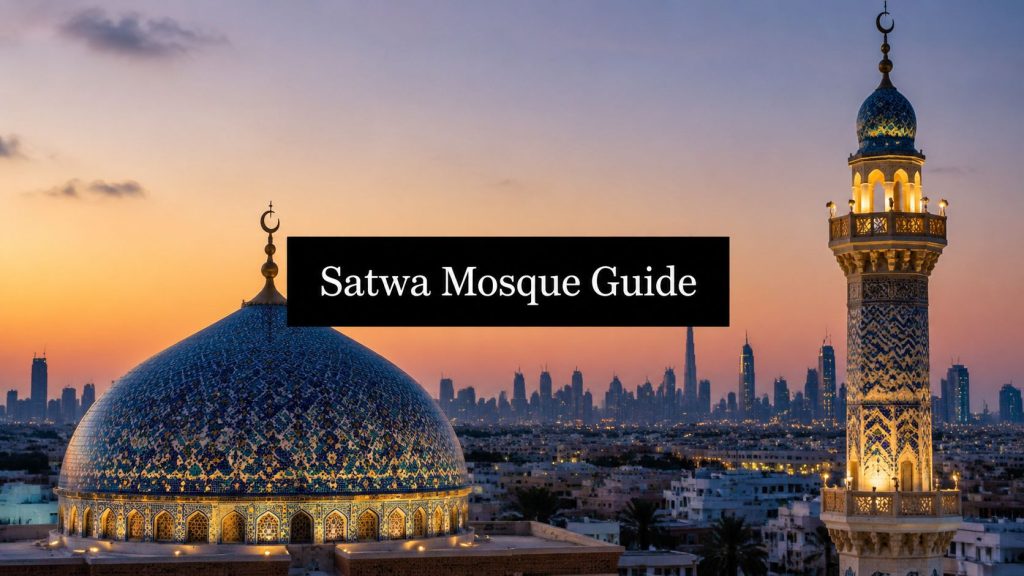
You're likely in one of two moods when you search for Satwa Mosque Dubai. Either you've already seen the towers, beach clubs, and polished malls, and now you want something that feels rooted and real. Or you're driving through central Dubai in a rental car, passing from glass façades into older neighbourhood streets, and you've spotted a mosque that looks entirely different from the city's familiar luxury image.
That shift is exactly why Satwa matters.
Al Satwa isn't a postcard version of Dubai. It's lived-in, busy, multicultural, and full of texture. Its mosques reflect that reality. For travellers who want more than another skyline viewpoint, this area offers a more meaningful kind of stop: one that reveals how communities built places of worship, identity, and daily life inside a fast-changing city.
For international visitors, the challenge is usually simple. The name “Satwa Mosque” gets used loosely, directions online are often general, and practical details for drivers are rarely written with comfort, timing, or etiquette in mind. If you're building a refined day out, especially by car, you need more than a vague pin on a map.
A good starting point is to place Satwa within the wider city before you leave your hotel. This map of Dubai tourist attractions helps you see how easily Satwa can fit between Jumeirah, Downtown, City Walk, or Bur Dubai without turning your day into a long detour.
An Introduction to Dubai's Hidden Cultural Jewel
A drive along Al Wasl Road can feel like a lesson in Dubai's contrasts. You pass modern retail, embassies, villas, and dense neighbourhood life, then suddenly a mosque commands your attention with a more traditional visual language. That's when many visitors realise Dubai isn't one story. It's several stories layered together.
For a traveller used to curated experiences, Satwa offers something rarer. It isn't designed primarily for tourism. It's a working district with real religious landmarks, loyal local communities, and a pace that feels different from the city's resort zones. That's precisely what makes it rewarding.
Why this area deserves your time
Many visitors assume a mosque stop in Dubai means a single famous landmark with a standard visitor route. Satwa is less straightforward. The area is associated with more than one major mosque, and the names often overlap in conversation and online listings. If you arrive without understanding that, you can easily end up at a different site than the one you intended to see.
That confusion isn't a problem once you know what to look for. It adds depth to the visit, because each mosque tells a different story about the neighbourhood.
Satwa rewards travellers who slow down. If you rush in expecting a museum-style attraction, you'll miss the point. If you arrive curious and respectful, the area opens up.
What luxury travellers usually need that generic guides miss
If you're travelling with a premium rental or private driver, your concerns are practical. You want to know whether the approach roads are simple, whether parking is realistic, what to wear without overthinking it, and how to combine the visit with lunch, shopping, or another cultural stop.
You also want to avoid awkward timing. Mosques are active religious spaces, not passive monuments. The best visit isn't necessarily the longest one. It's the one planned with enough context to feel smooth, respectful, and unforced.
Unveiling the Satwa Mosques History and Identity
A driver drops you in Satwa, you glance at the map, and two different mosques seem to answer to the same name. That is the first point to get clear. “Satwa Mosque Dubai” is often used as a catch-all label, but in practice visitors are usually referring to either the Iranian Mosque or the Al Satwa Big Masjid.

The Iranian Mosque and the Al Satwa Big Masjid
The distinction matters because these are not merely two names for one building. They represent two different expressions of Satwa's religious life.
The Iranian Mosque, also called the Imam Hussein Mosque, is the one closely associated with the Iranian community in Dubai and is widely recognized for its Persian visual identity and its late-20th-century founding story. If your interest lies in cultural texture, architectural character, and the way diaspora communities shaped older Dubai, this is usually the mosque you mean.
The Al Satwa Big Masjid plays a different role. Visitors tend to associate it with Satwa's larger congregational life and with the everyday rhythm of worship in a busy urban district. It is less about a distinct decorative identity and more about understanding the mosque as a major local institution.
A simple way to separate them is to treat the Iranian Mosque as the district's most visually distinctive religious landmark, while the Al Satwa Big Masjid reads more like the area's large communal prayer hub.
| Mosque | Best known for | What that means for visitors |
|---|---|---|
| Iranian Mosque / Imam Hussein Mosque | Community heritage and Persian-influenced identity | Better fit for travellers focused on architecture, history, and exterior viewing |
| Al Satwa Big Masjid | Large congregational presence in Satwa | Better fit for understanding the district's scale of religious life |
Why the distinction matters for visitors
For international tourists, especially those using a rental car, this is more than a naming detail. It affects your route, your stop time, and even what you tell valet staff or your driver if you are pairing Satwa with Downtown, Jumeirah, or DIFC in the same afternoon.
If you ask for “Satwa Mosque” without being specific, you increase the chance of arriving at the wrong entrance or building your schedule around the wrong type of visit. Luxury travellers usually feel this problem first because their day is tightly planned. One cultural stop can sit between a business lunch, gallery visit, and dinner reservation. Clarity saves time and avoids an awkward reset in traffic.
A neighbourhood shaped by communities
Satwa helps explain why both mosques matter. This district developed through working communities, long-term residents, and migrant networks that left a visible mark on the area's streets, shops, and places of worship. In that setting, a mosque is not just a landmark for photographs. It also reflects who built local life here and how that identity stayed visible as Dubai expanded around it.
That is part of Satwa's appeal for travellers who want more than headline attractions. The area gives you a closer view of lived Dubai. The experience feels less curated and more revealing.
If you are building a culture-focused day that balances heritage with comfort, this guide to historic sites in Dubai worth adding to a refined itinerary can help you connect Satwa with other meaningful stops across the city.
Practical rule: Put the exact mosque name into your map app before you leave the hotel. “Iranian Mosque” and “Al Satwa Big Masjid” are far better search terms than “Satwa Mosque.”
The Architectural Splendor of the Iranian Mosque
The Iranian Mosque is the one that often stops visitors in their tracks. In a district of practical shopfronts, traffic, and residential blocks, its ornament feels almost ceremonial. The building doesn't whisper. It announces itself through colour, pattern, and symmetry.

What you notice first
Most visitors first register the blue tile work. Then the dome. Then the minarets. The façade carries a Persian-influenced decorative language that feels markedly different from the plainer, more restrained exteriors many travellers expect from neighbourhood mosques in the Gulf.
The effect changes with the light. In strong daytime sun, the tilework looks crisp and graphic. Later in the day, the colours soften and the patterns become easier to study. If you appreciate architecture, don't just stand back for the full view. Walk slowly around the exterior and pay attention to repeated motifs, border treatments, and the way the surfaces frame arches and entrances.
Why it feels different from other Dubai landmarks
Dubai's best-known visitor sites often communicate scale through engineering, branding, or dramatic height. The Iranian Mosque works differently. Its beauty comes from craftsmanship and accumulated detail. It rewards close looking.
That's why it suits travellers who enjoy quieter cultural stops between headline attractions. You don't need a long programme to appreciate it. Even a brief exterior visit can become memorable if you approach it with the right eye.
A short visual reference helps before you go:
How to look at it like a design-minded traveller
Try this sequence when you arrive:
- Start from a distance so you can read the overall composition of dome, minarets, and frontage.
- Move closer to the tilework and notice how floral and geometric motifs create rhythm rather than clutter.
- Look upward at the transitions between structural lines and decorative surfaces. That's often where the craftsmanship becomes most interesting.
- Step back again after a few minutes. The building reads differently once you've seen the details.
The Iranian Mosque is one of those places where ten attentive minutes can be more rewarding than an hour of distracted sightseeing.
For many visitors, this is the point where Satwa stops feeling like a side trip and starts feeling like one of the city's most distinctive cultural encounters.
A Practical Guide to Visiting Etiquette and Timings
Visiting a mosque in Dubai isn't difficult, but it does require good judgement. Most uncertainty comes from etiquette, not logistics. Visitors worry about wearing the wrong thing, arriving at the wrong moment, or acting too casually in an active place of worship.
That's easy to avoid if you keep one idea in mind. Your goal isn't to “access a site”. Your goal is to enter respectfully, or if access is limited, to observe respectfully from outside.

Timing your visit well
The Al Satwa Big Masjid is listed with opening hours of 05:06 to 23:02 in this Al Satwa Big Masjid travel listing. For travellers, the important point isn't just that the hours are long. It's that mosques operate around the daily prayer rhythm, so a suitable visitor window usually means going between prayer times rather than during them.
Morning and late afternoon are often the easiest periods for a calm exterior visit or a brief respectful look, depending on access conditions on the day. Friday requires extra caution because congregational prayer can reshape the whole area's atmosphere, traffic, and accessibility.
Dress and conduct
A useful rule is to dress more conservatively than you think you need to. In a luxury itinerary, that may mean adjusting after brunch or shopping before you arrive.
Use this checklist:
- For women: Wear clothing that covers shoulders and knees, and carry a headscarf if you may enter a prayer area.
- For men: Avoid shorts and sleeveless tops. Lightweight long trousers and a simple shirt work well.
- For everyone: Choose quiet behaviour. Keep voices low, move slowly, and don't block entrances or prayer paths.
If shoes need to come off, follow the lead of worshippers or attendants. Don't assume photography is automatically acceptable just because you're outdoors near a landmark.
Photography without causing discomfort
Architecture photography and people photography are not the same thing. Exterior details are usually the safer focus. Faces, prayer moments, and close shots of worshippers are much more sensitive.
A good practice is simple:
- Photograph the building first.
- If people are in the frame, widen the shot rather than moving closer.
- If you want a more intimate image, ask permission.
Asking before photographing people isn't a formality. It's the clearest sign that you understand this is a living religious space.
If access seems unclear
Some mosques welcome observation more readily than others, and access can vary by timing, staff presence, or what's happening that day. If you aren't sure whether a non-Muslim visitor may enter a particular area, pause and ask. A polite question is always better than an assumption.
That restraint often improves the experience. Instead of treating the mosque like a checklist item, you begin to notice atmosphere, movement, and community habits around it. For many travellers, that's the part that stays with them.
Navigating to Satwa Mosque Driving and Transport Tips
Your driver has carried you through Dubai's wide, polished roads with ease. Then Satwa changes the rhythm. The streets become tighter, the pace becomes more local, and the last few turns matter more than the first twenty minutes of the drive.

Best approach for drivers
Satwa sits in a convenient part of the city, especially if your day already includes Downtown, DIFC, Jumeirah, or a hotel along the coast. Reaching the district is usually straightforward. The part that catches visitors off guard is the final approach, where local traffic patterns and narrower streets ask for patience rather than speed.
For car renters and luxury travellers, treat this stop the way you would treat arrival at a private gallery tucked inside an older city quarter. The address may be central, but the arrival style should be measured and deliberate.
A few habits help:
- Enter the full mosque name in your maps app rather than relying on a broad area search.
- Build in a time buffer so parking decisions do not feel rushed.
- Keep valuables out of sight if you are using a rental car and stepping away briefly.
- Plan Satwa as a short cultural stop between more polished venues, such as a beach club breakfast and a refined lunch in Jumeirah.
That approach suits the area well. Satwa rewards travellers who arrive calm.
Parking expectations
Parking is usually the main concern. The expectation is clear: you will often find a space, but not always directly in front of the mosque and not always on the first pass.
If you are driving a larger SUV, this matters even more. Some side streets feel easy in a sedan but more awkward in a wider vehicle, especially when delivery vans or resident cars narrow the lane. A short walk from a legal spot is often the better trade-off.
Use these habits:
- Arrive outside peak prayer periods if convenience is a priority.
- Check nearby side streets once, then choose decisively instead of looping the same block.
- Park legally and neatly even if the walk is slightly longer.
- Skip hurried kerbside decisions in active lanes with limited room to correct.
For a high-end itinerary, Satwa works best as a well-timed interlude. Visit, absorb the setting, then continue to the next part of your day before traffic builds.
When a taxi or ride-share makes more sense
Some travellers should leave the car behind. If your schedule is tight, if you dislike urban parking, or if your Dubai rental is a large premium model, a taxi or ride-share can be the cleaner option.
This matters most on busy afternoons or on days when you want the visit to feel light rather than logistical. Dubai makes that easy. Many visitors use a hired car for desert drives, resort transfers, and longer scenic routes, then switch to point-to-point transport for denser central districts like Satwa.
If you like checking the street setting before you leave your hotel, businesses increasingly boost local SEO with virtual tours. For travellers, the same preview can help you assess road width, likely pick-up points, and whether the area suits your comfort level as a driver.
For wider orientation before crossing between Satwa and older parts of the city, this Bur Dubai map guide gives a more useful geographic frame than a single dropped pin.
Beyond the Mosque Exploring the Best of Satwa
A mosque visit in Satwa shouldn't end the moment you step back to the car. The neighbourhood itself is part of the experience. This is one of the parts of Dubai where you can still feel the city at street level, in shop signs, tailoring storefronts, casual cafés, and conversations that spill onto pavements.
Walk a little if the weather allows. Satwa is known for textile and alteration shops, practical retail, and a food scene shaped by long-established expatriate communities. You'll find streets that feel worlds away from the polished choreography of luxury districts, yet that contrast is exactly what makes the area worthwhile.
A simple way to shape the rest of your stop
After the mosque, choose one of these moods:
- A short cultural circuit with a slow drive toward Jumeirah and another architectural stop.
- A street-food detour where the point is flavour and atmosphere, not formality.
- A neighbourhood browse for fabrics, tailoring, and the everyday rhythm of old Dubai.
If you're travelling as a couple or with guests, Satwa can work beautifully as the grounding part of a more enhanced day. Start with a polished breakfast elsewhere, come here for cultural depth, then continue to a refined lunch or sunset venue. The contrast makes both halves of the day feel sharper.
Satwa doesn't perform for visitors. That's why many seasoned travellers remember it. You come for a mosque, but you leave with a better sense of how Dubai holds together beyond its headline attractions.
For travellers who want to explore Dubai's cultural districts in comfort, Uptown Rent A Car offers an easy way to move between Satwa, Jumeirah, Downtown, and beyond without compromising on style or convenience. If your itinerary includes heritage stops, fine dining, business meetings, or a full day of city driving, a premium rental can make the experience far smoother.