
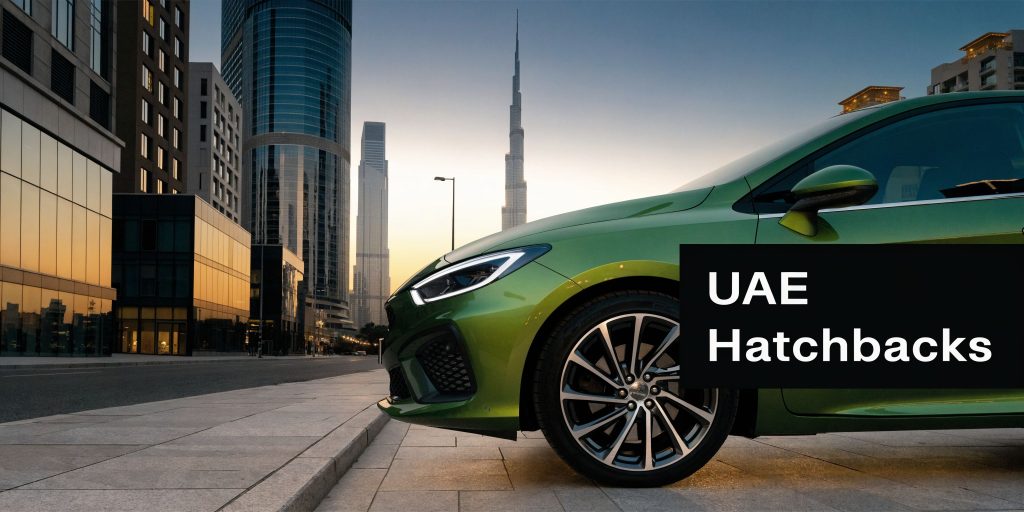
You land in Dubai, step outside into the heat, and immediately see what most visitors see first. Big SUVs, tinted luxury sedans, and roads that look built for confidence.
Then the practical questions start. Where will you park in Downtown? Do you really want a bulky car for hotel drop-offs, DIFC meetings, Marina traffic, and quick runs between malls? If you're staying in the city, bigger isn't always smarter.
That’s where hatchback cars in uae make more sense than many people expect. Not as a compromise, and not only as a budget option. A good hatchback can feel polished, easy to place on the road, and far less tiring to live with in daily Dubai traffic.
Most local round-ups still focus on lower-cost models and first-time buyers. There’s a visible gap around premium hatchback rentals, even though that format suits tourists and executives who want style without the footprint of an SUV. Coverage often centres on budget cars under AED 50k, while upscale short-term options for premium variants are largely ignored, as noted by Cars Club’s hatchback overview for the UAE.
Your Smart Alternative to Navigating Dubai's Roads
A lot of new arrivals make the same assumption. Dubai looks dramatic, so the car should be dramatic too.
That works if you’re doing long family road trips, carrying lots of luggage every day, or you prefer a high seating position. But for many city-based stays, a hatchback is the sharper choice. It’s easier to thread through basement parking, easier to slot into tight hotel bays, and easier to enjoy on roads that switch quickly from open highway to crowded urban turns.
Where hatchbacks win
Premium hatchbacks suit a very specific UAE routine. Think airport to hotel. Hotel to business lunch. Business lunch to Marina. Marina to a dinner reservation where valet space is busy and self-parking is tighter than expected.
In those moments, the appeal isn’t theory. It’s convenience.
- Urban size that doesn’t feel cheap: A compact footprint helps in Dubai’s dense areas without forcing you into an entry-level driving experience.
- Useful rear access: A hatch opening is more practical for shopping bags, cabin luggage, garment bags, and event items.
- Better day-to-day ease: You spend less attention managing the car itself, which matters when you’re already learning routes, Salik gates, and local driving patterns.
A premium hatchback makes the city feel smaller, not because Dubai is small, but because the car takes less effort to live with.
Why this matters to visitors and executives
If you're in Dubai for a short stay, your car doesn’t need to prove a point. It needs to work. That usually means quick manoeuvres, clean styling, decent luggage flexibility, and a cabin that still feels suited to business travel or a weekend out.
That’s why the premium end of the hatchback market deserves more attention than it gets. Models in this category deliver a blend many visitors want but don’t always search for first: smart luxury, city practicality, and lower stress in daily use.
Why a Hatchback is the Perfect Fit for the UAE

A hatchback is the closest thing to a Swiss Army knife on UAE roads. It handles city errands well, deals with motorway merges confidently, and gives you cargo flexibility that a small saloon can’t match as easily.
That matters more in Dubai than many visitors expect. You can go from a smooth Sheikh Zayed Road run to a cramped basement at a mall in the same hour. A car that feels manageable in both places saves time and frustration.
Built for real UAE driving
The strongest hatchbacks don’t just look neat on paper. Their engineering suits how people drive here.
The Peugeot 208 is a good example. Its engine, torque output, and relatively light body help it feel alert without being heavy-footed. It offers good fuel efficiency, and the combination of torque and low weight helps reduce turbo lag in overtakes, especially in typical Sheikh Zayed Road flow. Its 6-speed automatic is also noted as offering 15 to 20% fuel savings compared with less efficient rival setups, according to Cars24’s UAE hatchback review.
That’s the mechanical side. The practical side is easier to feel:
- In traffic: quick response matters more than outright power.
- In service lanes: shorter dimensions help more than a commanding stance.
- In car parks: visibility and tight turning behaviour reduce the mental effort of every stop.
Everyday usability beats showroom size
A hatchback’s biggest advantage in the UAE is that it does several jobs well.
- Mall runs: easier to park at places like Dubai Mall or Mall of the Emirates.
- Beach days: fold the rear seats and load towels, bags, and a small cooler without wrestling with a separate boot.
- Business use: easier drop-offs in crowded hotel entrances and commercial districts.
The driving feel also tends to suit people who spend more time in the city than in the desert. You sit lower, the car feels lighter on its feet, and the whole package is more responsive in urban movement.
A quick walkaround helps if you want to see the format in context.
What doesn’t work as well
Hatchbacks aren’t perfect for every UAE plan.
Practical rule: If your trip revolves around seven people, oversized luggage, or repeated mountain and desert hauling, choose a larger vehicle.
They also don’t provide the higher seating position many drivers like in SUVs. If that high view is essential for you, a hatchback may still feel too close to the road even when it does everything else well.
Exploring Hatchback Segments for Every UAE Journey
Not all hatchback cars in uae serve the same driver. Some are basic commuters. Some are polished premium city cars. Some are performance machines disguised as practical transport. And some are now pushing into EV territory, where the market is still catching up with renter questions.

Economy hatchbacks
This is the segment most guides talk about. It covers the everyday city cars that do short commutes, basic errands, and entry-level ownership well.
They’re useful as a baseline because they show what the hatchback shape already does better than people assume. Even modest models usually feel easy to park, simple to load, and less awkward in dense urban areas than similarly sized sedans.
That said, economy hatchbacks aren’t always what a visitor or executive wants for a polished stay.
Premium hatchbacks
This is the overlooked middle ground. A premium hatchback gives you a more refined cabin, stronger styling, better in-car tech, and a more suitable feel for urban Dubai without stepping into full SUV bulk.
Think of this segment as ideal for:
- Short luxury stays: you want a car that looks intentional at a hotel entrance.
- Corporate travel: you need something neat, modern, and easy to drive across the city.
- Couples and event use: you want style and convenience without renting something oversized.
Models such as the Mini Cooper, Audi A3, or Volkswagen Golf sit naturally here. They’re easier to live with than many larger cars, but they still feel premium enough for business and social use.
If your priority is compact urban driving, a dedicated city-sized option can also make sense. This guide to smart car hire in Dubai is useful for anyone comparing ultra-compact convenience against a more refined hatchback format.
Hot hatches and driver-focused options
Some hatchbacks are about enjoyment first. They still keep the rear hatch and compact footprint, but the attitude changes.
A Golf GTI or similar car suits a driver who wants a sharper throttle response, stronger road presence, and a car that feels entertaining on a night drive without becoming impractical the next morning. In Dubai, that blend has a real audience. You get something expressive without committing to a coupe that’s less useful day to day.
If you enjoy driving, a hot hatch often gives you more personality per metre of car than a larger SUV.
EV and hybrid hatchbacks
This segment warrants attention, but it still comes with unanswered rental questions.
Recent launches such as the BYD Seagull and MG 4 EV are part of a trend that hasn’t yet been well explained for renters, even with Dubai’s EV push. There’s still a gap around charging practicality, route planning, and how realistic these cars are for tourists or short-term executive use. That gap is noted in Zigwheels’ hatchback market overview for the UAE.
For now, petrol hatchbacks remain easier for many visitors because they require less planning. EV hatchbacks are promising, especially for city stays, but the rental conversation around them still needs to become much clearer.
The Financial Case for Choosing a Hatchback in the UAE
A hatchback only makes sense if the numbers work in real life. In the UAE, they often do.
The financial case isn’t just about a lower purchase price, and for renters it isn’t only about the daily rate either. What matters is the full picture: fuel use, demand in the local market, and whether these cars hold their appeal after the first owner or first rental cycle.
Strong demand supports the category
One of the clearest local signals is resale strength. In the UAE used market, the Toyota Yaris averaged AED 37,800 for 2019 models and AED 87,500 for 2023 models, which reflects 131% price appreciation in four years according to dubizzle’s analysis of popular used hatchbacks in the UAE.
That doesn’t mean every hatchback behaves the same way. But it does show something important. Buyers in this market continue to value hatchbacks that are economical, easy to run, and simple to use in city conditions.
Why that matters even if you’re renting
Resale demand affects rental fleets more than many people realise. Cars that stay desirable in the secondary market are easier for fleet operators to rotate and maintain as sensible inventory. In plain terms, that helps keep good hatchbacks in circulation.
For the renter, the practical effect is straightforward:
- Popular models stay available: fleets are more willing to stock cars people want.
- Well-known cars are easier to assess: there’s less guesswork around size, road manners, and usability.
- Running costs stay sensible: especially for city-heavy use.
A separate part of the financial picture is fuel. If you're checking current petrol trends before choosing a rental class, this overview of fuel price in UAE helps frame why efficient city cars remain attractive.
Where hatchbacks save money and where they don’t
Hatchbacks usually make the most sense when your driving is urban, frequent, and varied.
| Consideration | Hatchback outcome in UAE use |
|---|---|
| City fuel use | Usually favourable for daily urban driving |
| Parking friction | Lower than larger vehicles |
| Luggage flexibility | Better than many small saloons |
| Highway comfort | Good, though not always as relaxed as a larger sedan |
| Insurance | Can be slightly higher in some cases |
That last point matters. A hatchback isn’t automatically cheaper in every category. Some can carry slightly higher insurance costs because of repair complexity. So the smart move isn’t to assume “small equals cheapest”. It’s to match the car to the job.
For Dubai-based trips, that job is often commuting between dense destinations, carrying moderate luggage, and avoiding the penalties of unnecessary size.
How to Rent a Premium Hatchback in Dubai
Renting a premium hatchback in Dubai is usually straightforward when you know what to check before you book. The mistakes happen when people focus only on the badge and skip the rental terms.
A useful reality in this market is supply. The UAE used car market averaged 166,400 units sold annually from 2005 to 2023, and sales peaked at over 225,386 units in 2023. TechSci Research also projects the market at USD 22.92 billion in 2026, which supports a steady flow of popular hatchbacks into rental channels over time, as outlined by TechSci Research’s UAE used car market report.
What to check before booking
Start with fit, not flash.
Choose the right trim level
If you’re driving mostly in Dubai, prioritise parking ease, cabin tech, and luggage access over raw size.Confirm the daily rate and what it covers
Premium hatchback rentals in this niche can offer competitive rates, but you should always confirm what’s included in the quoted rate.Read the mileage policy
This matters if you’re planning drives beyond central Dubai.Review insurance options carefully
Basic cover may be included, while stronger protection can be optional. Ask what excess applies and what counts as excluded damage.
Documents and practicalities
Your paperwork depends on whether you’re visiting or living here.
- Tourists: passport, visa entry record where required, driving licence, and in some cases an International Driving Permit depending on your country.
- Residents: Emirates ID and UAE driving licence are typically the starting point.
- Everyone: inspect the car condition before departure and make sure existing marks are logged.
Ask for the exact handover process before arrival. It saves time, and it avoids the usual last-minute confusion around deposits, fuel level, and return location.
If you want the process explained in more detail, this practical guide on how to rent a car in Dubai is worth reviewing before you book.
One sensible booking approach
For premium city use, look for operators that let you browse available cars online, compare specifications clearly, and book without drawn-out counter paperwork. Uptown Rent A Car is one example of that model, with online booking for luxury rentals and rates starting from AED 250 per day.
That setup suits visitors who want speed and residents who don’t want to spend half a day arranging a short-term car.
Hatchback vs SUV vs Sedan Choosing Your Ride in the UAE
Choosing between a hatchback, SUV, and sedan in the UAE comes down to itinerary, not image. Each works well in the right setting. Each becomes annoying in the wrong one.

For business days in central Dubai
If your schedule is DIFC, Downtown, City Walk, and Marina, the hatchback has the cleanest argument. It’s easier to park, easier to place in traffic, and easier to manage in hotel and office basements.
A sedan also works well here if you want a more formal cabin feel. An SUV is the least convenient option unless you specifically value ride height more than manoeuvrability.
For family weekends and heavy packing
For these situations, SUVs earn their place. If you’re heading out with a family, multiple bags, a pram, or bulky leisure gear, the extra space helps.
A hatchback can still handle lighter family use, especially with foldable rear seats, but there’s a limit. If everyone is carrying large luggage, the SUV wins with less compromise.
For mixed use around the city
For mixed use around the city, the hatchback tends to outperform expectations.
- Hatchback: strongest all-rounder for urban practicality
- SUV: strongest for space and a higher seating position
- Sedan: strongest for classic road-trip comfort and a polished executive feel
Choose the smallest car that comfortably fits your actual plan. In Dubai, excess size becomes a daily chore faster than most visitors expect.
If your UAE trip revolves around city movement, valet stops, shopping, dinners, and a few business appointments, a hatchback usually gives the best balance of style and ease.
Find Your Perfect Hatchback with Uptown Rent A Car
The case for hatchback cars in uae is simple. They suit how many people move through Dubai.
They’re easier in traffic, easier in parking, and more flexible than their compact footprint suggests. In premium form, they also look right at home outside a hotel, restaurant, or business venue.

Who benefits most
- Visitors staying in Dubai proper: especially if most journeys are urban.
- Business travellers: when you want something refined but not cumbersome.
- Couples and event guests: where style matters, but so does easy parking and simple luggage access.
What to prioritise
Pick a hatchback with a cabin you’ll enjoy, not just a shape that seems practical. Good visibility, clean infotainment, sensible boot access, and comfortable front seats make more difference than a dramatic exterior alone.
If your plan is mostly city-based, a premium hatchback is often the most rational luxury rental choice you can make. It feels deliberate. It doesn’t overcomplicate the trip. And in Dubai, that counts for a lot.
Frequently Asked Questions About Hatchback Rentals
Do tourists need an International Driving Permit
Sometimes. It depends on your home licence and nationality. Many renters should check this before flying, because the rule can vary by country of issue and rental policy.
Is insurance included in a hatchback rental
Usually, basic cover is included, but the exact protection level can differ. Always confirm the excess, exclusions, and whether stronger cover is available as an add-on.
Can I drive a rental hatchback outside Dubai
In many cases, yes. Inter-emirate travel is commonly allowed, but you should confirm mileage limits and any location restrictions before pickup.
Are hatchbacks suitable for long UAE drives
Yes, if you’re travelling light and don’t need oversized luggage space. For city-to-city drives and typical couple or solo travel, they’re usually very comfortable.
If you want a car that feels stylish without becoming a burden in daily Dubai driving, browse the premium rental options at Uptown Rent A Car. The platform lets you view available vehicles online and book quickly, which is ideal when you want a hatchback that fits both your schedule and the city.