
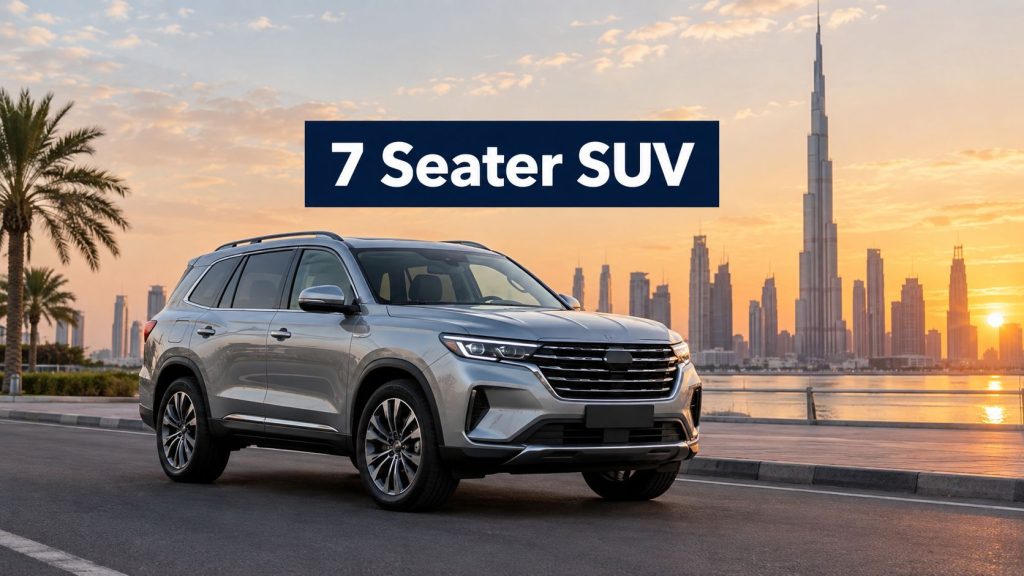
You've just collected your family at Dubai International Airport. There are three children, several suitcases, hand luggage, and a long drive ahead. A normal five-seat car may look cheaper on the booking screen, but it won't solve the problem. Someone will hold a bag on their lap, the children will argue over space, and the final suitcase will sit where a passenger should.
A 7 seater SUV gives you three rows, higher ground clearance, and the flexibility to move a family or group without splitting into two cars. The catch is that “seven seats” doesn't always mean seven comfortable adults with luggage. The useful question is whether the vehicle gives you usable space, easy third-row access, and enough boot room for the trip you've planned.
What a 7 Seater SUV Is and Who It Is Built For
A 7-seater SUV is a sport utility vehicle with three seating rows and enough designated seating positions for seven occupants. It's generally longer than a five-seat SUV, often with a longer wheelbase to create room behind the second row. That extra length is what makes the third row more practical, although the badge alone doesn't guarantee comfort.
A genuine family-sized model should provide proper seatbelts, head restraints, and a reasonably safe route into the back. Some smaller crossovers technically offer seven seats, but their third row may suit children or short journeys rather than adults travelling across the UAE. Treat those vehicles as 5+2 cars, not as full seven-passenger transport.
The main types in Dubai rental fleets
Dubai renters usually encounter two broad categories:
- Full-size three-row SUVs: Toyota Land Cruiser, Nissan Patrol and Chevrolet Tahoe offer a larger cabin, a substantial driving position, and better prospects for adult passengers in row three.
- Family-oriented crossovers: Hyundai Santa Fe, Kia Sorento and Toyota Highlander are easier to handle around city car parks and school zones, but their third rows demand closer inspection.
- Premium SUVs: Some luxury models offer a seven-seat option, but the third row can be an occasional-use feature rather than a daily passenger space.
The UAE market strongly favours SUV-style vehicles. SUVs and crossovers represented 46.58% of vehicle registrations in 2025, while other UAE market coverage put SUVs at 43% of new passenger car sales (UAE SUV market coverage). That makes the format especially relevant for family mobility, airport work, and premium travel in Dubai.
Who should rent one
A three-row SUV makes sense for families with children, groups travelling together, and visitors carrying pushchairs, shopping bags, or sports equipment. It also works well when everyone wants to stay in one vehicle for trips between Dubai, Abu Dhabi, Al Ain, or Hatta.
It's less suitable for two couples with heavy luggage if the third row won't be used. In that case, a large sedan or spacious five-seat SUV usually gives better luggage capacity, easier parking, and a calmer driving experience.
Practical rule: Book a 7-seater because you need space, not because the listing says seven. Ask for the exact seat layout and a photograph of the boot with all rows raised.
Seating Layouts You Will Actually Find
The seating plan changes the rental experience more than many buyers expect. Two SUVs can both carry seven people, yet one may make third-row access straightforward while the other turns every stop into a reshuffling exercise.
Three common arrangements
The first is 2-3-2. Two people sit in front, three occupy a second-row bench, and two use the rear bench. This layout is common in family crossovers such as the Kia Sorento and Toyota Highlander. It gives the second row a proper central seat, which is useful when five people are travelling without using row three, but someone normally has to fold or slide part of the bench to reach the rear.
The second is 2-2-3, with two front seats, two second-row captain's chairs, and a three-person third-row bench. This arrangement appears in large SUVs such as the Toyota Land Cruiser, Nissan Patrol, and Chevrolet Tahoe. Children can usually reach row three through the gap between the captain's chairs, and second-row passengers gain individual armrests. The compromise is obvious. If you need seven adults, the second row no longer has a middle seat.
The third arrangement combines a 2-3-2 layout with a tumble function. The middle bench folds or tips forward to create an opening. It keeps a useful second-row centre seat, but loading child seats can make access more awkward because the seat may not tumble fully with restraints fitted.
| Layout | Configuration | Third-Row Access | Best For |
|---|---|---|---|
| 2-3-2 bench | Two front seats, three-seat middle bench, two-seat rear bench | Through a folded or sliding second-row section | Families that usually carry five people and occasionally use row three |
| 2-2-3 captain's chairs | Two front seats, two individual middle seats, three-seat rear bench | Through the centre gap or by moving a chair | Groups that regularly carry children or adults in the third row |
| 2-3-2 with tumble | Two front seats, middle bench, rear bench | By tipping or folding the middle row forward | Families needing a full second-row bench and flexible access |
What happens at pickup
The layout matters immediately. At the rental counter, the taller passengers usually choose the front or second row, while children are placed in row three. If the vehicle has a bench that doesn't slide easily, you'll be lifting bags out of the way before anyone can climb in.
Captain's chairs are generally the better choice for frequent third-row use, especially with young children. A bench is better when you need three people across the middle and the third row is only occasional.
Don't judge access while the SUV is empty. Test it with a child seat, a day bag, and someone who will sit in the back. That reveals more than a showroom walk-around.
Dimensions, Cabin Space and Luggage Reality
A long body doesn't automatically create a useful family cabin. The important measurements are wheelbase, overall width, and the cargo area left behind the third row.
The Toyota Land Cruiser provides a useful reference point with a 2,850 mm wheelbase, roughly 1,980 mm of width, and around 1,100 litres of cargo space behind the third row, as commonly listed in UAE vehicle specifications and market references. The Nissan Patrol stretches to a 3,075 mm wheelbase, while the Chevrolet Tahoe uses a 2,946 mm wheelbase. These figures are cited in the relevant UAE 7-seater market guide (UAE 7-seater SUV guide).
Turning measurements into comfort
Wheelbase is the distance between the front and rear axles. A longer wheelbase usually gives the manufacturer more room to position the second and third rows without forcing passengers directly against the wheel arches.
For a renter, that translates into a simple test. Sit in the second row, adjust the seat for a taller adult, and then ask an adult to sit directly behind you. If the rear passenger's knees press into the seatback, the SUV may be a seven-seater on paper but not a comfortable inter-emirate vehicle.
Width matters too. A wide body can make a second-row bench more tolerable, especially when two child seats leave a parent or helper in the centre. It also affects parking. The same width that gives you shoulder room can make a Dubai Marina basement or DIFC podium feel narrow.
| Model | Wheelbase (mm) | Cargo Behind Row 3 (L) | Notes |
|---|---|---|---|
| Toyota Land Cruiser | 2,850 | Around 1,100 | Large cabin reference with substantial space behind the third row |
| Nissan Patrol | 3,075 | Not specified in the verified data | Long wheelbase supports a spacious three-row format |
| Chevrolet Tahoe | 2,946 | Not specified in the verified data | Full-size SUV suited to passenger-heavy highway use |
| DFSK Fengon 600 | 2,785 | 347 | UAE-listed packaging example with a 4,720 mm body and six-seat specification (DFSK UAE specifications) |
The boot test you should use
Load the luggage before leaving the depot. With all three rows upright, suitcases occupy more space than soft bags, and the boot floor may be shallow or irregular. A full cabin of passengers can leave less flexibility than the brochure suggests.
For airport transfers, ask whether the operator can provide a roof solution or a different vehicle if your bags exceed the available boot. Roof rails and a suitable carrier can matter more than a polished cargo figure, but don't assume you can add equipment to a rental SUV without approval.
The useful measurement isn't the number of seats. It's the amount of room left after every passenger and every bag has been loaded.
Real-World Use Cases in Dubai
A 7-seater SUV earns its cost when it solves a specific transport problem. It isn't automatically the right choice for every Dubai itinerary.
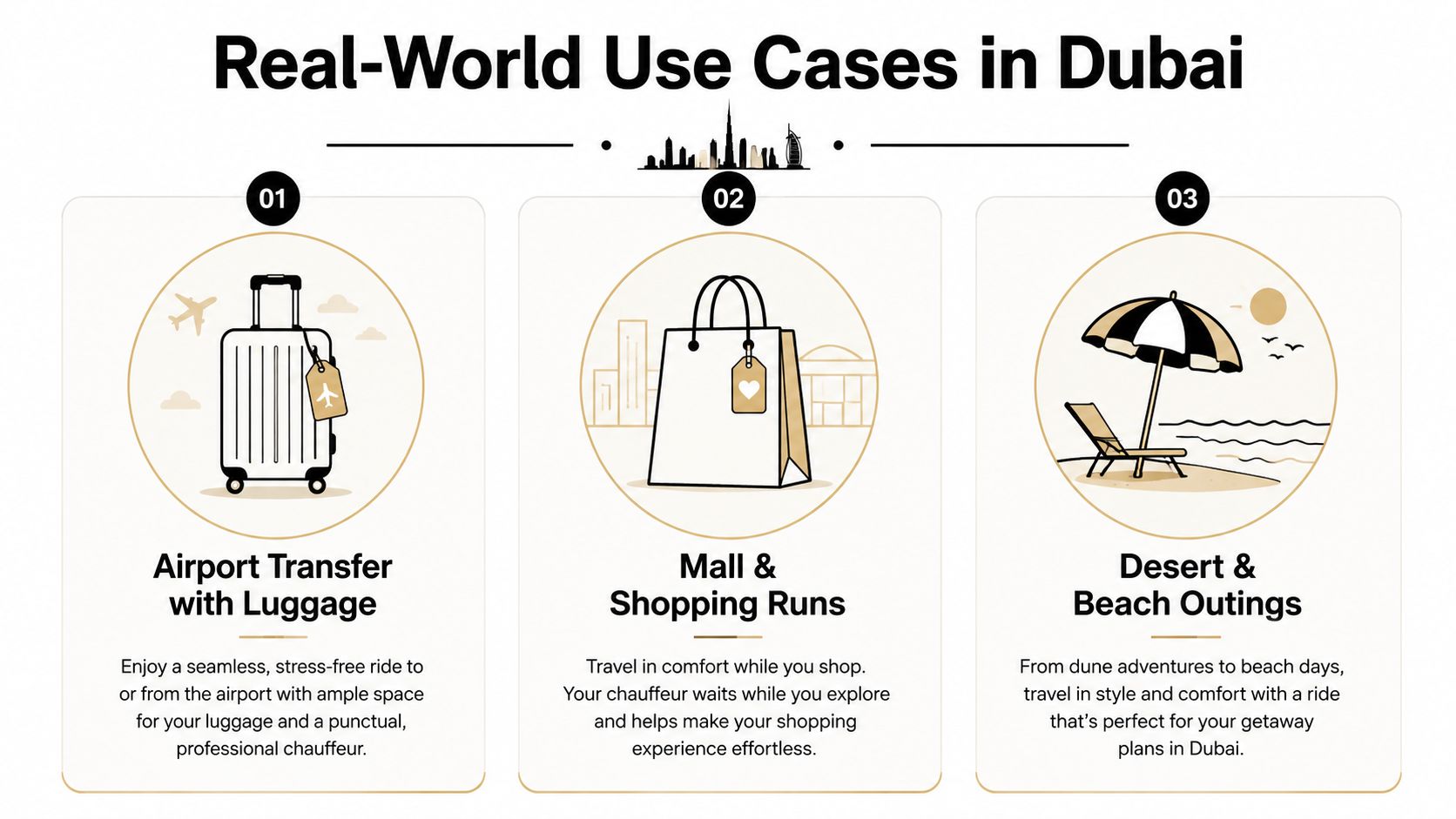
A family landing at DXB
Take two parents, two children, and a helper travelling with a stroller, cabin bags, and holiday luggage. The family doesn't need impressive acceleration. They need an easy path into row three, accessible child-seat anchors, and a second row that can hold children without blocking the rear entrance.
A captain's-chair layout can work well here because a child can reach the third row through the middle gap. A tumble mechanism is also useful, but only if it still works with the child seats installed. Before accepting the vehicle, fit the actual seats and check that the remaining passenger can buckle in without leaning across the cabin.
A group heading out of the city
Now consider four adults and two teenagers travelling from Dubai Marina towards Hatta or the Abu Dhabi Grand Prix. The group may manage well in a large SUV with a split-folding rear bench, but the arrangement has to let passengers share the cabin without sacrificing every bag and water cooler.
The key feature is flexible seat folding. One side of the third row should fold while the other remains available, allowing the group to carry equipment without removing a passenger. A full-size model with a longer wheelbase will usually feel less compromised when several adults occupy the rear.
An airport transfer with serious luggage
Six passengers arriving on a wide-body flight can create a different problem. If each traveller has a large suitcase, the number of passengers becomes less important than the usable boot behind row three.
A vehicle that looks spacious can fail at the kerb. The driver may need to place luggage on an unoccupied seat, leave bags loose in the cabin, or make a second trip. For professional transfers, check the boot with the seats raised before confirming the booking, especially if the passengers are travelling with rigid cases.
Dubai's SUV demand is broad and premium-led. In H1 2026, Toyota attracted more than 10.4 million SUV searches in the UAE, Nissan drew 8.6 million, and the Nissan Patrol recorded over 4.1 million views, ranking as the country's most-viewed SUV model (UAE SUV search demand). Interest is strong, but the correct choice still depends on what happens after the third row is occupied.
Pros and Cons of Choosing a 7 Seater SUV
The strongest reason to rent a three-row SUV is flexibility. You can carry seven people for one journey, fold seats for shopping on the next, and keep everyone together during a long UAE drive.
What you gain
- Real passenger capacity: A proper third row gives passengers their own seatbelts and head restraints instead of relying on improvised seating.
- Better family organisation: Children, a helper, or teenagers can sit separately, while parents keep the front seats clear and the cabin less chaotic.
- Higher driving position: The raised view helps you read traffic around busy junctions and crowded mall approaches.
- Useful versatility: Folded rear seats can accommodate pushchairs, shopping, beach equipment, and holiday bags.
- Strong fleet presence: Popular SUV models are widely represented in Dubai rental fleets, giving customers more choice when a particular trim or colour isn't available.
What you absorb
Parking is the first penalty. A full-size SUV can be tiring in Marina Towers, tight residential ramps, and DIFC podiums. You'll need to use mirrors carefully, leave more space when opening doors, and accept that some bays aren't comfortable.
The third row also consumes boot capacity. If all seven seats are in use, luggage may compete with passengers. That's manageable for shopping bags and soft luggage, but it can become a problem at airport pickup.
Fuel use is another practical cost. A large petrol SUV generally consumes more fuel than a sedan during city driving and long runs towards Al Ain. Salik charges and premium parking can also raise the trip cost beyond the advertised daily rental rate.
Before you accept the vehicle, understand collision cover and the excess. The collision damage waiver insurance guide explains why the headline rental price isn't the same as your total financial exposure.
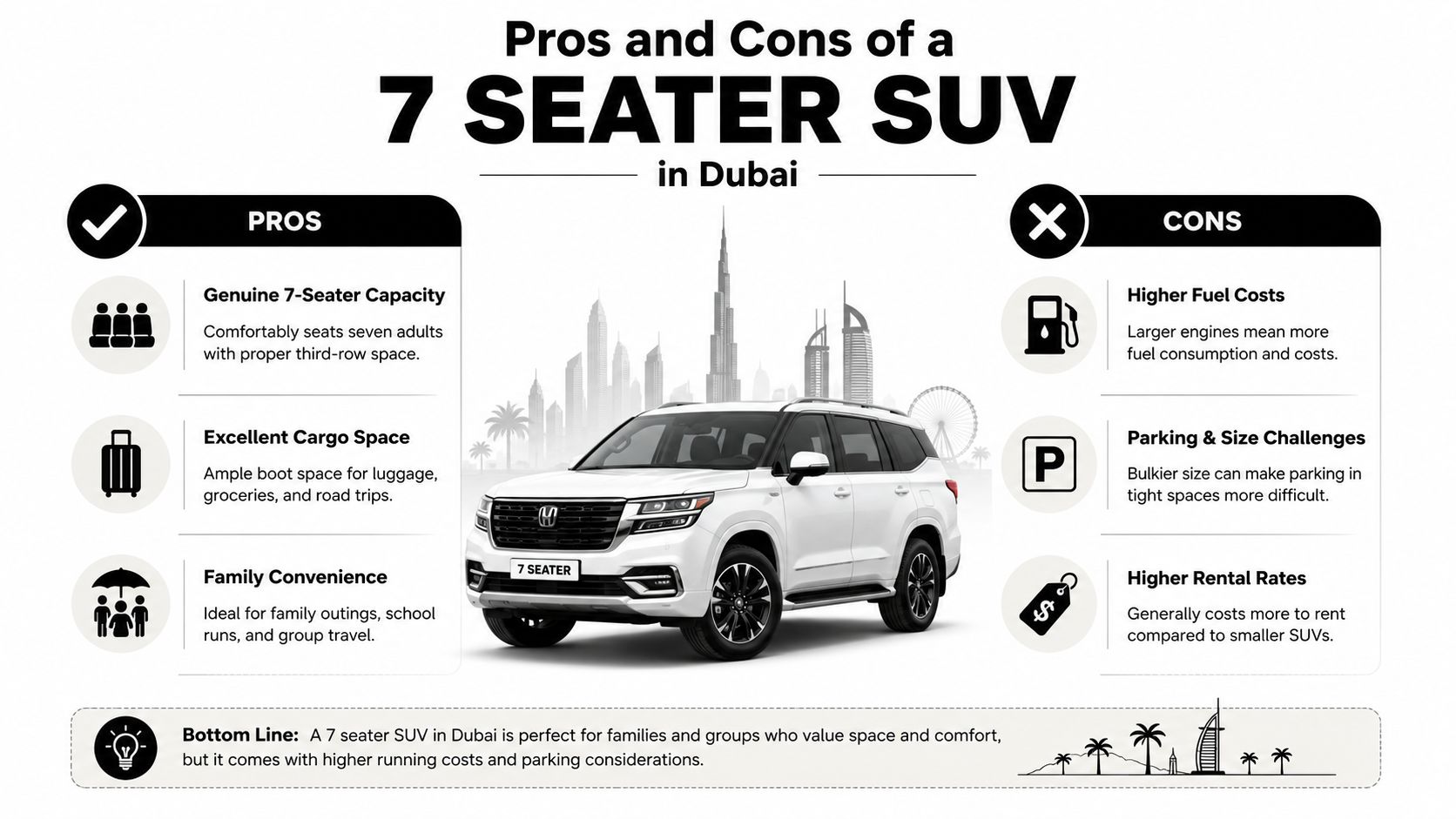
The trade-off is simple: you pay for seating flexibility and cabin height, then absorb the penalties of size, fuel, parking and luggage compromise.
How to Rent a 7 Seater SUV in Dubai
Start with the itinerary, not the model badge. A rental that works for school runs may be the wrong tool for a desert excursion, while a full-size Patrol may be unnecessary for a couple staying around Downtown Dubai.
Book early and select the right category
For peak December, March and Eid periods, reserve two to three weeks ahead. Online booking is often more competitive than walking up to an airport counter, and early planning gives you time to verify the exact configuration rather than accepting whatever is available.
Use the trip to narrow the fleet:
- City driving: Hyundai Santa Fe or Kia Sorento suits renters who care about easier parking and manageable dimensions.
- Desert-oriented travel: Toyota Prado or Nissan Patrol gives you a more suitable starting point, but confirm the rental company's off-road rules before leaving paved roads.
- Airport and highway work: Chevrolet Tahoe or GMC Yukon prioritises broad passenger space and relaxed cruising.
Confirm the financial terms
Ask for the written rental conditions before payment. Cover is common in the UAE, but the excess, third-party liability, off-road exclusions, and beach-driving restrictions still need confirmation.
Check these points directly:
- Deposit: Confirm the card hold, release process, and accepted card type. Some operators quote a deposit in the AED 1,500 to AED 3,000 range, so ask for the exact amount for your selected vehicle.
- Mileage: Verify the daily allowance. Some agreements use 250 km per day, with a per-kilometre fee beyond the limit.
- Additional driver: Check whether another driver is included or charged separately.
- Child seats: Reserve the correct type in advance. Don't assume the vehicle will arrive with one.
- Permitted roads: Get written confirmation for Hatta, desert tracks, beaches, and border travel.
The all-inclusive rental package information can help you compare what is included rather than judging offers by the daily rate alone.
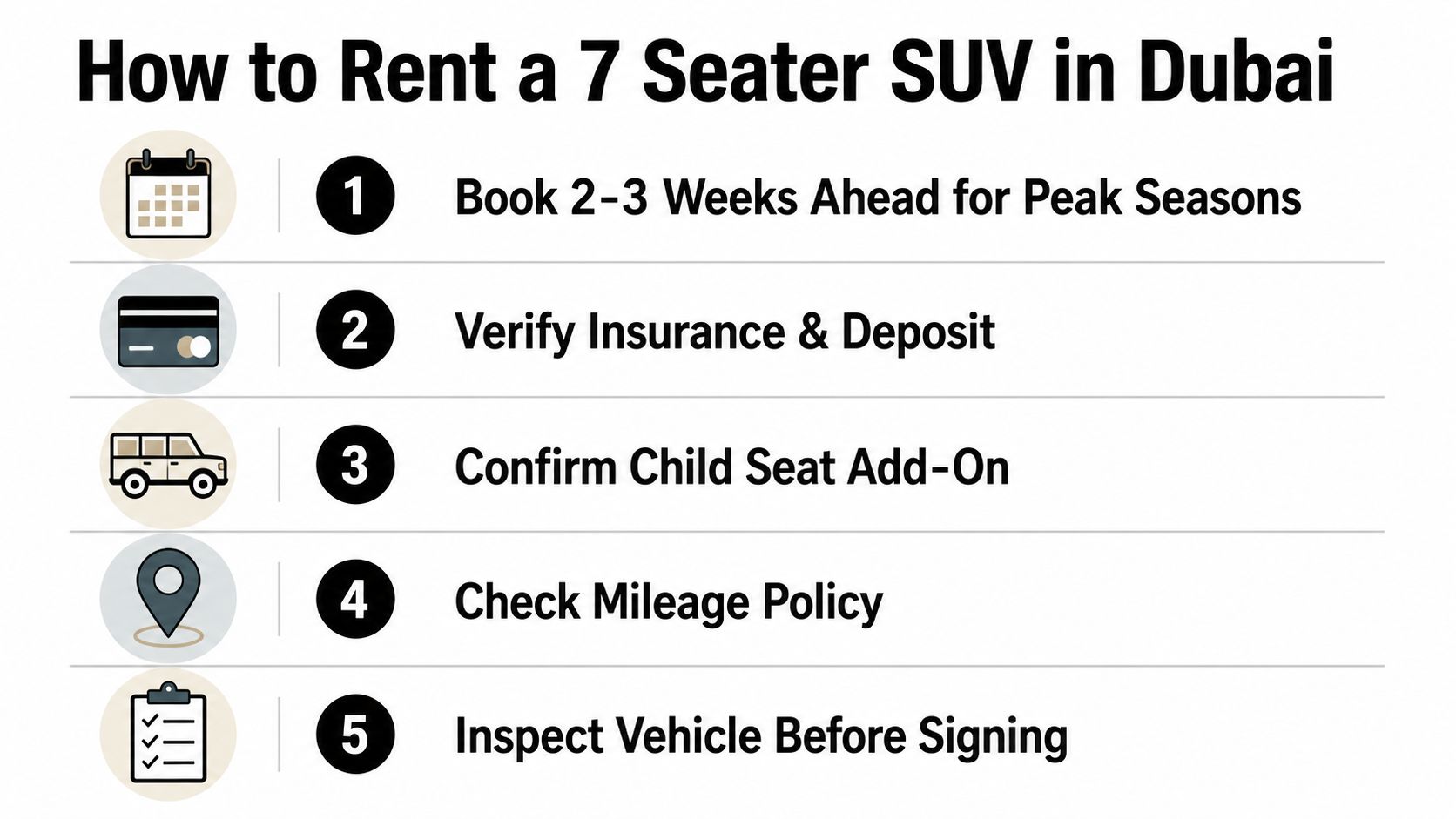
At pickup, photograph every side of the vehicle, including wheels and glass. Ask the staff to record scratches, dents, kerb marks, and windscreen chips on the agreement before you drive away.
Test every seatbelt, move the second-row seats, open the tailgate, and inspect the spare tyre or tyre-repair kit. Check the air conditioning in all rows, because Dubai heat makes rear ventilation a practical necessity rather than a luxury.
At drop-off, refuel to the agreed level, remove personal items from every row, and return the SUV during staffed hours when possible. Ask for a return inspection and keep the signed paperwork until the deposit release is complete.
Picking the Right 7 Seater SUV for Your Trip
Match the vehicle to the passenger pattern and luggage load. Brand prestige comes later.
For an airport transfer with light luggage, a Chevrolet Tahoe or Nissan Patrol is a sensible choice. Both offer a substantial cabin and a more adult-friendly route to row three than many compact crossovers. If the transfer involves several large cases, inspect the actual boot instead of trusting the seat count.
A week-long family stay needs a different priority. Strollers, shopping, beach gear and suitcases quickly expose a short-wheelbase layout. Choose a model with strong second-row legroom and a third row that folds cleanly, such as a Toyota Land Cruiser or Mitsubishi Pajero Sport, then confirm the exact rental configuration before signing.
Match features to the journey
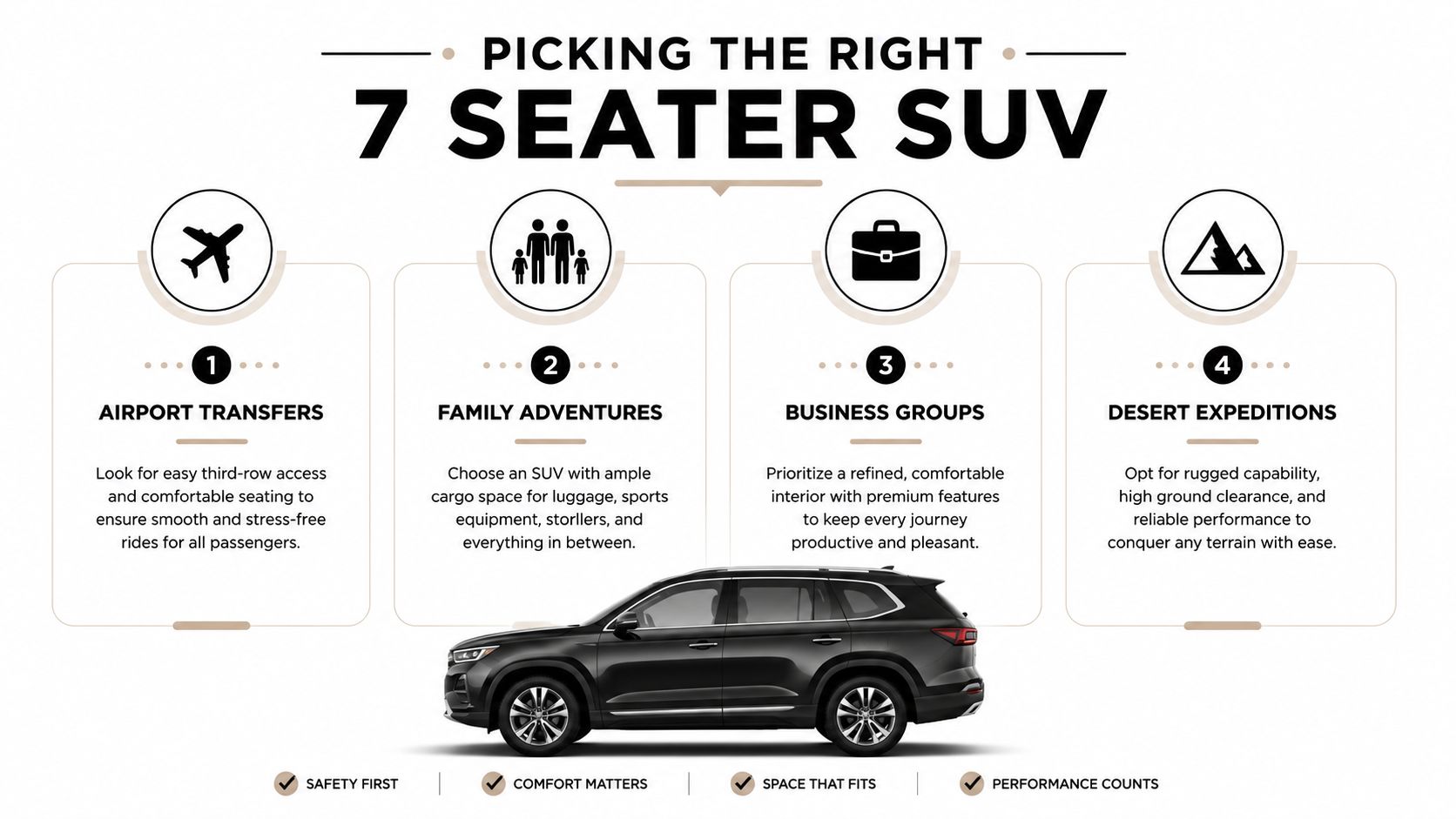
- Airport transfers: Prioritise a wide tailgate opening, quick third-row access and enough boot depth for the expected cases.
- Family adventures: Choose split-folding rear seats, accessible child-seat anchors and rear air conditioning.
- Business groups: Give second-row adults proper legroom, individual armrests and easy entry rather than sacrificing comfort for a luxury badge.
- Desert expeditions: Insist on four-wheel drive, sensible ground clearance and tyres suited to the permitted route. Never assume a seven-seater rental is approved for off-road use.
Electric SUVs can be worth considering for urban driving, particularly when lower running noise and charging access fit the itinerary. For broader context on range-focused electric models, review EV Stats best SUV range, then confirm local availability, charging arrangements and the exact seven-seat configuration in Dubai.
A 7-seater is the wrong tool for two couples on a city break, a short transfer with bulky luggage, or any journey where five people can travel comfortably in a better-packaged car. A spacious sedan may give you more boot room and easier access to hotel entrances.
Before collection, use a detailed vehicle inspection checklist and record the condition with photographs. For most Dubai family rentals, choose the vehicle that protects second-row comfort first, third-row usability second, and brand prestige last.
Uptown Rent A Car offers Dubai rentals with seven-seat options including models such as the Nissan Patrol, Toyota Land Cruiser, Chevrolet Tahoe and Hyundai Palisade, subject to availability and booking configuration. Visit Uptown Rent A Car to compare the available SUVs, confirm luggage suitability, and arrange a vehicle that matches your passengers and route.