
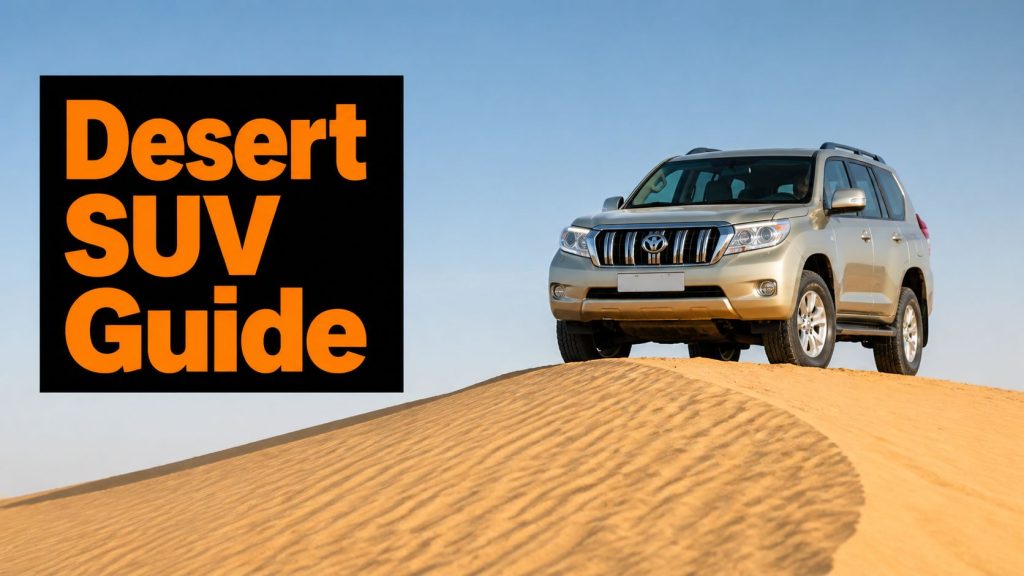
You've booked a glossy three-row SUV outside your Dubai hotel. Seven people climb in, the luggage is pushed around the third row, and everyone assumes the desert will be as easy as the motorway. Then the tyres start spinning in soft sand, the rear passengers lose their legroom, and the vehicle's impressive badge suddenly matters far less than its drivetrain, tyre setup and usable cargo space.
That's the ultimate test of a 7 seater off road SUV in the UAE. It must carry passengers, child seats, coolers and recovery equipment, then handle sand without turning a family outing into a recovery call. The UAE market already treats seven-seat SUVs as a mainstream choice. One major marketplace lists 3,785 new seven-seater cars across the UAE and 3,724 in Dubai, with average starting prices of about AED 114,902 nationally and AED 115,000 in Dubai (UAE seven-seater listings and market benchmarks). The choice is broad, but not every large SUV is prepared for dunes.
Why a Standard Family SUV Often Falls Short in the Desert
The problem usually appears before the first dune. A family collects a large SUV from a hotel, loads the boot with a stroller and cooler, places children in the middle row, then folds or squeezes luggage around the third-row passengers. The vehicle looks spacious from outside, but with all seats occupied, the remaining cargo area can be surprisingly restrictive.
On the road, a soft-riding family SUV feels comfortable and composed. In sand, those same road-focused priorities can work against you. All-season tyres, limited ground clearance, a low front air intake and an AWD system designed for wet roads don't provide the same control as a proper 4WD system with suitable sand settings.
The showroom promise is not a desert specification
A seven-seat layout tells you how many people the cabin can accommodate. It doesn't tell you whether those people can travel with luggage, whether a child seat fits correctly, or whether the vehicle can climb a dune without overheating or burying its tyres.
Urban family SUVs often lack several features that matter off-road:
- Low-range gearing: Without it, the driver has fewer options when the vehicle needs controlled torque at low speed.
- Appropriate tyre construction: Road-biased rubber can lose traction quickly in soft sand.
- Underbody protection: Exposed components face greater risk on uneven approaches and sharp transitions.
- Recovery points: Decorative tow hooks aren't automatically rated recovery equipment.
- Cooling capacity: Sustained sand driving places more demand on the engine and transmission than normal city use.
The most common family mistake is choosing by body size alone. A large crossover may have a generous cabin but still lack the traction management, clearance and recovery provisions needed for dunes. UAE off-road guidance reports that 4WD-equipped SUVs completed challenging terrain at an 89% success rate, compared with 41% for AWD-only vehicles, while 68% of recoveries involved drivers who didn't understand drivetrain limits (UAE AWD and 4WD desert analysis).
Practical rule: If the rental advisor can't clearly explain the vehicle's 4WD system, sand mode, recovery points and tyre policy, don't take it into the dunes with a full family.
The right SUV solves the logistics problem before the journey begins. You need enough third-row ventilation, accessible child-seat anchors, stable handling when fully loaded and a boot plan that doesn't leave recovery gear under everyone's feet.
Off-Road Features to Demand in a 7 Seater SUV
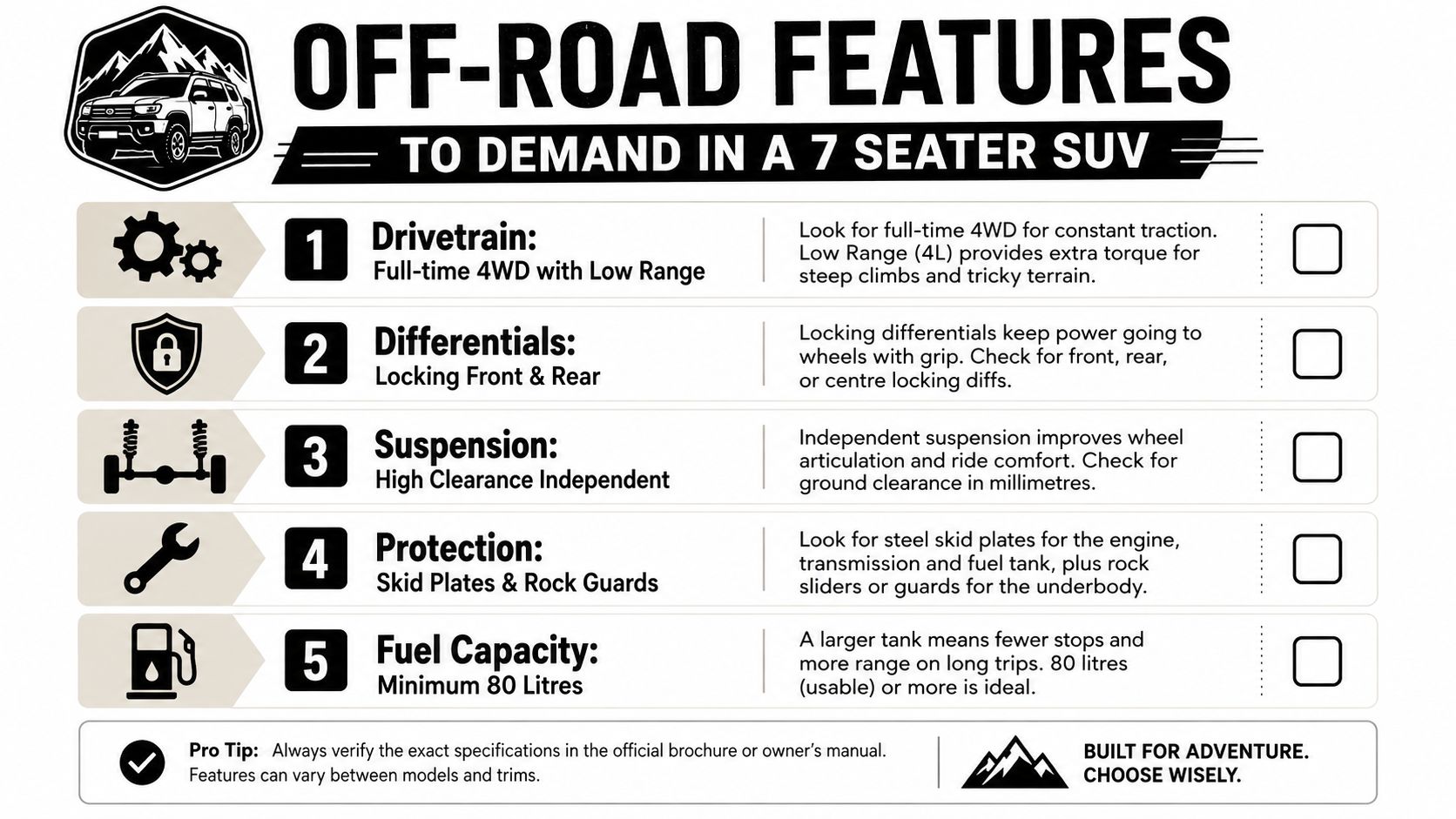
Start with the drivetrain. For serious desert use, look for true 4WD, preferably with low-range gearing or a terrain-management system designed specifically for sand. A system that automatically sends torque between the axles can be useful on roads, but it isn't the same as a selectable 4WD setup that gives the driver more control when the surface becomes deep and loose.
Check the rental specification sheet rather than relying on the model name. Confirm whether the SUV offers low range, a dedicated sand mode, hill-descent control and differential-lock functions. If the advisor describes the vehicle only as “all-wheel drive”, ask whether it has the hardware and software intended for sustained off-road use.
Look underneath, not just at the badge
Ground clearance matters when the vehicle crosses a dune crest or drops into a trough. The brief for this guide uses above 220 mm as a practical benchmark, but clearance alone won't save a badly driven SUV. Approach and departure angles also determine whether the front or rear bumper contacts the sand during a transition.
Then inspect the protection package:
- Skid plates and rock guards: These reduce exposure for vulnerable underbody components.
- Rated recovery points: Confirm that the front and rear points are designed for recovery loads and not merely visual styling.
- All-terrain tyres: Chunkier sidewalls and more suitable tread patterns offer a better starting point than standard road tyres.
- Cooling equipment: Sand driving generates sustained heat, so the engine and transmission cooling system must be in good condition.
- Fuel capacity: The supplied infographic identifies 80 litres as a useful reference point for a desert-oriented seven-seater, but the actual rental specification still needs checking.
The cabin deserves equal attention. Third-row passengers need proper ventilation, not just a small air outlet that struggles in summer. Middle-row child-seat anchors must be accessible with the seat installed, and every seatbelt should latch without forcing passengers to twist around luggage.
The GWM Tank 500 shows how the UAE market positions this category. The local distributor describes it as a seven-seat luxury off-road SUV, with pricing from AED 164,900 plus VAT (GWM UAE Tank 500 information). That positioning is useful, but the same inspection still applies. A premium badge doesn't replace a tyre check, recovery plan or sensible loading.
Popular 7 Seater Off Road SUVs in the UAE Compared
A desert family comparison should begin with the third row, not the engine output. The key questions are simple. Can seven occupants sit comfortably? Is there useful luggage space behind them? Can the vehicle carry a cooler and recovery equipment without blocking visibility or access?
The UAE market covers everything from accessible family SUVs to luxury models. Regional listings place examples such as the Nissan X-Terra from AED 104,000, Haval H9 from AED 109,900, Hyundai Santa Fe from AED 129,000, Honda Pilot from AED 176,000 and Land Rover Defender 130 from AED 232,785, while the wider seven-seat market reaches from the Toyota Veloz to the BMW X7 (UAE seven-seat SUV pricing and model coverage). Prices don't answer the practical question, so use the following rental-focused matrix.
| Model | Ground Clearance | 3rd-Row Space (7 Occupants) | Luggage With 7 Seats | Off-Road Hardware | Best For |
|---|---|---|---|---|---|
| Toyota Land Cruiser 300 | Strong desert clearance | Adult-friendly for family use | Useful for soft bags and a compact cooler | Serious 4WD capability and established desert support | Families prioritising reliability and dune confidence |
| Nissan Patrol | Strong clearance and large body | One of the more comfortable choices for a full cabin | Better than most, though bulky luggage still needs planning | Robust 4WD systems on suitable grades | Larger families, executives and longer desert days |
| Chevrolet Tahoe | Road-focused large-SUV stance | Spacious, especially for children | Strong cabin volume, but loading height matters | Verify the exact trim and recovery equipment | Families needing interior room with occasional off-road use |
| Ford Expedition | Large three-row layout | Comfortable for passengers | Among the more practical options for family luggage | Confirm 4WD, sand mode and tyre specification | Seven passengers carrying substantial soft luggage |
| Land Rover Defender 130 | High stance and capable geometry | Good passenger flexibility | Can work well, but the third row still consumes usable cargo room | Advanced terrain systems and strong off-road credentials | Premium desert touring where comfort and capability both matter |
The Land Cruiser 300 and Nissan Patrol are my first choices when the route includes meaningful dunes and the family wants a vehicle that feels predictable under load. The Expedition is the strongest logistics choice when luggage volume matters, provided the rental unit has the right 4WD equipment. The Tahoe can be excellent for space, but never assume every trim is desert-ready.
The Defender 130 earns its place when clients want luxury and capable terrain management, but its premium cabin doesn't eliminate the third-row cargo compromise. For a vehicle-focused Dubai trip, compare the available fleet through Dubai desert safari vehicles, then ask specifically about luggage space with all seven seats in use.
My recommendation: Choose the Land Cruiser 300 or Patrol for demanding dunes, the Expedition for family logistics, and the Defender 130 for premium comfort with carefully controlled luggage.
Pre-Departure Safety Checks You Should Never Skip
Don't leave Dubai city limits until the vehicle passes a physical check. A clean exterior and full fuel tank tell you almost nothing about its readiness for sand. The order below keeps the inspection practical and prevents the family from discovering a problem halfway to the dunes.
Start at the tyres
Inspect each tyre's tread, valve area and sidewall for cuts, bulges or previous damage. Check the spare tyre, jack and wheel tools before reducing pressure. Tyre pressure should be adjusted only within the manufacturer's safe off-road guidance and with a reliable gauge, not by guesswork.
Next, open the bonnet. Check coolant and washer-fluid levels, look for visible leaks and ask the rental company whether the vehicle has recently completed a desert inspection. Sand driving can expose cooling weaknesses that never appear during a short city journey.
Test the cabin and controls
Every passenger must have a functioning seatbelt. Sit in each position, latch each belt and verify that child seats attach firmly to the available anchors. Dubai requires seat-belt compliance, and restraint becomes even more important when a tall, heavily loaded SUV changes direction on uneven ground.
Test the controls before departure:
- Sand mode: Confirm how to select it and whether the system changes throttle and traction behaviour.
- Low range: Engage it only as instructed and verify that the indicator appears correctly.
- Hill descent control: Test the activation procedure on a safe, flat location.
- Differential locks: Ask when they should be used and confirm that the warning lights behave normally.
- Off-road ABS settings: Check the vehicle manual or rental advisor's instructions before entering sand.
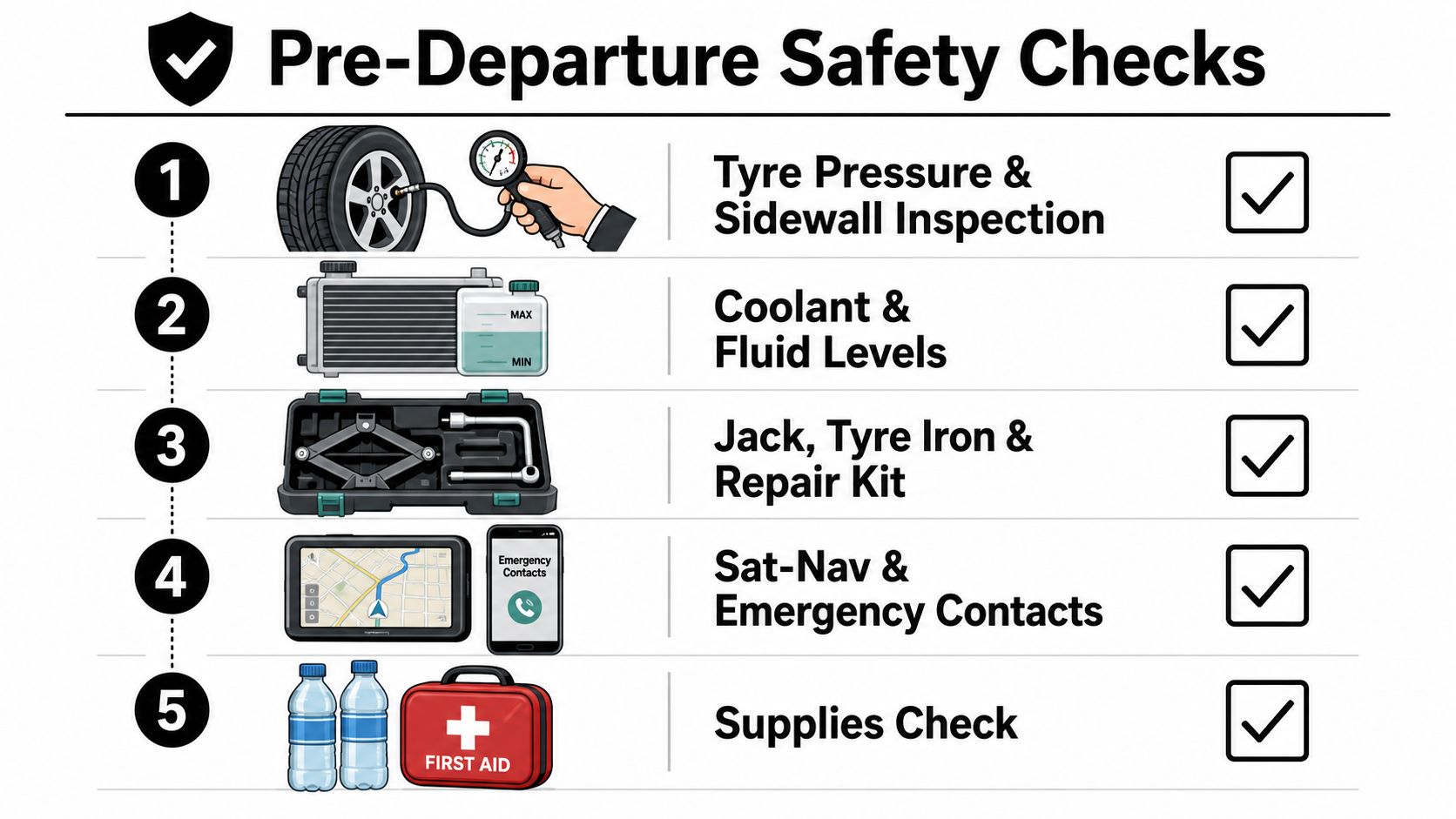
The final check is communication. Save the rental company's number, confirm the planned route, check whether signal is expected along it and locate the recovery equipment. Photograph the vehicle, wheels, bumpers and interior before moving off. That record protects both sides and gives you a useful reference if a warning light or tyre issue appears later.
UAE safety commentary warns that tall, boxy SUVs have greater rollover exposure during abrupt manoeuvres, while a vehicle-dynamics study reported that emergency braking at 80 km/h on curved grades reduced rollover safety margin by 11% to 5%, depending on curve radius (UAE-relevant SUV safety commentary). Keep the load balanced, drive smoothly and treat every passenger belt as essential equipment.
Smart Packing for Seven Passengers and a Desert Day
With all seven seats occupied, the boot isn't a warehouse. Pack as though the third row will remain upright for the entire journey, because folding a seat after departure usually means disturbing passengers, child seats and the vehicle's balance.
Give each passenger a small, soft bag instead of allowing hard cases to fill the cargo area. Water, sun protection and a light layer should be distributed through the cabin, while shared items stay low and close to the centre of the vehicle.
Build the load around people first
The supplied packing guide uses three litres of water per person as its reference. Treat that as a planning benchmark from the visual guide, then account for the season, route and the advice of your desert operator. Add hats, sunscreen, sunglasses, light clothing and an evening layer, especially if the trip extends beyond the hottest part of the day.
Families regularly forget the items that make a full vehicle uncomfortable:
- Child sun shades: Third-row glass can create direct heat and glare.
- Rear chargers: Passengers shouldn't need to share one front-seat charging port.
- First-aid kit: Keep it reachable rather than buried under luggage.
- Rubbish bag: A secure bag prevents wrappers and sand-covered tissues from spreading through the cabin.
- Small towels: Useful after children handle sand, drinks and snacks.
Recovery equipment needs its own plan. Keep a tyre deflator, pressure gauge, shovel and traction boards where they can be reached without unloading the vehicle. The second-row footwell can be more practical than the boot, provided equipment is secured and doesn't interfere with passengers or belts.
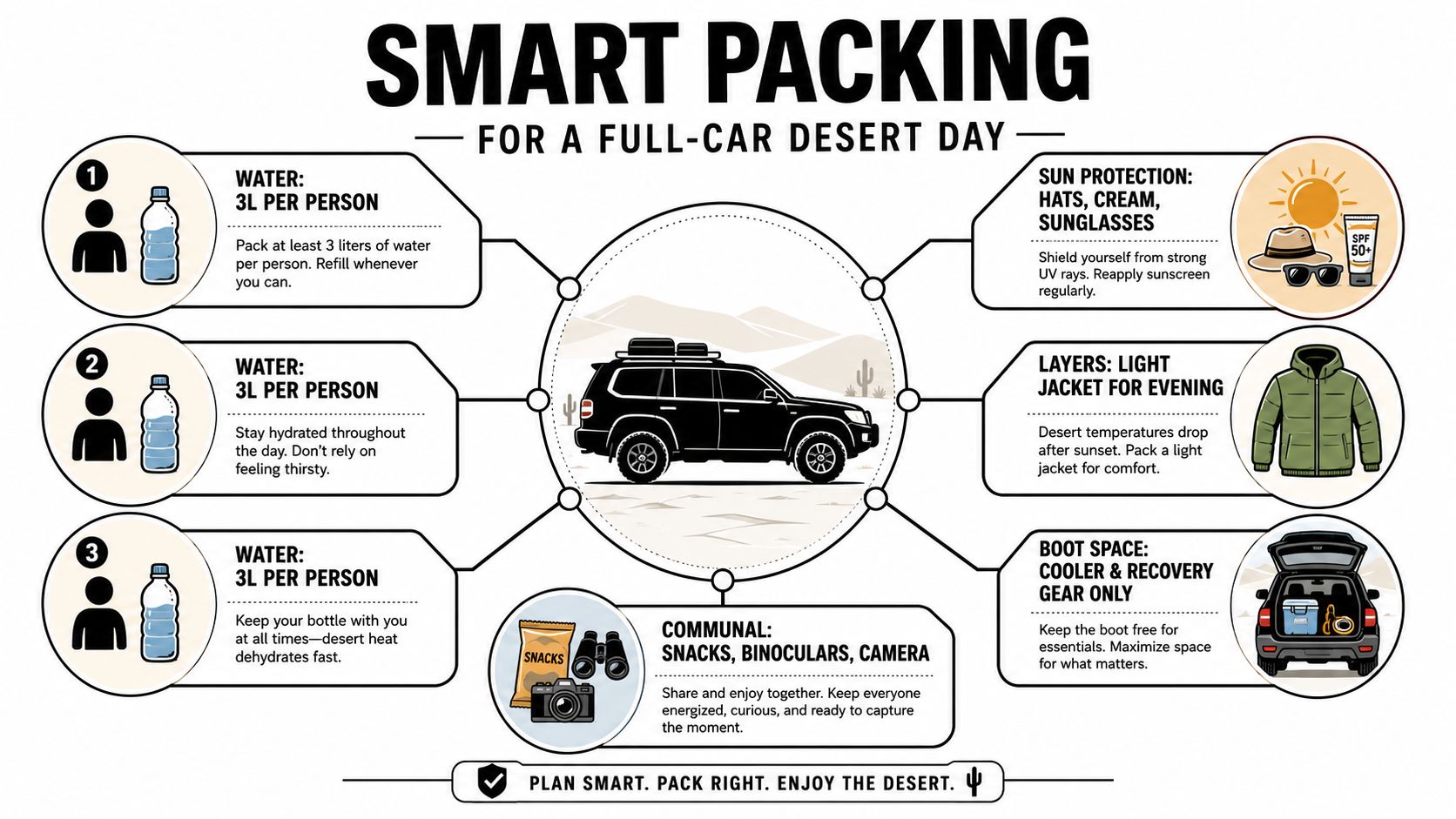
Load heavier items low, place them near the centre of the vehicle and avoid stacking weight high behind the third row. Soft bags fit around the cabin better than rigid suitcases, and a cooler should be secured so it can't move during braking. The final arrangement should let the driver see through the mirrors and reach the recovery kit without asking every passenger to get out.
Driving Techniques That Keep You Moving on Sand
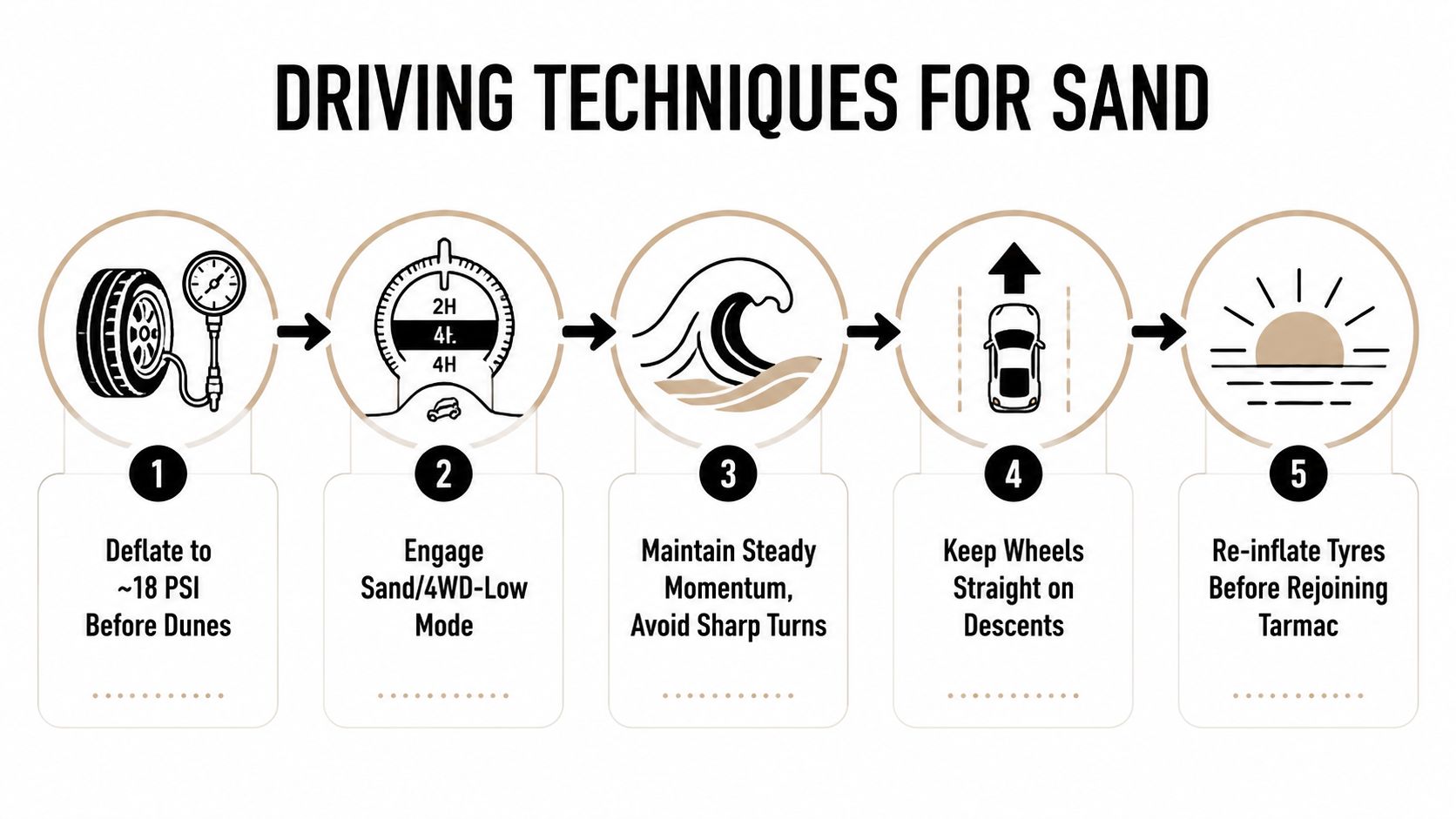
The drive starts before the dunes. Stop on firm ground, deflate the tyres to the manufacturer's approved sand-driving range and use a gauge to confirm the result. The visual guide supplied for this article uses approximately 18 PSI before reaching the dunes, but the rental vehicle's specification and tyre condition take priority.
Select the correct sand or 4WD setting before the surface becomes difficult. Entering soft sand with the wrong mode encourages wheel spin, and an overconfident throttle input can dig a heavy seven-seater down faster than most families expect.
Treat every dune as a sequence
Approach an ascent with steady momentum rather than a sudden burst of acceleration. Keep the steering smooth and avoid sharp turns that increase resistance. If the vehicle begins to lose speed, don't just bury the accelerator. Ease off, keep the wheels as straight as possible and decide whether reversing along the existing track is safer.
At the crest, slow the decision down. You don't know what lies beyond the top, so avoid launching the front of the SUV over the edge. On a descent, point the vehicle nose-down along a controlled line, use the appropriate descent system if fitted and avoid sharp braking that can dig the front tyres into the sand.
Surface colour and texture provide useful clues. Firmer, compacted tracks are generally easier to maintain than pale, loose sand, but previous tracks can conceal ruts or abrupt changes. Follow a route that matches the vehicle, passenger load and driver's experience instead of chasing the steepest visible line.
Watch this sand-driving technique video before departure and review the rental company's instructions for the exact SUV.
If the vehicle stops, stop spinning the wheels. Clear sand from around the tyres, create a gentle exit path, use traction boards if available and try a controlled recovery. Reinflate gradually before returning to tarmac, and don't continue digging once the vehicle is resting on its underbody. At that point, call the agreed recovery contact. Drivers who understand the limits of AWD and 4WD avoid many of the recoveries reported in UAE desert guidance, where 73% of non-mechanical desert recoveries during peak season involved AWD vehicles (UAE desert drivetrain guidance).
For a controlled alternative, review the requirements for a Dubai self-drive desert safari before choosing a route.
Dubai Rental Requirements and Final Booking Checklist
Dubai rental rules vary by company, vehicle category and driver profile, so confirm everything in writing before payment. A UAE or GCC driving licence may be accepted for eligible drivers, while tourists generally need a driving licence and an accepted international permit where the rental company requires one. Minimum age requirements can fall between 21 and 25, depending on the fleet category.
Ask for the complete cost rather than a daily rate alone. A credit-card security deposit commonly sits between AED 2,000 and AED 5,000, and desert use may require full insurance with an off-road add-on or separate third-party cover. Never assume normal road insurance covers dunes. Written permission to leave paved roads is essential.
Confirm these points before signing
- Licence approval: Send every driver's licence and identification documents for confirmation.
- Age and additional-driver rules: Check whether each person meets the vehicle category requirement.
- Insurance scope: Confirm desert, off-road and recovery coverage in writing.
- Security deposit: Verify the amount, payment method and release process.
- Off-road permission: Get written approval for sand and desert routes.
- Tyre condition: Photograph tread, sidewalls, valves and the spare.
- Recovery equipment: Confirm the presence and condition of a jack, tyre tools, deflator, shovel and rated recovery points.
- Child seats: Reserve the correct seats and test their anchors before leaving.
- Salik and fuel policy: Ask how tolls are recorded and whether the vehicle must return with a particular fuel level.
- Emergency contacts: Save the rental provider, recovery service and route contact in every driver's phone.
UAE market coverage shows why this diligence matters. Seven-seat SUVs span accessible, mid-market and luxury categories, while popular UAE listings include the Toyota Land Cruiser, Toyota Prado, Toyota Fortuner, Lexus LX600 and Nissan Patrol (UAE seven-seater market inventory). Availability doesn't guarantee that a particular unit is configured for your route.
Use Dubai car rental requirements to organise your documents, then ask the rental company to confirm the exact vehicle, seating configuration, insurance terms and desert permission. The best booking is the one that leaves no uncertainty about who is covered, what the SUV can do and what happens if the sand wins.
Uptown Rent A Car offers Dubai rentals that include seven-seat options such as the Toyota Land Cruiser, along with SUV choices suited to family travel and off-road use. Review the available fleet, confirm desert permissions and luggage requirements with the team, then visit Uptown Rent A Car to arrange a vehicle that matches your passengers, route and recovery plan.