

Planning an event, whether it's a high-profile corporate summit, a glamorous wedding, or an exclusive product launch, demands meticulous organisation and foresight. The difference between a memorable success and a logistical nightmare often lies in the details. This is where a comprehensive event management checklist becomes your most valuable asset. It acts as a strategic roadmap, guiding you through every critical phase, from initial budgeting to the final post-event analysis.
This guide breaks down the complex process into seven essential pillars, ensuring no detail is overlooked and every task is managed efficiently. We will explore each area with actionable insights and practical examples tailored for execution in dynamic environments like Dubai. A key focus will be on elevating the attendee experience from standard to exceptional. For instance, we'll highlight how integrating premium services, such as seamless luxury transportation from Uptown Rent A Car, can significantly enhance guest perception and overall event prestige.
Prepare to transform your event planning process from overwhelming to organised. Following this blueprint ensures every element aligns perfectly for a flawless and impressive outcome. For those focusing specifically on the business world, you can also explore an ultimate corporate event checklist for more targeted insights. This listicle is designed to be your go-to resource, providing the structure needed to deliver a truly remarkable event that resonates with every guest, from their arrival to their final applause.
1. Budget Planning and Financial Management: The Financial Cornerstone
Before a single guest arrives or a single light is switched on, your event's success is determined by its financial blueprint. Comprehensive budget planning is the absolute cornerstone of any successful event, serving as the strategic guide that dictates every decision from venue selection to final reconciliation. This crucial first step in any event management checklist involves more than just listing costs; it's about creating a dynamic financial framework to control spending, maximise value, and prevent costly surprises.

This process begins with defining the total available budget and then systematically breaking it down into major categories. These typically include venue hire, catering, marketing, staffing, production (audio-visual equipment), and transportation. For high-profile events in cities like Dubai, factoring in premium services is essential. This might involve allocating funds for a fleet of luxury vehicles from Uptown Rent A Car to ensure VIPs, speakers, or key delegates arrive in style and comfort, making a powerful first impression.
How to Implement Effective Budget Management
Successful implementation relies on a structured, multi-stage approach. The initial phase involves research and estimation, where you gather quotes for all potential expenses. For instance, the renowned TED Conferences famously allocates specific percentages of their budget to core areas like speaker fees, production quality, and the overall attendee experience, ensuring no single element is neglected.
Once the budget is set, real-time tracking becomes paramount. Modern event organisers leverage software like QuickBooks or specialised event platforms to monitor every expenditure as it happens. This proactive approach allows for immediate adjustments if one category overspends, preventing a domino effect that could derail the entire event. Large-scale events, such as the London 2012 Olympics, utilised incredibly sophisticated systems to track over £9 billion in spending across thousands of sub-categories, demonstrating the power of meticulous financial control. For a corporate event, this might involve setting up approval workflows where any expense over a certain amount requires sign-off from multiple stakeholders.
Actionable Tips for Financial Control
- Establish a Contingency Fund: Always allocate 15-20% of your total budget as a contingency reserve. This buffer is critical for managing unforeseen costs, such as last-minute equipment rentals or unexpected staffing needs, without compromising the core event experience.
- Secure Multiple Quotes: Never accept the first price you receive. For major expenses like venues, catering, or transportation, obtain at least three competitive quotes to ensure you are getting the best value and quality for your investment.
- Track Expenses Weekly: Don't wait until the event is over to reconcile your finances. Set a recurring time each week to review spending against the budget. This discipline allows you to identify potential overruns early and make necessary adjustments.
- Analyse Regional Costs: When planning an event in an international hub, understanding local pricing is key. For those organising events in the UAE, it's beneficial to understand Dubai's cost landscape to build a more accurate and realistic budget from the outset.
2. Venue Selection and Management: The Stage for Success
The physical space where your event unfolds is far more than just a backdrop; it's the stage that shapes the entire attendee experience. Strategic venue selection and management is a critical step in any event management checklist, involving a detailed process of identifying, evaluating, and securing a location that aligns with your objectives, brand identity, and logistical needs. This decision influences everything from guest comfort and accessibility to the overall atmosphere and potential for engagement.

The process starts with defining your non-negotiable requirements: capacity, location, available dates, and technical capabilities. The right venue amplifies your message and enhances your brand. Consider high-stakes corporate events in Dubai; the choice of venue must reflect prestige and efficiency. This extends to logistics like transportation, ensuring VIPs and speakers have seamless access. Partnering with a service like Uptown Rent A Car to provide a fleet of luxury vehicles for transit to and from exclusive venues like the Burj Al Arab or the Armani Hotel reinforces an image of sophistication and meticulous planning.
How to Implement Strategic Venue Selection
Effective implementation requires a methodical approach that goes beyond a simple web search. A prime example is Apple's iconic product launches, often held at the Steve Jobs Theater. The venue is not just a hall but a part of the brand narrative, selected for its modern aesthetic, technological integration, and ability to create an immersive brand experience. Similarly, the World Economic Forum's use of Davos, a remote mountain town, is a deliberate choice to foster an environment of exclusive, focused networking away from daily distractions.
To achieve this level of strategic alignment, create a standardised venue evaluation scorecard. This tool should list your criteria, such as capacity, accessibility, parking, AV capabilities, and catering options, assigning a weight to each based on its importance to your event's goals. This allows for an objective comparison between potential locations. Once a shortlist is created, in-person site visits are non-negotiable. These visits should be conducted at a similar time of day to your planned event to assess factors like natural light, ambient noise, and traffic flow.
Actionable Tips for Venue Management
- Create a Standardised Scorecard: Develop a venue evaluation checklist with weighted criteria (e.g., location 25%, capacity 20%, cost 20%, amenities 15%). This ensures an objective, data-driven decision-making process.
- Negotiate Contract Terms Rigorously: Don't just accept the standard agreement. Scrutinise and negotiate key clauses, including cancellation policies, setup and breakdown times, liability, and any restrictions on using external vendors.
- Visit in Person at the Planned Event Time: A venue can look completely different on a quiet Tuesday morning compared to a bustling Thursday evening. Visiting at a similar time to your event helps you realistically assess atmosphere, lighting, and accessibility.
- Clarify All Included and Excluded Costs: Understand precisely what is covered in the hire fee. Are tables, chairs, basic AV, and cleaning included? Hidden costs for these essentials can quickly inflate your budget.
3. Timeline and Task Management: The Master Blueprint for Execution
Beyond the budget, the most critical asset for any event planner is time. A meticulously crafted timeline is the master blueprint that transforms a vision into a flawlessly executed reality. This comprehensive project management approach involves breaking down every conceivable event-related activity into manageable tasks, each assigned with specific deadlines, dependencies, and responsible parties. This systematic process, a cornerstone of any professional event management checklist, ensures nothing falls through the cracks and the entire team remains synchronised.
This strategic plan starts from the event's conception and stretches far beyond the final guest's departure, covering post-event analysis. It’s the framework that guarantees that critical elements, such as securing a high-demand venue or booking a fleet of luxury cars for VIP transport, are handled well in advance. For a premiere in Dubai, this means scheduling vehicles from Uptown Rent A Car months ahead to ensure the availability of specific models, locking in rates, and coordinating logistics for a seamless red-carpet arrival.
How to Implement a Strategic Event Timeline
Successful implementation hinges on working backwards from the event date. Start by identifying the major milestones, such as finalising the guest list, launching marketing campaigns, and confirming all vendors. For example, major music festivals like Coachella operate on year-long project timelines with structured monthly milestone reviews to manage their immense logistical complexity. Similarly, corporate conferences like Google I/O initiate their planning 18 months in advance, demonstrating the value of a long-term strategic timeline.
The next step is to break these milestones into smaller, actionable tasks assigned to specific team members. Modern event organisers rely on project management tools like Asana, Monday.com, or Trello to create a shared, transparent workspace. These platforms allow for real-time tracking of progress, management of dependencies, and immediate communication, which is crucial when coordinating with multiple external vendors and stakeholders.
This timeline infographic visualises three critical milestones in a typical year-long event planning cycle.
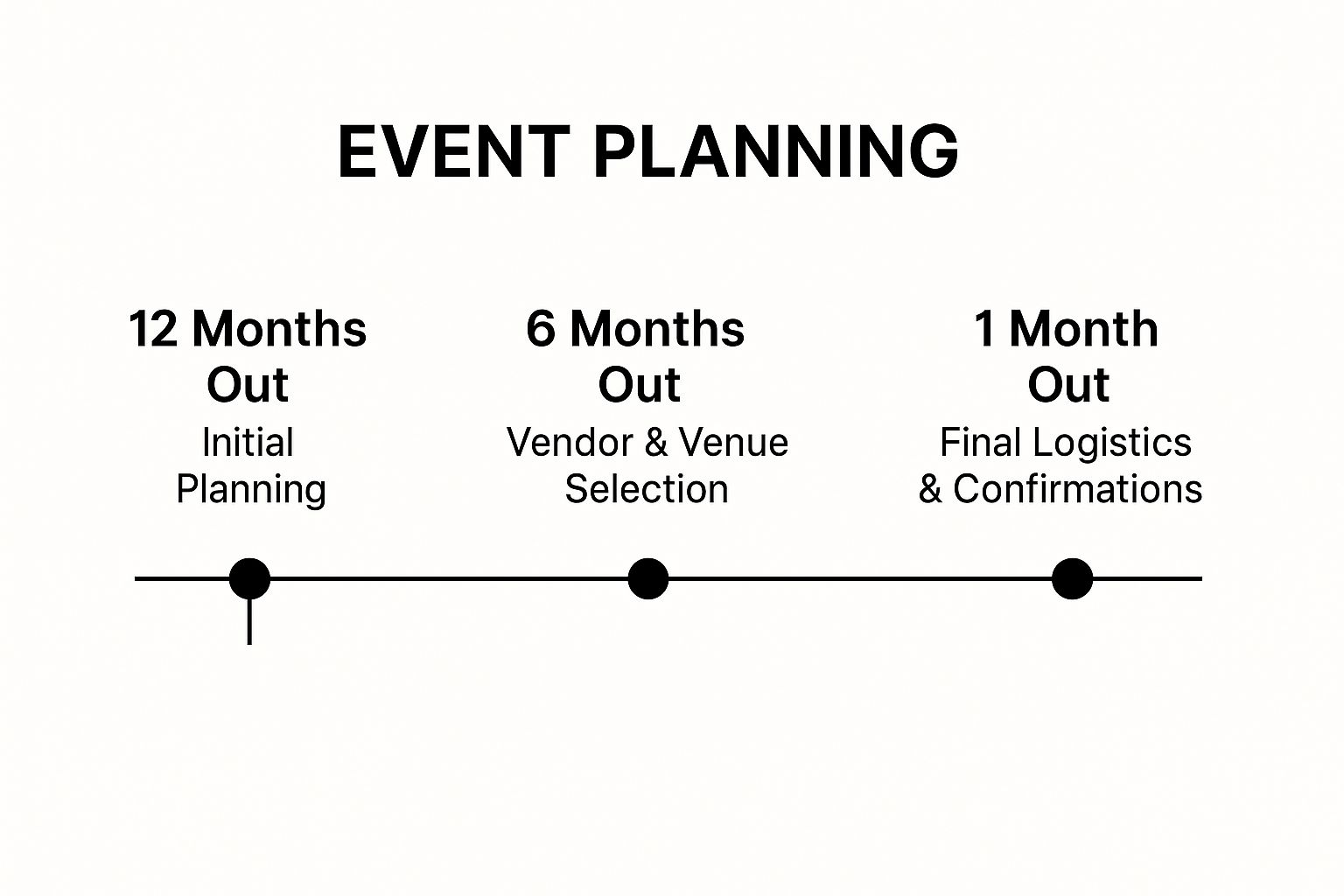
The infographic highlights that foundational decisions are made a year out, major vendor and venue selections are locked in at the six-month mark, and the final month is dedicated to meticulous logistical confirmations.
Actionable Tips for Flawless Task Management
- Work Backwards from Major Milestones: Begin with your event date and plot key deadlines in reverse. This "reverse-chronology" method helps you accurately gauge how much time is needed for each major phase of planning.
- Utilise Project Management Software: Employ tools like Asana, Trello, or Monday.com to create, assign, and track tasks. This centralises communication and provides a clear overview of the entire project for all team members.
- Build in a Time Buffer: For any task that relies on external factors, like vendor responses or permit approvals, add a 10-15% buffer to the deadline. This prevents delays in one area from causing a chain reaction.
- Conduct Weekly Progress Meetings: Hold regular, structured check-in meetings with your team to review completed tasks, address roadblocks, and adjust the timeline as needed. This keeps the project on track and fosters accountability.
- Create a Minute-by-Minute Day-Of Schedule: For the event day itself, develop a highly detailed run-of-show document that outlines every activity, transition, and responsibility down to the minute. This is essential for the on-site team's coordination.
4. Marketing and Promotion Strategy: Creating Buzz and Driving Attendance
An event without attendees is merely a concept. This is where a robust marketing and promotion strategy transforms your meticulous planning into a tangible, well-attended success. This critical part of any event management checklist involves a multi-channel approach to build awareness, drive registrations, and foster engagement. It is about crafting a compelling narrative around your event and delivering it to the right audience through targeted outreach and captivating content across various platforms.

The process begins with defining your event's brand identity and unique value proposition. From there, you identify your target audience and select the most effective channels to reach them. This could range from digital campaigns on social media and email marketing to traditional media outreach and influencer partnerships. The goal is to create a consistent and compelling message that resonates with potential attendees and motivates them to participate.
How to Implement a Powerful Marketing Strategy
Effective implementation requires a strategic, phased campaign. The initial phase focuses on creating foundational assets like a professional event website with clear information and a seamless registration process. For example, Salesforce’s Trailhead events excel by using gamification and user-generated content to create pre-event buzz and drive sign-ups. Similarly, the world-renowned SXSW festival leverages social media and powerful influencer partnerships to maintain a year-round conversation, turning attendees into a dedicated community.
As the event date approaches, the strategy shifts to nurturing leads and amplifying reach. This involves consistent communication through email newsletters, social media updates, and targeted advertising. For exclusive events, the promotion itself can signal prestige. Highlighting premium offerings, like a dedicated fleet of luxury vehicles from Uptown Rent A Car for VIP transport, can be a powerful marketing tool to attract a high-calibre audience. This communicates a commitment to an exceptional experience from the moment guests decide to attend. This is especially relevant for the numerous high-profile automotive events held in Dubai where luxury and presentation are paramount.
Actionable Tips for Event Promotion
- Start Early: Begin your core marketing activities at least 3-4 months before the event. This provides ample time to build momentum, nurture leads, and maximise registration numbers without a last-minute rush.
- Create a Compelling Event Website: Your website is your digital storefront. Ensure it has a clear value proposition, an easy-to-navigate layout, detailed agenda, speaker information, and a simple, frictionless registration form.
- Leverage Email Automation: Use email marketing to create a journey for potential attendees. Send a series of automated emails that welcome new subscribers, provide valuable event updates, introduce speakers, and create a sense of urgency to register.
- Use Hashtags and Contests: Create a unique and memorable event hashtag to track conversations and encourage user-generated content. Run social media contests, like ticket giveaways, to significantly boost organic reach and engagement.
5. Vendor Coordination and Management: The Symphony of Services
An event is not the product of a single entity but a symphony of services performed by numerous external experts. Vendor coordination and management is the art of orchestrating these providers, from caterers and decorators to audio-visual technicians and security personnel. It is the systematic process of identifying, vetting, contracting, and managing every third-party supplier to ensure they work in perfect harmony, delivering a cohesive and seamless experience for every guest. This element of your event management checklist is crucial, as the quality of your vendors directly reflects on the quality of your event.
This process involves more than simply hiring help; it’s about building a reliable, high-performing team. For a high-stakes corporate conference or a lavish wedding in Dubai, this means securing a network of proven professionals. This extends to every touchpoint, including guest transportation. Engaging a premium service like Uptown Rent A Car ensures that key attendees, speakers, or the bridal party are managed by professional chauffeurs, aligning the transportation experience with the event's high standards and removing a significant logistical burden from your plate.
How to Implement Effective Vendor Management
Successful vendor management begins with rigorous selection and clear communication. The initial phase involves deep research to identify suppliers with a proven track record relevant to your specific event type. For example, music festivals like Bonnaroo rely on specialised vendors for staging, sound, and lighting who have extensive experience with large-scale outdoor productions. This ensures they can handle the unique challenges of the environment. Similarly, industry leaders like The Knot offer curated vendor marketplaces with reviews and portfolios, allowing planners to vet potential partners based on past performance.
Once vendors are shortlisted, the focus shifts to creating watertight contracts and establishing clear communication channels. Every agreement must explicitly detail deliverables, timelines, payment schedules, and cancellation clauses. Following this, regular check-ins become essential. Corporate event giants, such as the team behind the IBM Think conference, use preferred vendor networks with pre-negotiated terms and integrated communication platforms to streamline this process, ensuring all parties are aligned from the initial briefing to the final execution.
Actionable Tips for Vendor Coordination
- Create Detailed Vendor Briefs: Provide each vendor with a comprehensive document outlining your event vision, goals, schedule, and specific expectations for their service. This minimises misunderstandings and aligns everyone's efforts.
- Check References and Portfolios: Before signing any contracts, speak directly with past clients of the vendor. Ask specific questions about their reliability, problem-solving skills, and the quality of their final product.
- Develop a Master Contact Sheet: Compile a master document with contact information for every key person from each vendor company. Distribute this to your core team and all vendors so everyone knows who to contact for what.
- Simplify Logistics with Full-Service Partners: For complex needs like transportation, engaging a single, high-quality provider is often more efficient. When you need to hire a driver in Dubai for your event, using a comprehensive service simplifies coordination, ensuring professional and reliable transport for all your VIPs.
6. Registration and Attendee Management: The Attendee Gateway
The attendee journey begins long before they set foot in your venue; it starts with the registration process. A seamless and efficient registration system is the first point of contact and a critical component of any event management checklist. It sets the tone for the entire event experience, manages expectations, and provides the data backbone for all subsequent communications and logistics. This process encompasses everything from the initial sign-up and payment processing to check-in and post-event engagement, ensuring a smooth, professional, and frustration-free experience for every participant.
How to Implement Effective Attendee Management
Successful implementation requires a user-centric approach powered by robust technology. The first step is selecting a suitable registration platform, such as Eventbrite or Cvent, that aligns with your event's complexity and scale. These platforms automate many tedious tasks, from collecting attendee information to processing payments securely. For a smooth attendee journey, optimising how you handle online ticket sales is crucial; learning how to effortlessly sell event tickets on your own platform can provide greater control and branding consistency.
Comic-Con, for example, expertly uses a tiered registration system with early-bird pricing and exclusive VIP packages to create urgency and segment its audience effectively. This not only maximises revenue but also helps manage crowd flow. For corporate training events, integration with internal HR systems can automate enrolment, track attendance for compliance, and simplify reporting. The key is to map out the entire attendee lifecycle, from the first marketing touchpoint to the final "thank you" email, ensuring every stage is cohesive and branded. This strategic management transforms registration from a simple transaction into a powerful tool for engagement and data collection.
Actionable Tips for Smooth Registration
- Test Your System Rigorously: Before going live, conduct thorough end-to-end testing of your registration form, payment gateway, and confirmation emails. Create test accounts and run multiple scenarios to identify and fix any technical glitches that could deter potential attendees.
- Offer Diverse Payment Options: Cater to a wider audience by providing multiple payment methods. Include standard options like credit/debit cards and PayPal, and for B2B events, offer corporate invoicing to simplify the process for company-sponsored attendees.
- Automate Key Communications: Send an immediate confirmation email upon successful registration. Follow up with a "know before you go" email a few days before the event, containing crucial details like the schedule, venue map, parking information, and check-in instructions.
- Keep Forms Concise and Mobile-Friendly: Design your registration forms to be simple and easy to complete on any device. Only ask for essential information to minimise friction and reduce abandonment rates. You can always gather more detailed data later through post-registration surveys.
7. Risk Management and Contingency Planning: Your Event’s Safety Net
Even the most meticulously planned event is vulnerable to unforeseen disruptions. Proactive risk management and contingency planning form the essential safety net that protects your event from potential disasters, ensuring it can adapt and proceed smoothly regardless of what challenges arise. This critical component of any event management checklist is not about expecting failure; it's about building resilience and preparing for every possibility, from a sudden downpour to a critical vendor no-show.
The process involves identifying potential risks, assessing their likelihood and potential impact, and then developing robust strategies to mitigate or respond to them. These risks can range from technical glitches and medical emergencies to security threats and transportation delays. For a high-stakes corporate summit in Dubai, a key risk could be the late arrival of a keynote speaker. A contingency plan might involve having a luxury vehicle from Uptown Rent A Car on standby, ready for an expedited, direct transfer from the airport to the venue, bypassing potential transport issues.
How to Implement Effective Risk Management
Successful implementation requires a systematic and proactive approach, not a reactive one. Start by creating a "risk register", a document that lists all conceivable risks. This was famously put into practice by outdoor music festivals like Coachella, which have detailed weather contingency plans that include everything from covered stages and emergency drainage to clear evacuation routes and communication protocols for severe weather events.
Once risks are identified, they must be categorised and prioritised. The 2020 pandemic forced major events like CES (Consumer Electronics Show) to rapidly pivot from in-person to fully virtual formats. Their ability to do so relied on pre-existing digital contingency plans, demonstrating the power of foresight. For your event, this means developing backup plans for your most critical elements. If your primary venue becomes unavailable, do you have a pre-vetted alternative? If a caterer cancels, is there another on a retainer? To enhance on-site security for your event, exploring temporary security camera solutions can provide vital surveillance and peace of mind.
Actionable Tips for Contingency Planning
- Create a Detailed Risk Register: Brainstorm every possible risk with your team. Rank each risk based on its probability (low, medium, high) and its potential impact (minor, moderate, severe) to focus your efforts on the most significant threats.
- Secure Comprehensive Event Insurance: Never underestimate the importance of insurance. Purchase policies that cover public liability, cancellation, and property damage. This financial protection is non-negotiable for any professionally organised event.
- Establish a Clear Communication Tree: In a crisis, clear and rapid communication is vital. Develop a communication plan that outlines who needs to be contacted, in what order, and through which channels (e.g., text, email, two-way radio).
- Conduct Team Emergency Drills: Ensure key staff members are not just aware of emergency procedures but have practised them. Run drills for scenarios like medical emergencies or security breaches so that the response becomes second nature.
7-Point Event Management Checklist Comparison
| Aspect | Budget Planning and Financial Management | Venue Selection and Management | Timeline and Task Management | Marketing and Promotion Strategy | Vendor Coordination and Management | Registration and Attendee Management | Risk Management and Contingency Planning |
|---|---|---|---|---|---|---|---|
| Implementation Complexity 🔄 | Medium to High: Requires detailed tracking and integration | Medium: Involves extensive site evaluation and contracts | Medium: Task breakdown and dependencies require upkeep | High: Multi-channel campaigns and segmentation | Medium: Managing multiple vendors and contracts | Medium: Platform setup and integration complexity | High: Detailed risk analysis and emergency procedures |
| Resource Requirements ⚡ | High: Financial tools, accounting integration | Medium to High: Personnel for site visits and negotiation | Medium: Team coordination and project management tools | High: Marketing expertise, content creation, ad spend | Medium: Vendor database and communications | Medium: Registration systems and customer service | Medium to High: Insurance, monitoring tools, training |
| Expected Outcomes 📊 | ⭐⭐⭐⭐⭐ Prevent cost overruns, ROI insights | ⭐⭐⭐⭐ Improved attendee experience and venue cost control | ⭐⭐⭐⭐ Clear deadlines, risk reduction on delays | ⭐⭐⭐⭐ Increased attendance, engagement, and ROI | ⭐⭐⭐⭐ Expert service delivery, reduced internal load | ⭐⭐⭐⭐ Streamlined attendee experience and data insights | ⭐⭐⭐⭐ Reduced losses, reputation protection, quick recovery |
| Ideal Use Cases 💡 | Events requiring tight financial control | Events with specific attendee needs and logistical demands | Complex events needing detailed task tracking | Large/high-profile events needing strong audience outreach | Events relying on multiple external service providers | Events with significant registration and check-in needs | Events exposed to high-risk factors or large scale events |
| Key Advantages ⭐ | Financial transparency, contingency buffers, ROI reporting | Foundation for success, accessibility, and credibility | Improved communication, accountability, and timeline control | Enhanced visibility and brand credibility | Access to expertise, cost-effective, stress reduction | Reduced errors, personalized communication | Proactive risk handling, stakeholder confidence |
Elevating Your Event with Strategic Transportation
Navigating the intricate landscape of event planning requires more than just a simple to-do list; it demands a comprehensive, strategic framework. This ultimate event management checklist has guided you through the seven critical pillars of success, from meticulous budget planning and venue selection to robust risk management and attendee coordination. Mastering each of these domains is essential for creating an event that is not just well-organised, but truly resonant and impactful.
The journey from concept to execution is a testament to your dedication and foresight. You have laid the groundwork by defining your objectives, allocated resources wisely, and built a timeline that ensures every task is completed with precision. Yet, the true measure of an event's success often lies in the intangible elements, the moments of delight that elevate the attendee experience from standard to exceptional.
From Logistics to Lasting Impressions
As we have explored, a successful event is a symphony where every instrument plays its part in harmony. Your marketing has built anticipation, your vendors are aligned with your vision, and your registration process is seamless. But how do your guests arrive at this perfectly curated experience? In a city synonymous with luxury and ambition like Dubai, the journey itself is a crucial part of the narrative.
Transportation should never be a mere logistical afterthought. Instead, it should be viewed as a powerful tool for reinforcing your event's theme and demonstrating a profound level of care for your attendees.
Key Insight: Strategic transportation planning is the bridge between excellent logistical management and an unforgettable guest experience. It is one of the first and last physical touchpoints an attendee has with your event, making its impact disproportionately significant.
Consider the powerful messages that thoughtful transportation choices send:
- For Corporate Events: Arranging for a fleet of executive sedans to collect key speakers and stakeholders from the airport immediately establishes a tone of professionalism, respect, and importance.
- For Weddings and Celebrations: Providing a luxury vehicle for the wedding party or special guests adds a touch of glamour and sophistication, transforming a simple transit into a memorable part of the celebration.
- For International Conferences: Offering attendees the option of a premium rental car, like a luxury SUV, gives them the freedom and flexibility to explore Dubai at their leisure, significantly enhancing their overall trip and perception of the event.
Actionable Next Steps: Integrating Transportation into Your Checklist
As you move into the final stages of your planning, it is time to integrate transportation with the same level of detail you have applied to other areas. Revisit your event management checklist and add a dedicated subsection for transportation under 'Vendor Coordination' or 'Attendee Management'.
Here are your actionable next steps:
- Segment Your Attendees: Identify different guest tiers. Who are your VIPs, speakers, international guests, or key stakeholders?
- Define Their Needs: What are the specific transportation requirements for each group? Consider airport transfers, transport between venues, or a dedicated vehicle for the duration of their stay.
- Align with Your Brand: Select a transportation partner whose fleet and service standards mirror the quality and prestige of your event. In Dubai, this means opting for luxury, comfort, and impeccable service.
- Communicate Clearly: Ensure all transportation details are communicated to your guests well in advance, including pickup times, locations, and contact information. This proactive communication minimises stress and reinforces your commitment to their comfort.
By meticulously planning your transportation strategy, you are not just ticking a box. You are curating the entire guest journey, ensuring that every moment aligns with the high standards of your event. This final, thoughtful touch is what separates a good event from a great one, leaving a lasting impression that speaks volumes about your brand's commitment to excellence.
Ready to ensure every aspect of your event reflects sophistication and seamless organisation? Partner with Uptown Rent A Car to provide your guests with an unparalleled transportation experience. Explore our fleet of luxury vehicles at Uptown Rent A Car and discover how our premium service can become a memorable highlight in your event management checklist.