
A client has just landed at Dubai International. Their assistant booked the vehicle days ago. They don't want a call centre maze, a delayed confirmation, or three different staff members asking for the same passport details. They want one clean message, one clear pickup instruction, and a car waiting exactly where promised.
That expectation defines luxury now. The vehicle matters, of course. So does the handover. But for high-net-worth travellers and senior executives, the service experience often starts long before they touch the steering wheel. It starts with the first confirmation, the first reply, the first moment your brand proves it can operate with speed, discretion, and polish.
The New Standard for Luxury Client Communication
Luxury brands still make a basic mistake. They treat communication as admin. Elite clients experience it as part of the product.
A Dubai visitor booking a premium car for a board meeting in DIFC doesn't separate “support” from “service”. If the booking confirmation is vague, the WhatsApp reply is slow, or the pickup instructions are buried in an email thread, the brand already feels less refined. No amount of leather trim fixes friction.
What elite clients actually notice
International travellers notice details that mass-market businesses ignore:
- Speed without chasing: They shouldn't need to follow up for confirmation.
- Privacy by default: Sensitive details should move through the right channel, not whichever one is easiest for your team.
- Context retention: If a client already explained their arrival terminal, dietary request for a concierge add-on, or billing structure, your team should already know it.
- Tone: Luxury communication should sound composed, attentive, and human. Never stiff. Never casual to the point of careless.
Practical rule: If your client has to repeat themselves, wait unnecessarily, or wonder who owns the conversation, your communication has failed.
Generic service scripts don't survive in Dubai
Dubai attracts people who compare every experience against the best hotels, private aviation teams, and elite concierge desks they've used elsewhere. That changes the standard. A templated “Dear customer, your request has been received” message feels cheap in this environment, even if the car itself is exceptional.
The right approach is an integrated communication ecosystem. One that lets a client move from email to WhatsApp to phone without losing momentum. One that gives your staff a complete view of the relationship. One that feels orchestrated rather than improvised.
That's the difference between a booking process and a luxury experience.
A Guide to Modern Customer Communication Channels
Presenting customer communication channels as a mere list is too simplistic. You need a decision model.
Think in two dimensions. First, immediacy. Some channels are built for instant action. Others are better for considered, detailed communication. Second, interaction style. Some are one-to-one and conversational. Others are better for formal records or broad notifications.
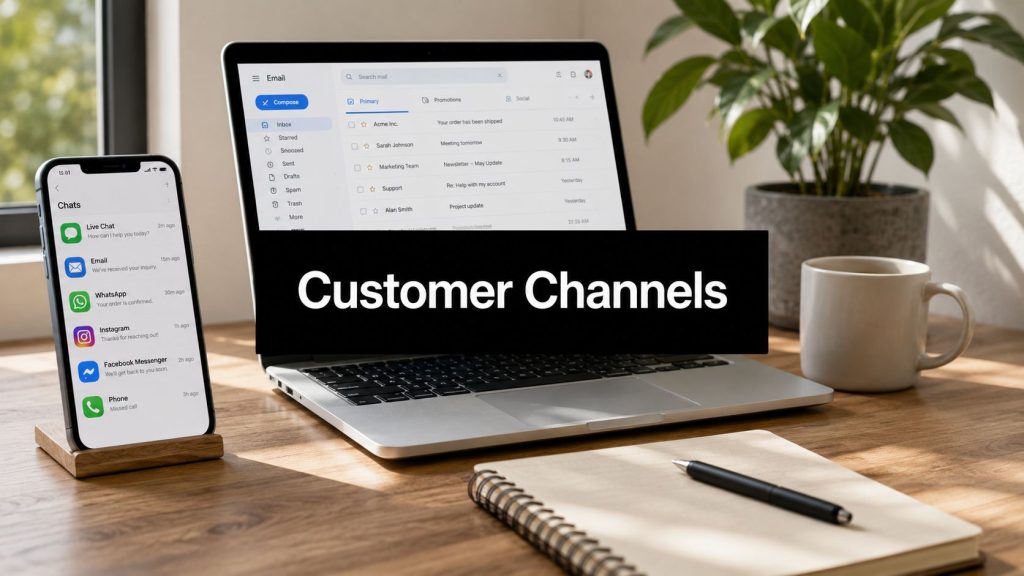
Here's a quick visual to anchor the discussion.

Real-time channels for urgent moments
These are the channels you use when timing matters.
- Phone: Best for high-stakes exceptions, complex changes, or emotionally charged situations. If a chauffeur route changes because of an event closure, a call is often the fastest route to certainty.
- Live chat: Useful when a client is on your site and needs fast clarification before booking.
- Messaging apps: Ideal for quick coordination, especially during arrival, pickup, handover, and live itinerary changes.
- SMS: Strong for short, time-sensitive alerts that must be seen quickly.
According to Salesgenie's customer engagement statistics, 90% of consumers expect brands to engage them on their preferred channels, and offering that preferred channel can increase customer retention by 82%. The same source notes that SMS is highly effective for time-sensitive messages such as booking confirmations, while social media direct messages are becoming the preferred service channel for nearly 1 in 5 Gen Z and Millennial users.
A short explainer can help your team align on this mix.
Detailed channels for clarity and record-keeping
These channels support structure, documentation, and lower-pressure exchanges.
| Channel | Best luxury use |
|---|---|
| Contracts, invoices, full booking details, executive itineraries | |
| Push notifications | App-based reminders and status updates for opted-in users |
| In-person | Handover, inspection, concierge-style reassurance |
| Social media | Public brand visibility, light-touch support, initial enquiries |
Email remains valuable because it creates a clean paper trail. Push notifications work when the client has your app and wants convenience. In-person communication matters at delivery because it turns logistics into hospitality.
The right question isn't which channel is best
The right question is which channel fits the moment.
Fast channels create reassurance. Formal channels create confidence. Premium brands need both.
For luxury operators, the strongest customer communication channels strategy isn't “be everywhere”. It's “be available in the right way, at the right moment, with the right tone”.
Choosing the Right Channels for Dubai's Elite Traveler
Dubai's premium customer base isn't one audience. It's several, layered on top of one another. A family from London on holiday behaves differently from a private investor in town for forty-eight hours, and both behave differently from a local resident booking a weekend vehicle for an event.
That's why channel choice should be deliberate. Judge each option against five criteria: immediacy, documentation, formality, privacy, and brand perception.
What works in the UAE market
In the UAE, messaging apps dominate. WhatsApp is a primary tool, and Facebook Messenger reaches 80.3% of the population. At the same time, 41% of UAE customers prefer SMS for brand communications because it's reliable. That mix is why a multichannel strategy matters in this market, as noted in Sinch's regional communication channel analysis.
If you run a luxury operation in Dubai, here's the blunt truth. You can't rely on email alone, and you can't run everything through WhatsApp either. One channel won't cover the full experience elegantly.
Communication Channel Comparison for a Luxury Audience
| Channel | Immediacy | Privacy Level | Best For (Uptown Use Case) |
|---|---|---|---|
| High | Medium to high | Arrival coordination, pickup instructions, quick amendments | |
| SMS | High | Medium | Backup alerts, one-time reminders, urgent notifications |
| Medium | High | Contracts, billing details, executive summaries, formal confirmations | |
| Phone | Highest | High | Escalations, bespoke requests, complex itinerary changes |
| Live chat | High | Medium | Pre-booking questions on the website |
| Social media DM | Medium | Low to medium | Early-stage enquiries, redirecting to a private channel |
| In-person | Immediate | High | Handover, walkthrough, VIP greeting |
My recommendation for a Dubai luxury brand
Use a mobile-first structure.
Lead with WhatsApp for active service conversations. Use SMS as your fail-safe for critical alerts. Reserve email for documentation, payment records, and anything a client's assistant or finance team may need later. Keep phone available for situations where nuance matters more than convenience.
That mix reflects how elite guests behave in Dubai. They want convenience when moving. They want precision when deciding. They want records when approving.
For clients expecting a more bespoke layer of service, the communication model should mirror a concierge relationship. The standard described in concierge service expectations is useful here. The client shouldn't have to wonder which channel to use. Your team should guide them naturally.
Match the channel to the moment
Use this approach:
- Before arrival: Email for formal confirmation, then WhatsApp for direct access.
- At landing: WhatsApp first. SMS as backup if connectivity or app access becomes unreliable.
- During rental: Messaging for convenience, phone for exceptions.
- After service: Email for final documents and any requested follow-up.
A luxury guest doesn't want “all available channels”. They want the one that feels effortless in that exact moment.
That's the standard. Not channel volume. Channel judgement.
Building Your Seamless Omnichannel Experience
A CEO lands at DXB after a long-haul flight from London. His assistant has already confirmed the booking on email. He sends a WhatsApp message from the runway to change the pickup point. Ten minutes later, your team calls and asks for the same details again. That is how a luxury brand looks careless.
Luxury communication in Dubai has one job. Protect the client's time, privacy, and confidence across every touchpoint. If your channels operate in isolation, the guest feels the friction immediately.

Build one client record, not separate conversations
Your team needs a single operating view of the client. One profile should hold the details that matter in live service, not scattered fragments across inboxes and devices.
Include:
- Booking history
- Preferred language
- Arrival details
- Special requests
- Payment and billing notes
- Recent conversation history across channels
- Privacy preferences
- Assistant or family office contact details
That last point matters more in Dubai than many brands admit. High-net-worth travelers often book through an executive assistant, a PA, or a family office. Your team must know who can approve changes, who receives invoices, and who should never be copied on operational chatter.
If a phone agent cannot see the last WhatsApp exchange, your setup is incomplete. If a chauffeur cannot see the updated terminal instruction, your handover process is weak. Fix the infrastructure first.
As noted earlier by Siteimprove's guidance on consistent messaging across channels, a shared view reduces context loss during handoffs. You do not need another slogan about omnichannel service. You need memory.
Design for discretion and speed
Luxury clients do not judge channels separately. They judge the overall handling.
That means every channel should follow the same service rules:
- Recognize the client instantly
- Continue the conversation without repetition
- Protect confidential details
- Confirm changes in writing
- Escalate exceptions to a senior human fast
For Dubai brands serving diplomats, founders, family offices, and C-suite travelers, privacy is part of the experience. Do not put sensitive billing details into casual chat threads. Do not ask a VIP to repeat passport-linked booking information in an open channel. Keep operational updates quick, but move sensitive approvals and documents into the right environment.
A premium transport operation, including a Dubai luxury chauffeur service, depends on this discipline because airport changes, security requests, route updates, and formal follow-up often happen within the same booking window.
Use automation with restraint
Automation should clear routine traffic, not imitate concierge judgment.
Use it for straightforward requests such as confirmation messages, pickup reminders, live location prompts, and basic availability checks. The moment a conversation involves a VIP amendment, a billing issue, an assistant managing multiple travelers, or a request with reputational sensitivity, route it to a trained person.
This is also the sensible cost model. The Office Gurus benchmark for customer support costs shows that messaging interactions are generally less expensive than voice support, while automation reduces pressure on human teams for repetitive enquiries. Use that efficiency to protect your senior staff for high-value moments.
Good luxury operations automate the predictable and reserve human judgment for the moments that shape loyalty.
Set a clear operating model
A practical structure works well here.
Automated first response
Confirm receipt, share the next step, and capture key facts without delay.Priority routing for nuance
Send VIP changes, multi-stop itineraries, special security instructions, and executive assistant requests to experienced staff.Written confirmation after every material update
After a call or chat, send a concise summary with the revised time, location, contact, and any approved exception.Channel continuity across teams
Reservations, chauffeurs, concierge staff, and finance should work from the same live client record.
If you are refining the service architecture behind this model, Chatgrow on omnichannel customer support is a useful reference point for continuity across channels.
The standard is simple. The client should never have to manage your internal handoffs for you.
Scripts and Templates for Five-Star Interactions
A CEO lands at Dubai International after a midnight flight from London. His assistant wants the confirmation by email for records. He wants the latest handover update on WhatsApp. Security instructions need to stay discreet. If your team sends generic copy, delayed follow-ups, or conflicting details, the brand instantly feels smaller than the rate card suggests.
Words carry the service. For high-net-worth travellers in Dubai, every message should feel controlled, discreet, and precise. The standard is simple. Your team should sound like people who already have the situation handled.

Consistency matters because affluent clients notice small errors fast. If a family office receives one timing by email and a different one by chat, trust drops immediately. As noted earlier, consistent messaging only matters if it appears in the actual wording your team uses every day.
WhatsApp booking confirmation
Use this after a reservation is confirmed and the client expects immediate reassurance on the same thread.
Good afternoon, Mr Ahmed. Your booking is confirmed for tomorrow at 10:30 AM, with delivery to Terminal 3 Arrivals, Dubai International Airport. Your vehicle details and driver contact will be shared shortly in this chat. If your arrival time changes, reply here and we will update the handover at once.
Why it works:
- It confirms the key details first.
- It respects the client's preference for speed.
- It keeps the reply path obvious, which matters for travellers in transit.
Executive email for formal details
Business travellers, chiefs of staff, and personal assistants need an email they can scan in seconds and forward without rewriting. Keep it polished, short, and complete.
Subject: Your vehicle booking confirmation for Dubai
Dear Ms Taylor,
Thank you for your reservation.
Please find your confirmed booking details below:
- Vehicle category
- Delivery location
- Scheduled date and time
- Rental duration
- Billing contact
- Required documents, if applicable
If you prefer, we can also coordinate arrival-day updates via WhatsApp.
Kind regards,
[Name]
Client Services
For operators reviewing systems alongside language, this guide to choosing an omnichannel solution is useful because it connects templates, routing logic, and client history in one operating model.
SMS reminder for time-sensitive updates
SMS is still the right tool for concise, urgent information. Use it for valet entrances, gate changes, and final timing confirmations. Keep it unmistakable.
Your vehicle handover is scheduled for 6:00 PM today at Address Downtown valet entrance. Reply to this message if you need to adjust the timing.
No decoration. Just a clear instruction.
Phone script for a service recovery moment
When plans change, your team should sound composed and decisive. Long apologies weaken confidence. Clear ownership restores it.
Good evening, Ms Khan. I'm calling with an update on your delivery timing. We have already arranged an alternative route, and your vehicle is still on the way. I will manage this personally and send the updated arrival point to you in writing immediately after our call.
This works because it does three things in the right order. It states the issue. It confirms the fix. It shows personal accountability.
Keep your templates tied to one source of truth
Scripts fail when the record behind them is messy. A polished WhatsApp message cannot rescue the damage caused by conflicting times, missing chauffeur notes, or outdated billing instructions.
For businesses that need a reliable digital paper trail, a structured booking confirmation email process helps every client receive the same core details in a format they can store, forward, or review quickly. That matters even more in Dubai, where one booking may involve the traveller, an executive assistant, hotel concierge, and private security contact all at once.
How to Measure and Elevate Your Communication ROI
A CEO lands in Dubai at 11:40 PM, messages your team from the tarmac, and expects a precise answer before the aircraft door opens. That moment defines communication return better than any vanity dashboard. In luxury service, ROI comes from speed, discretion, and how little effort the client spends getting what they need.
A resolved request is only part of the picture. What matters is whether the client had to repeat a passport name, switch from WhatsApp to phone, or wait while your team checked three systems. High-net-worth travellers and executive assistants notice friction immediately. In Dubai, where privacy and immediacy sit at the top of the brief, that friction costs repeat business.

Why effort matters more than resolution
Luxury brands should measure ease with the same discipline they apply to fleet quality, room standards, or concierge presentation. A client may get the answer in the end and still leave with the impression that your operation is disjointed.
That is the wrong outcome.
In the UAE, messaging plays a major role in customer contact, which makes channel effort even more important to track. Cloud Call Center's discussion of omnichannel contact centres in the AE region highlights how customers increasingly expect connected support rather than isolated channel responses. For a Dubai luxury brand, that means measuring whether the conversation stayed smooth from first message to final confirmation.
Use one post-interaction question consistently: “How easy was it to complete your request today?”
The KPI stack I recommend
Keep the scorecard tight. Senior teams do not need fifty service metrics. They need a handful that reveal whether the experience felt polished or patchy.
- Customer Effort Score: Track ease after bookings, amendments, airport pickups, billing changes, and returns.
- First-contact resolution for straightforward requests: Measure whether your team handled simple needs without a callback or handoff.
- Escalation rate by channel: If WhatsApp enquiries regularly move to phone or email, the process is poorly set up.
- Response time for VIP and after-hours contacts: For international travellers, midnight in Dubai may be midday in London or New York.
- Message quality reviews: Audit clarity, discretion, tone, and whether staff gave firm next steps.
For leaders refining the wider scorecard, this guide on critical KPIs for contact centers is a useful companion. Keep your attention on effort first. Luxury clients forgive very little confusion.
Improve the standard every month
Read transcripts. Listen to calls. Check whether the team answered the actual question in the first reply, protected private details, and chose the right channel for the situation. A billing query from a family office should not be handled with the same cadence as a general availability request.
Then fix what slows the client down. Rewrite weak templates. Tighten routing rules. Remove approval bottlenecks for routine VIP requests. Train staff to confirm next steps with confidence instead of padding the conversation with vague politeness.
That is how communication ROI improves. You get stronger retention, better referrals, fewer complaints, and a brand presence that feels controlled under pressure.
If your brand serves travellers, executives, or event clients in Dubai, your communication should feel as polished as the vehicle itself. Uptown Rent A Car provides online luxury car booking with instant confirmation, phone support at +971504777250, and email contact through booking@uptowndxb.com, making it a practical reference point for brands building a more effortless premium customer journey.