
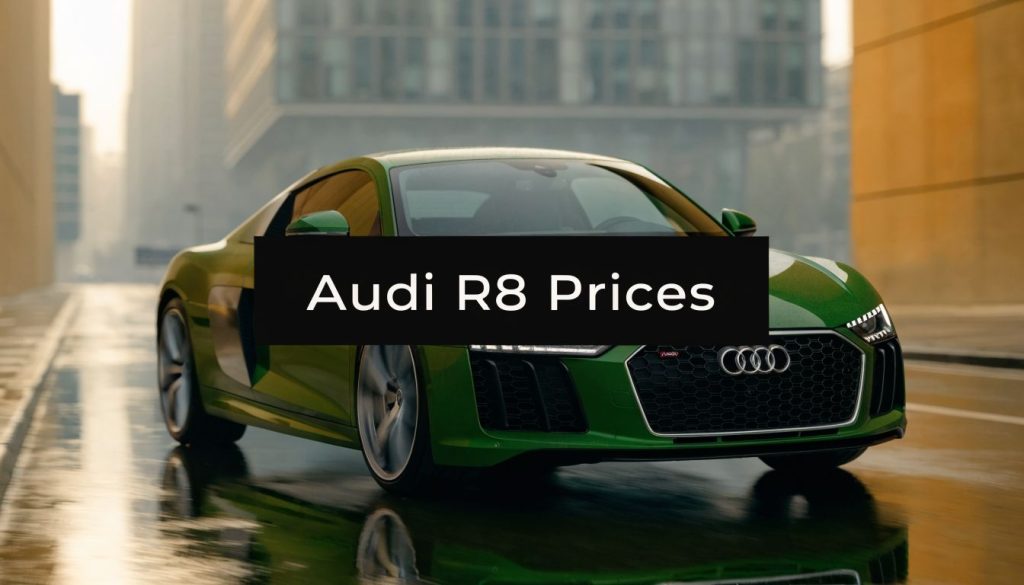
You’re probably in one of two positions right now. You either love the Audi R8 and want to know what it really costs in Dubai, or you don’t want to buy one at all, you just want the experience without getting trapped in supercar ownership maths.
That’s the right way to approach the cost of audi r8 in this market. The sticker price matters, but it’s only one part of the decision. In Dubai, the smarter question is usually this: do you want to own the machine, or do you want to buy the moment?
For some clients, ownership makes sense. For many others, especially tourists, executives, couples planning an event, or residents who want one memorable weekend, renting is the cleaner financial move. The R8 is one of those cars that feels special very quickly, but it also starts billing you very quickly once it sits in your garage.
The Purchase Price of an Audi R8 in 2026
A client lands in Dubai, sees an R8 outside a five-star hotel, and asks the same question I hear every week. What does it cost to buy one here?
The entry point is high before ownership costs even start. According to UAE Audi R8 pricing and used-market tracking from The Classic Valuer, late new-shape cars from the 2023 to 2024 period usually sit around AED 750,000 to AED 1,200,000, while 2015 to 2020 used examples commonly trade around AED 450,000 to AED 650,000. Spec, mileage, service history, and seller quality all push a car up or down within that band.

New money versus used money
The top end of the range buys peace of mind, stronger presentation, and usually a car that needs less sorting. It also means tying up a serious amount of capital in a weekend car.
Used examples reduce the upfront hit, but the word "used" misleads buyers in this segment. An R8 at half a million dirhams is still a supercar purchase, and it needs to be judged like one. Cheap-looking listings often become expensive ownership stories once inspections, deferred maintenance, and resale pressure enter the picture.
A practical view of the market looks like this:
| R8 market position | Typical price range |
|---|---|
| New 2023 to 2024 models | AED 750,000 to AED 1,200,000 |
| Used 2015 to 2020 models | AED 450,000 to AED 650,000 |
What the purchase price really tells you
The sticker gives you the admission fee. It does not tell you whether the car is the right financial decision for how often you will use it in Dubai.
I tell buyers to test themselves with one simple rule. If the budget only covers acquisition, the car is out of reach. On an R8, the smarter budget has three layers: purchase, running costs, and exit value when it is time to sell.
That is the trade-off. Buying gives you access anytime, but it also commits you to a large upfront spend for an experience many drivers only use a few weekends a year. Renting works differently. You pay for the moment, get the same arrival, the same sound, and the same event value, without parking six or seven figures in the garage.
If you are benchmarking Audi pricing before stepping into R8 territory, this Audi A3 price in Dubai guide gives a useful local reference point. It shows how quickly the numbers change once you move from premium Audi ownership into true supercar money.
Key Factors That Influence the R8's Price Tag
Two R8s can look similar in photos and sit very far apart in value. In Dubai, the spread usually comes down to a handful of variables that buyers need to judge properly.
The biggest one now is simple. The Audi R8 has been discontinued. That changes how the market behaves. Once production ends, some cars stop being just used performance cars and start becoming collector targets.
According to regional Audi R8 auction and market tracking from Classic.com, first-generation models from 2007 to 2015 in the UAE have seen a 35% value increase since 2020. The same market record notes that a pristine 2008 Audi R8 V8 manual fetched AED 1,700,000 at a regional auction, driven by Gulf collector demand.
Collector appeal changes the rules
Many buyers often get caught out. They shop for an R8 like they’re shopping for any used German sports car. That approach doesn’t work for the right older R8.
A first-generation V8 manual in excellent condition now sits in a different category from a high-mileage later car bought only for casual use. One is a collector conversation. The other is still a performance purchase.
That means price is influenced by more than age.
- Model generation matters: The market doesn’t reward every R8 equally. Some early cars now carry rarity value that newer examples may not.
- Transmission and configuration matter: Enthusiast-spec cars tend to attract more attention than ordinary listings.
- Condition matters more than promises: A neglected “cheap” R8 often becomes an expensive correction project.
- Mileage still matters: Buyers in Dubai will pay up for cleaner examples with lower wear, especially if documentation is strong.
Spec can move the number fast
Factory options and trim also change the value proposition. Carbon trim, special paint, performance-focused variants, and rare combinations can all push asking prices higher. The key is whether those extras improve desirability for the next buyer, not just whether they looked expensive when the car was ordered.
I’ve seen buyers overpay for the wrong kind of spec. Flashy options don’t automatically equal future value. On an R8, the strongest money usually follows the cars that enthusiasts respect, not just the cars that look expensive on a dealer floor.
Buyers pay a premium for stories they can verify. Service history, original specification, careful ownership, and rarity carry more weight than cosmetic upgrades.
What to inspect before calling a price fair
When reviewing a listing, use a simple filter:
- Year and generation. Ask whether the car is part of the newer ownership market or the emerging collector market.
- Trim and drivetrain. A performance variant sits differently in the market than a lower-spec example.
- History file. Invoices, dealer servicing, and clean ownership history matter.
- Condition under Dubai use. Heat, storage, and road use all leave clues.
- Future liquidity. Think about how easy it will be to resell.
If you’re used to shopping prestige assets in Dubai, the mindset isn’t that different from evaluating personalised registration pieces. Scarcity, provenance, and desirability always affect value, which is why even a market as niche as Dubai number plates follows similar logic.
Uncovering the Hidden Costs of R8 Ownership in Dubai
A client buys an R8 on emotion, then calls me six months later about insurance renewal, a major service, tyre wear, and the resale hit he did not fully price in at the start. That pattern is common in Dubai. The purchase price gets the attention. The ownership bill arrives in pieces.
According to UAE-used-market ownership data summarised by Carfax, a used Audi R8 can carry annual servicing costs of AED 15,000 to AED 25,000, insurance of AED 4,000 to AED 6,000, and resale declines of 30% to 40% over 3 years. Put together, those are the costs that decide whether the car is enjoyable or financially irritating.

Servicing in Dubai is a real budget item
An R8 needs proper care, not bargain maintenance. Heat, stop-start traffic, short urban drives, and long idle periods all make Dubai ownership more expensive than many buyers expect.
Routine servicing is only part of it. You also need to budget for tyres, brakes, batteries, cosmetic correction, and the kind of preventative work that keeps the car saleable later. Skip that work and the savings usually come back as lower buyer confidence at resale time.
For broader context on how premium-car service costs build over time, this guide for dealers on luxury car maintenance is useful because it explains maintenance as an ongoing ownership commitment, not a one-off workshop invoice.
Depreciation usually outweighs the workshop bills
Servicing feels painful because you pay it in cash. Depreciation is worse because it erodes value, then shows up when you try to sell.
Even a carefully kept R8 is still exposed to market timing, mileage sensitivity, model-year shifts, and buyer preference for certain specs. In practice, owners in Dubai often face four pressure points at once:
- Insurance renewals that stay expensive because the car sits in the supercar bracket
- Maintenance history that must stay clean if you want strong resale interest
- Usage-related wear from heat, dust, and city driving
- Exit timing that may force you to sell in a softer market than the one you bought in
That is the fundamental ownership trade-off. You are not only paying to drive the car. You are paying to preserve it well enough for the next buyer.
Running costs depend on how casually you use the car
Owners often underestimate what casual usage does to the monthly total. Every extra night drive, hotel run, Marina cruise, and weekend errand adds fuel, wear, mileage, and future resale scrutiny.
Fuel alone will not be the biggest cost, but it still belongs in the calculation, especially if you plan to use the car regularly instead of keeping it as a garage piece. For current local running-cost context, it helps to monitor fuel prices in the UAE.
A short walkaround like this helps put the car into real-world perspective before you start budgeting around emotion alone.
Ownership only makes sense for a specific type of buyer
Owning an R8 works for buyers who want year-round access, can absorb maintenance and resale swings, and are comfortable treating the car as a high-cost discretionary asset.
A different client profile is more common in Dubai. They want the arrival, the sound, the photos, the weekend, or the one memorable drive down Sheikh Zayed Road. For that person, the total cost of experience matters more than the title deed to the car. That is why short-term access often makes better financial sense than long-term ownership.
The Smart Alternative Renting an Audi R8 in Dubai
If your goal is to enjoy the R8 rather than manage it, renting is usually the cleaner answer.
The rental market in Dubai gives you access to the car without forcing you into depreciation, annual servicing, storage concerns, or resale timing. According to Kelley Blue Book background on Dubai-side R8 rental pricing, daily rental rates range from AED 1,500 to AED 3,000, and the important part is the extra structure around that price: daily insurance can add AED 100 to AED 200, VAT is 5%, and mileage caps are typically 200 to 300 km per day.

Why renting fits the way most people actually use an R8
Most clients don’t need an R8 every Tuesday. They need it for a short, defined purpose.
That could be:
- A holiday upgrade: You want your Dubai trip to feel special from the first drive.
- A business impression: You need executive transport that stands out.
- A wedding or anniversary: You want presence, photos, and an arrival people remember.
- A personal reward: You’ve always wanted to drive one, but you don’t want a garage commitment.
In each of those cases, renting maps better to the actual need than buying does.
The rental cost is easier to control
Ownership has open-ended expenses. Rental pricing is much easier to model before you commit. You know the daily rate. You can ask about insurance, VAT, and mileage caps. You can decide whether your plan fits the included distance or whether you need to budget for extra kilometres.
That transparency matters because it keeps the experience focused on use, not obligation.
A sensible rental review should always check these points:
| Rental item | What to confirm |
|---|---|
| Base daily rate | Whether the car falls within the AED 1,500 to AED 3,000 range |
| Insurance | Whether AED 100 to AED 200 per day applies |
| VAT | Whether the quote includes the 5% VAT |
| Mileage cap | Whether the allowance is 200 to 300 km per day |
| Excess mileage | How extra distance is billed |
Renters who ask for the full all-in figure before booking usually make better choices than renters who chase the lowest headline daily rate.
What renting does not solve
Renting isn’t perfect for everyone. If you want unlimited access, constant personal use, or a car to collect and keep, rental won’t replace ownership. It’s a usage solution, not an emotional substitute for having the car in your own garage.
But for the majority of real-world luxury use in Dubai, it solves the expensive part of the equation. You get the car for the exact window you want, and then you hand back the long-term risk with the keys.
Comparing Scenarios Buying vs Renting Your R8 Experience
A client lands in Dubai on Thursday, wants an Audi R8 for the weekend, and asks the question I hear often. Should I buy one, or just rent one and enjoy it properly?
The answer depends on how often the car will be used, how long it will sit parked, and whether the goal is ownership or a short, high-impact experience. For occasional use, the cost of audi r8 makes far more sense when you pay for access instead of carrying a full year of ownership.
One published benchmark is useful for context. According to Edmunds-based cost guidance for the Audi R8 in Dubai conditions, the total cost of owning an Audi R8 in Dubai for one year can average AED 250,000 to AED 350,000, and renting can save users 60% to 70% compared with buying, even for frequent short-term use.
That comparison matters because these are two very different financial structures. Buying gives permanent access, but it also ties you to depreciation, insurance, servicing, registration, and resale timing. Renting gives you the best part of the experience in a fixed window, with a cleaner exit.

Scenario one tourist in Dubai for three days
For a visitor, the R8 is part of the trip itself. The value comes from the drive to a beach club, the hotel arrival, the desert road photo stop, and one memorable weekend.
Buying is completely misaligned with that use case. A three-day guest has no reason to enter Dubai’s ownership cycle just to enjoy a supercar briefly. Renting keeps the spend attached to the holiday, not to months of paperwork and future resale.
For this client, the smart question is simple. How much experience do you want to buy, and how much long-term liability are you willing to carry for it?
Scenario two business executive for one week
A visiting executive usually cares about timing, presentation, and predictability. The car needs to be ready, well-prepared, and easy to hand back.
Ownership adds tasks that have nothing to do with the trip. Renting turns the R8 into a defined expense for a defined purpose. That matters if the car is being used for client meetings, a conference week, or a luxury hospitality schedule where convenience is worth more than sentiment.
In practice, the trade-off looks like this:
- Buying: full-year cost exposure for a short visit
- Renting: one-week cost for one-week use
- Result: rental matches the job more accurately
Scenario three resident planning a special weekend
This is the buyer profile I advise most carefully. A Dubai resident may want an R8 for Friday drives, dinner arrivals, birthdays, or an anniversary weekend. The plan sounds sensible at first, especially if the car will only be used for enjoyable occasions.
Then the ownership math starts to show itself. The car is still costing money during the weeks it is not being driven. Insurance does not pause. Depreciation does not pause. Servicing and registration still arrive on schedule.
Many buyers discover they do not want ownership. They want the experience.
That distinction saves a lot of money. If the R8 is mainly for selective, memorable use, renting preserves the excitement without turning idle time into an expensive habit.
A practical comparison
| Type of use | Buying | Renting |
|---|---|---|
| Short holiday | Weak fit | Strong fit |
| One-week executive trip | Weak fit | Strong fit |
| Wedding or anniversary | Weak fit | Strong fit |
| Frequent long-term personal use | Can make sense | Depends on frequency |
| Collector ownership | Can make sense | Limited relevance |
Which option fits which client
Buying works for someone who will use the car often enough to justify the fixed annual cost, or for a collector targeting a specific R8 variant with a clear long-term plan. In those cases, the owner is paying for control, availability, and the satisfaction of having the car at home.
Renting works better for clients who want impact without carrying the full ownership cycle. That includes visitors, event clients, and residents who want the R8 for selected moments rather than daily life.
From a Dubai cost perspective, that is usually the sharper choice. You get the arrival, the drive, the sound, and the memory. You leave the long-term financial drag with the ownership model.
Final Verdict and Money-Saving Tips
Treat the decision like a cost-control exercise, not a passion purchase.
If you plan to buy, protect your downside:
- Inspect service records before price discussion: A clean history matters more than a loud spec sheet.
- Set a real ownership budget: Include insurance, registration, servicing, tyres, and a resale cushion before you commit.
- Buy with the resale market in mind: Popular colours, sensible mileage, and documented maintenance are easier to move later.
- Skip expensive extras that do not hold value: Some options improve the car. Others only raise your entry cost.
If you plan to rent, protect the total trip cost:
- Get one written quote: Confirm the rental rate, insurance, VAT, deposit terms, and mileage allowance in the same message.
- Choose the rental length around your schedule: Paying for idle days weakens the value fast.
- Check the mileage cap against your route: A lower headline rate can become expensive once excess kilometres are added.
- Inspect the car at handover: Record photos and note any marks before you drive away.
For clients in Dubai, the biggest saving usually comes from choosing the right model for the right length of use. That decision does more for your budget than chasing a small discount.
If you want the Audi R8 experience without the long-term ownership burden, Uptown Rent A Car is the practical place to start. You can browse available luxury models online, compare options for your trip or event, and book a high-end car for the exact period you need, whether that’s a day, a weekend, or a full business stay in Dubai.