
You're thirty minutes out from Terminal 3 on Airport Road, suitcases packed in the boot of a luxury SUV, and your flight boards in just over two hours. You type "Dubai International Airport" into your navigation app and follow the blue line straight toward the terminal frontage. Within minutes, overhead gantries split into public-transport-only lanes, security marshals wave private cars away from the kerb, and you're forced onto a multi-kilometre loop back onto the main approach road while the clock keeps ticking.
Most drivers assume a car rental return at Dubai Airport comes down to handing over a set of keys and walking to departures. In practice, the handover itself rarely causes the delay. Terminal access restrictions, mismatched car park entrances, and unverified handover locations are what catch visitors out at a hub that just logged the busiest year in its history and the highest annual international passenger volume ever recorded by an airport, according to the Dubai Media Office announcement. Getting your vehicle back cleanly starts with knowing which car park bay your agreement specifies and treating airport road rules with the same care as your boarding pass.
Where to Return Your Car at Dubai Airport
Your return destination is never “Dubai Airport” as a single pin on a map. Every drop-off belongs to a specific terminal and a designated car park or handover bay listed on your booking confirmation. Because DXB operates across three separate terminals with distinct road approaches and public transport links, confirming the right terminal is your first operational check.
According to Dubai Airports corporate information, Terminals 1 and 3 connect directly to the Dubai Metro Red Line, while taxis run around the clock from designated ranks across DXB terminals and private vehicles use dedicated airport parking facilities. The table below breaks down how access differs across all three terminals so you know what to verify before you drive in.
| Terminal | Direct Metro link | Taxi access | Return point to confirm |
|---|---|---|---|
| Terminal 1 | Yes, Red Line | 24-hour ranks | Car park named in your booking |
| Terminal 2 | Not directly linked (use road transport or taxi) | 24-hour ranks | Car park named in your booking |
| Terminal 3 | Yes, Red Line | 24-hour ranks | Car park named in your booking |
Terminal 2 sits on the opposite side of the airfield from Terminals 1 and 3, so mixing up your terminal number doesn't mean a quick U-turn. It means re-entering city arterial roads and losing check-in time before you even park the car. The practical fix is simple: match the terminal on your booking to the gantry signs before you commit to an exit, because a wrong curb can cost more time than a slow approach road.
Why Following Navigation to the Terminal Kerb Fails
Standard navigation apps default to passenger drop-off lanes or arrivals frontages, which creates an avoidable trap for rental drivers. The Dubai Airports car parking guidance makes clear that DXB has no general pick-up areas, requires drivers to use designated car parks, and restricts the arrivals forecourts at Terminals 1 and 3 strictly to public transport and authorised airport vehicles. Steering a rented sports car or executive saloon toward the arrivals kerb puts you straight into a restricted zone, onto the wrong ramp level, or onto a forced bypass road.
The fastest return at DXB is rarely the closest kerb. Driving straight to a pre-agreed car park bay avoids restricted-lane detours more reliably than leaving home ten minutes earlier.
That margin for error keeps tightening as passenger numbers climb. According to the Dubai Media Office announcement, DXB handled a record 95.2 million guests in 2025, a 3.1% rise from the previous year, with annual traffic projected to approach 99.5 million in 2026. When terminal roads carry that much volume, vague instructions to “drop the car at the airport” leave wedding groups, corporate travellers, and holidaymakers circling ramps while queues build at check-in.
Treat your rental car like any private vehicle entering a regulated transport hub. Your return point is the car park named in your booking, not the kerb your map suggests. On return day, the access rule matters as much as the handover: enter the right car park, take the correct exit, and keep the route simple. A return that looks five minutes away can become a long detour if the terminal approach sends you past the only usable entrance.
Confirm the Handover Point Before Return Day
The single habit that prevents almost every airport drop-off headache happens twenty-four hours before your flight, not on the motorway. Confirming the exact handover point in writing strips out guesswork before you're juggling luggage and traffic. Here are five checks to complete the day before you fly out.
- Get the terminal and car park zone in writing. Don't rely on a verbal remark made when you collected the keys. Ask for a message stating the exact terminal number, car park name, and level or meeting bay so you can cross-check overhead road signs on the approach.
- Save a live return-window contact number. Airport shifts change, and an office landline that goes to voicemail at midnight won't help you at a parking barrier. If you're returning a vehicle with us, save our direct phone and WhatsApp line (+971 58 68 77777) alongside the number printed on your Uptown Rent A Car booking confirmation.
- Lock in a return time that absorbs road delays. Pick an appointment slot built around a conservative airport buffer rather than your airline's final bag-drop cut-off. That way, a slow motorway exit, a longer inspection walk-around, or a missed ramp won't turn into a sprint through departures.
- Bundle your travel and rental documents together. Put your passport (and visa page if you're visiting), Emirates ID if you're a UAE resident, valid driving licence, signed rental contract, and booking reference in one zipped pouch on the passenger seat. Hunting through checked suitcases in a warm multi-storey car park wastes time and creates unnecessary stress during the handover.
- Request written clarity on pending charges. Ask before return day how open Salik tolls, airport parking fees, traffic fines, or damage checks are settled and confirmed. Knowing the process ahead of time stops awkward debates at the bay while your boarding gate is already open.
What to Screenshot Before You Drive Off
Mobile signal can dip inside concrete multi-storey car parks just when you need to open an email attachment. Before leaving your hotel or residence, take one clean screenshot and pin it to your phone's favourites folder.
- Exact terminal and car park name: Keep the written drop-off zone visible without scrolling through an inbox.
- Direct handover contact: Save the live WhatsApp or phone number so you can message the moment you pass the airport gantry.
- Confirmed return time: Having the agreed slot on screen confirms you arrived inside your window if staffing queues form.
Getting There and Timing Your Drop-Off
Flight schedules tell you when boarding closes, not how long Airport Road will take to clear. According to the Arab Air Carriers Organization, citing Dubai Airports data, DXB recorded 454,800 aircraft movements in 2025, up 3.3% from 2024. Every wave of arriving and departing widebody flights pushes fresh surges of taxis, hotel shuttles, and private cars onto the same approach loops and multi-storey ramps.
Look at how two returns in the same week play out differently. Say you're returning a Mercedes GLS Maybach on a Tuesday at 10:30 AM for an afternoon departure: approach lanes usually flow steadily, parking bays open up quickly, and the walk-around runs without hurry. Compare that to a Friday afternoon drop-off ahead of an evening long-haul flight, when weekend traffic, hotel check-out waves, and peak departure banks collide on Garhoud Bridge and Airport Road. The distance on the map hasn't changed, yet the approach alone can double in duration.
Operational buffer rule: Aim to reach your designated DXB car park at least 90 minutes before your airline's recommended airport arrival time, then allow extra minutes on top for the joint walk-around, luggage unloading, and receipt issuance.
Before you set off, check live traffic on Waze or Google Maps and review our guide to parking at Dubai Airport so you recognise the car park entry lanes before the final motorway split. Leaving yourself a proper margin protects your schedule if a ramp backs up or if you take the wrong turn into an adjacent car park zone.
Leaving the Airport After You Drop the Car Off
Not every airport return leads straight to a departure gate. Plenty of business travellers and Dubai residents drop off a hire car at DXB to meet an arriving colleague, switch vehicles, or head back into the city before a later flight.
If you're travelling light from Terminals 1 or 3, the Dubai Metro Red Line gives you a predictable, traffic-free ride straight toward Business Bay, Downtown, or Dubai Marina. When you're carrying multiple suitcases, travelling with children, or leaving from Terminal 2, walk straight to the designated taxi rank instead. Taxis operate around the clock across all terminals and save you hauling bags across concourses and station escalators.
Large terminal footprints also catch first-time visitors off guard once the handover finishes. Walking from an upper car park bay through lifts, skybridges, and check-in halls can easily eat fifteen minutes, which is why resources focused on improving passenger assistance at airports highlight clear indoor wayfinding as essential for keeping departures stress-free. Your timing decision comes down to one simple standard: pick a return slot that absorbs a slow approach road, a thorough inspection, and the indoor walk to check-in without putting your flight at risk.
Return Steps and Dispute-Proof Records
A clean handover protects both your travel schedule and your wallet long after you've boarded your flight. In the first half of 2025 alone, DXB averaged roughly 254,000 guests per day across 46 million total travellers, according to Dubai Airports half-year figures. At that pace, airport bays stay busy and staff juggle tight turnaround windows, so a structured return routine keeps small oversights from turning into billing disputes.
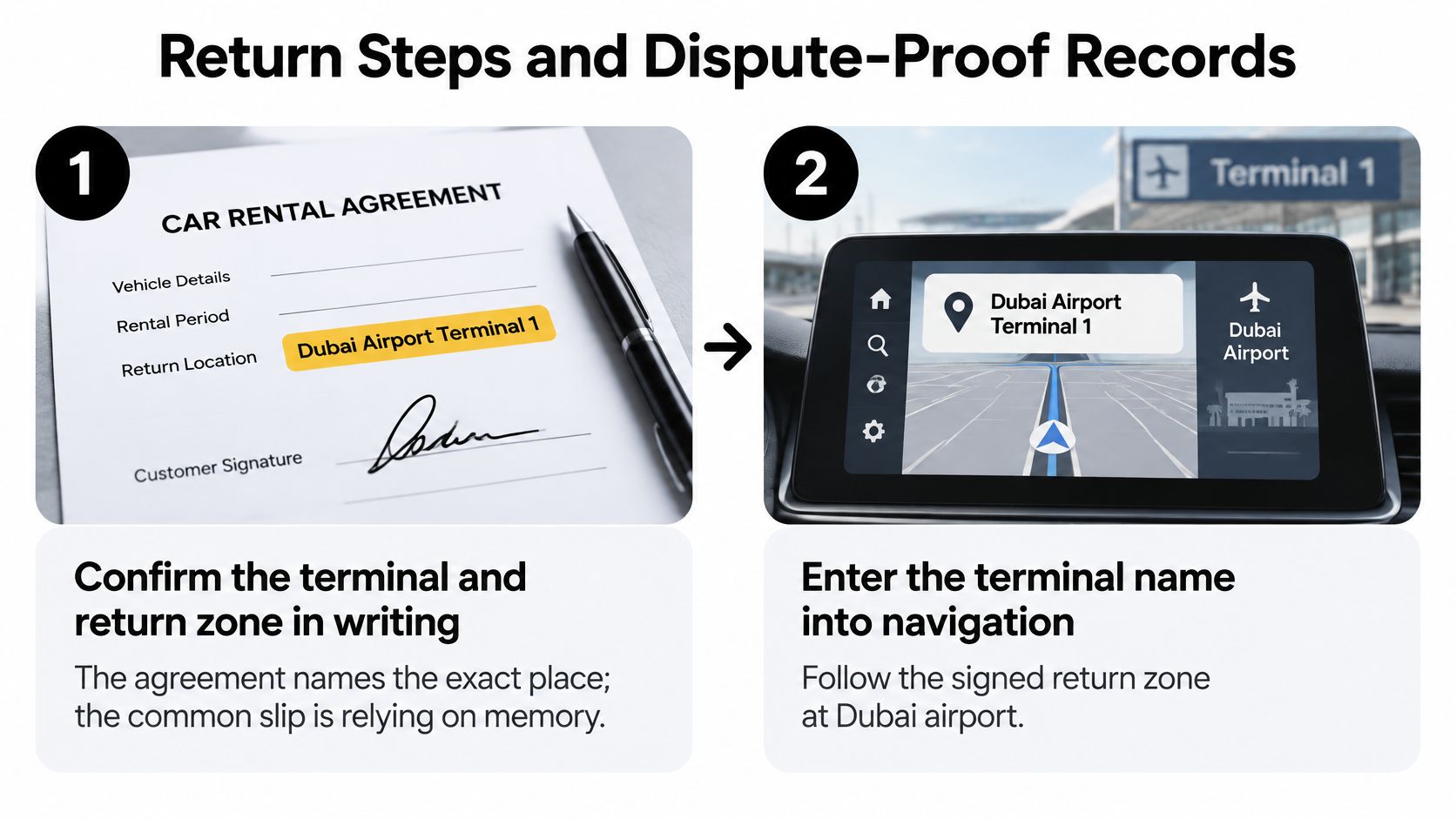
The graphic below highlights the first two habits that set up a smooth terminal arrival before you even reach the parking barrier.
Seven Steps From Approach Road to Written Sign-Off
- Verify your terminal and return zone against the signed agreement. Your contract names the exact meeting point, whether that's a specific car park zone or valet desk. The usual slip here is driving from memory after a busy week in Dubai and heading to the terminal you landed at rather than the one you're flying out of.
- Enter the terminal name into navigation and read overhead gantries. Once you enter the airport approach, switch your focus from the phone screen to overhead signage directing private vehicles to the named car park or return facility. Pulling into a passenger drop-off forecourt instead triggers an immediate wave-on from airport traffic marshals.
- Pull into the bay inside your planned time window. Arriving unhurried gives you daylight or good bay lighting to check the car calmly rather than rushing against bag-drop closing times.
- Complete a joint walk-around and take timestamped photos. Walk the perimeter with the inspection representative and photograph all four corners, every alloy wheel, the windscreen, the dashboard fuel gauge, the odometer reading, and the parked bay number. Drivers regularly lose simple claims because they snap hurried photos after walking away or forget to capture the instrument cluster before switching off the engine.
- Clear the cabin and check every supplied accessory. At Uptown Rent A Car, vehicles must be returned in the same condition they were rented, along with all accessories provided, such as GPS devices and child seats. Check the glovebox, door pockets, centre console, and boot floor for passports, sunglasses, and charging cables before handing over the key fob.
- Collect written or electronic handover confirmation. Never walk toward departures on the strength of a casual "everything looks fine" from an attendant. Wait the extra two minutes for a signed check-in sheet, emailed receipt, or timestamped message confirming the vehicle has been received.
- Store your return file before heading to departures. Keep your timestamped photos, signed or digital handover confirmation, final fuel station receipt, and an itemised note of returned accessories in one folder until your rental account is fully closed.
Before you head to the terminal, watch this quick walkthrough showing how a well-organised airport drop-off and handover looks in practice.
Separating Pre-Existing Marks From New Damage
Disputes rarely start over major collisions. They almost always hinge on minor scuffs that nobody logged properly at handover. Before you walk away from the bay, place your original pick-up condition report beside the vehicle and review any blemishes side by side using a structured vehicle inspection checklist.
Suppose an inspector points to a light scratch on the rear bumper during return. If that mark never appeared on the check-out sheet and you didn't save a timestamped pick-up photo showing it was already there, proving it pre-dated your trip becomes an uphill battle. Flagging every existing scuff before leaving the lot at collection, and matching it against your final return photos, shuts down that disagreement in seconds.
Ask the representative to confirm in writing how any pending Salik tolls, parking charges, traffic fines, or inspection findings will be processed. Hold onto every photo and receipt until you receive written confirmation that your security deposit is released and no balances remain open. Walking into departures with that confirmation already in your inbox is what a finished return looks like.
Fixing Common Return Problems
Even careful drivers hit snags on busy travel days, and congestion at DXB isn't a rare edge case. According to Dubai Airports Q1 2025 results, the airport handled 23.4 million guests and 111,000 flight movements in the first quarter alone, with January recording 8.5 million guests. When passenger flows sit at that level, small mistakes snowball quickly unless you know the exact fix.
The most common return breakdown starts right at the terminal kerb. A driver follows sat-nav instructions straight into a restricted arrivals forecourt, gets refused entry or waved along by traffic staff, and suddenly burns twenty minutes looping back around the airport perimeter. The direct fix is to ignore the kerb prompt, stay on the signed approach lane for the car park named in your booking, and message your handover contact as soon as you enter the ramp so they know your bay.
| Symptom | Likely cause | Fix |
|---|---|---|
| Refused or diverted at the terminal kerb | Following navigation to a restricted forecourt | Follow the car park route named in your booking |
| Parking exit barrier stays closed | Payment not completed or ticket lost | Pay through Scan, Pay and Go before reaching the exit barrier and keep the ticket |
| Late check-in | Peak-hour traffic on approach roads | Use a return time with a buffer and check live road conditions before leaving |
| Damage claim after handover | No timestamped photos or joint walk-around | Photograph the car with timestamps and get written confirmation of handover |
| Accident on airport roads | Collision during the return drive | Notify the rental provider and the relevant UAE authorities immediately |
That second row trips up more departing drivers than people realise. Payment at DXB car parks runs through the Scan, Pay and Go system, and it has to be settled before you reach the exit boom. If you stop to repack a suitcase, wander back to the terminal for a forgotten bag, or misplace your ticket on the way out, the barrier stays down and cars back up behind you. Pay once, keep the ticket where you can reach it, and drive straight to the exit.
Relying on an informal kerbside handover at a hub moving tens of millions of passengers a year is fragile. A controlled, documented drop-off inside the designated car park gives you proof if anything goes wrong.
Quick Fixes at the Barrier Versus Calls Before You Leave
Knowing which issues you can solve yourself in two minutes and which require immediate contact with your rental team keeps minor hiccups from escalating.
- Two-minute fixes at the barrier or kiosk: A closed exit boom after a Scan, Pay and Go payment problem can usually be resolved right at the payment kiosk or via the barrier intercom by revalidating your ticket. Taking a wrong turn onto an upper approach loop also resolves itself once you follow the car park signage back to your confirmed terminal.
- Calls you must make before leaving the airport: Never board your flight before speaking to your rental team if there's an unrecorded scuff, a missing accessory such as a GPS device or child seat, a late arrival caused by gridlock, or any discrepancy on the inspection sheet. Sorting out documentation on the spot protects your refund timeline and helps avoid surprises around how Dubai car rental security deposits work.
- Immediate action after any collision: If you're involved in an accident on airport roads or inside a car park, stop safely and don't try to settle informally. After an accident, the renter must immediately notify Uptown Rent A Car LLC and the relevant UAE authorities so an official police report is issued and insurance procedures stay valid.
Keep your phone charged and resolve any open paperwork before clearing security. Ten focused minutes in the car park beats weeks of back-and-forth emails from overseas.
Returning a luxury sedan, executive SUV, or exotic sports car at DXB feels effortless when the drop-off bay, inspection steps, and direct contact line are organised well before your flight day. At Uptown Rent A Car, we pair a carefully maintained Dubai fleet with clear terminal-specific handover guidance, transparent documentation, and responsive support from booking to final sign-off. Browse our available vehicles and arrange a smooth Dubai Airport arrival and return for your next trip.