

Corporate car rental rates in Dubai's MENA and EMEA market are averaging around $57.60 per day in 2024 and $58.10 in 2025, which is structurally above the $45.40 to $46.50 global average. Premium operators in Dubai also start much higher on the shelf, with luxury rental entry points from AED 250 per day.
That's the number you see on the quote. It's not the number you pay if you're moving executives through DXB, booking airport delivery, or adding insurance and mileage protection. If you're a procurement manager or finance lead, the job is to separate the headline from the landed cost before the invoice hits your desk.
What Corporate Car Rental Rates Actually Mean
If you're comparing two Dubai invoices for the same executive trip, you're not comparing vehicles. You're comparing two pricing models, two sets of risk assumptions, and two ways of hiding cost inside the quote. That's why corporate car rental rates need to be read as a procurement problem, not a casual price check.
For AE buyers, the market context matters. The MENA and EMEA forecast sits at $57.60 per day in 2024 and $58.10 in 2025, against the $45.40 and $46.50 global averages in those same years, so the region is already pricier before any airport or insurance add-on shows up (Business Travel News Europe). In practice, Dubai and Abu Dhabi buyers should expect a structurally expensive rental environment, not a bargain hunt.
Read the quote in three layers
Start with the headline rate, then move to the cost stack, then test the contract model. That's the only way to answer the core question, which is not “what's the daily rate?” but “what does this trip cost once the supplier has applied all the rules?”
Practical rule: if a rate card only looks cheap at the top line, it usually means the supplier is pushing value into mileage terms, insurance, or airport delivery.
A finance lead should also separate business travel needs from consumer-style thinking. A sporty sedan for a weekend hire can be priced one way, while an executive transfer with airport meet-and-greet, a second driver, and flexible cancellation needs another logic entirely. Uptown-style premium starts at AED 250 per day, but that number only makes sense when you read the rest of the quote the right way.
The Building Blocks of the Daily Rate
A daily rate is a bundle. The supplier has to cover the car, the holding cost, the risk, and the admin overhead before they can call it a viable corporate offer. A good buyer doesn't ask, “Can you go lower?”. A good buyer asks, “Which part of the bundle can move, and which part is fixed?”
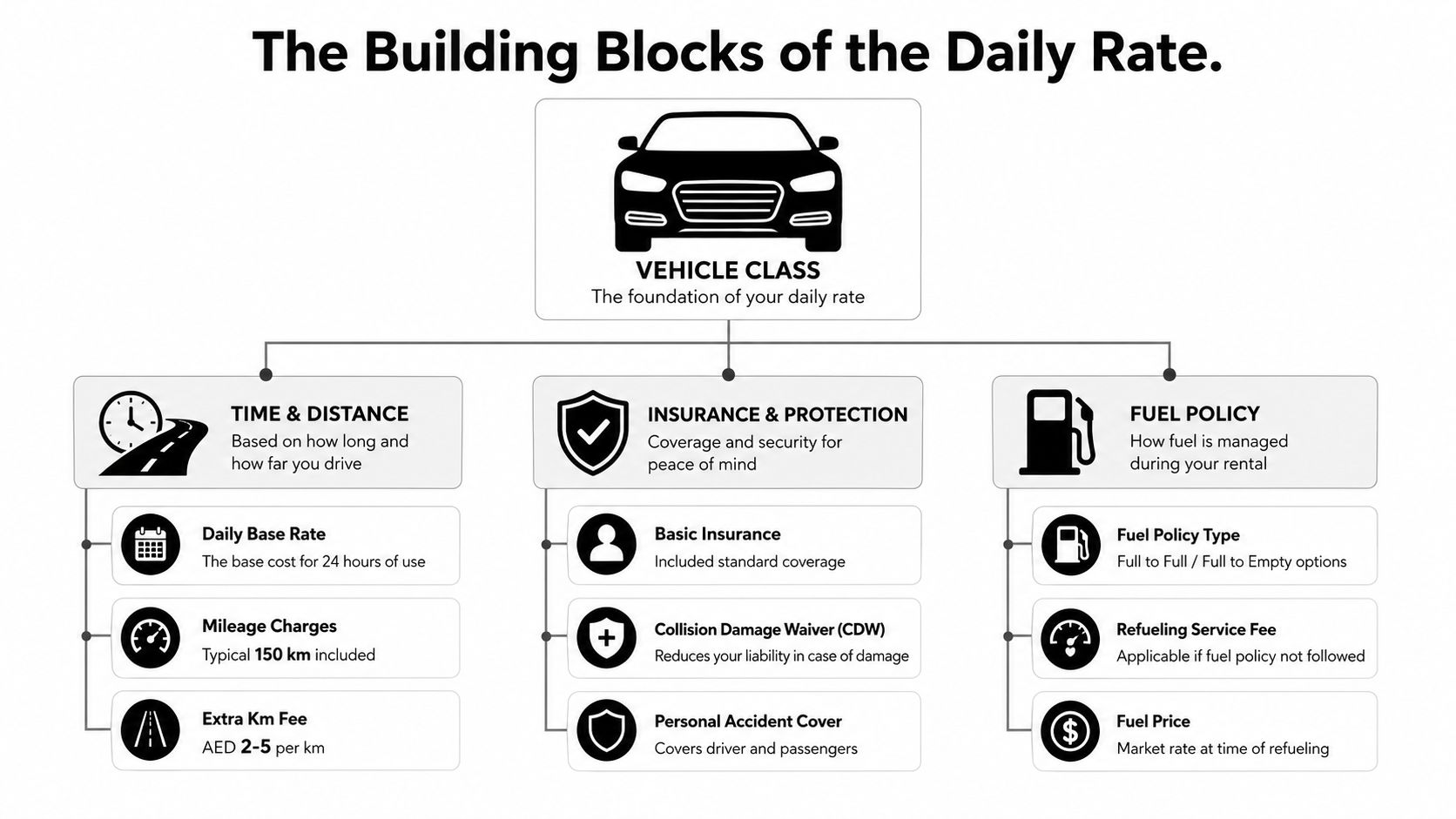
Vehicle class and trim
The first driver is the car itself. An executive sedan, premium SUV, or sports model won't price the same because the supplier's capital tie-up, depreciation exposure, and replacement cost are different. That's why rate cards should always be read by vehicle class, not just by brand badge.
Time, distance, and mileage policy
The second driver is usage. A quote that looks clean can still become expensive if mileage is tight or overage charges are aggressive. In a corporate setting, the mileage policy matters as much as the headline daily rate because executive travel plans change fast, especially when meetings move between DIFC, Business Bay, and airport districts.
Insurance, taxes, and operational overhead
The supplier is not pricing from zero. A 2025 U.S. industry cost model shows depreciation and other operating costs consume 78.7% of revenue, which tells you why operators can't slash prices forever without cutting service quality or fleet freshness (MMCG Invest). That cost structure matters in Dubai too, because insurance, servicing, licensing, and fleet turnaround are real economics, not optional extras.
For UAE buyers, fuel policy and tolls sit inside the same logic. Salik, VAT, insurance waivers, and delivery charges all change the true rate, so you should read the quote as a system, not a line item. A useful reference on fuel policy basics is the operator's own guidance on fuel price in the UAE, because fuel clauses often look small until they show up across a monthly invoice.
A competitive rate only stays competitive if the operator can keep utilisation high and downtime low. That's the economics behind the quote.
Dubai Price Ranges and Where Uptown Rent A Car Fits
Dubai corporate pricing isn't one flat number. It moves by class, by service level, and by how much operational friction the supplier has to absorb. If you're buying for an executive team, stop asking for one “best rate” and start asking where each vehicle class sits in the day-rate stack.
The range below is indicative, not a universal tariff. It gives you a procurement lens, not a brochure.
| Vehicle Class | Indicative AED per Day | Typical Use Case |
|---|---|---|
| Economy sedan | Lower corporate band | Short city runs, low-friction point-to-point travel |
| Executive sedan | Mid corporate band | Client meetings, airport transfers, director travel |
| Premium SUV | Higher corporate band | Regional trips, mixed luggage, senior executives |
| Sports or luxury flagship | AED 250 and up | High-profile visits, brand-sensitive trips, VIP movement |
That AED 250 per day starting point is a useful marker for premium rental entry, not a mass-market floor. It fits the reality of Dubai's luxury segment, where the supplier is pricing the vehicle, the presentation, the maintenance standard, and the service expectation together. Uptown Rent A Car sits in that premium starting band and advertises pricing that begins from AED 250 per day, which is relevant if you're comparing executive options rather than basic transport.
For buyers who are deciding between car hire and chauffeur-led movement, a resource on premium airport transfers Dubai 2026 is useful because it frames the same decision through transfer convenience instead of vehicle ownership. That comparison matters when the trip is about punctuality and perception, not just transport.
The main point is simple. Luxury pricing in Dubai isn't random, it reflects service depth and fleet economics. If you want a lower rate, narrow the class. If you want a better deal, control the duration and terms instead of pushing the supplier to pretend a premium SUV behaves like an economy sedan.
Contract and Billing Models That Change the Math
The rate card is only half the story. The billing structure can change the economics more than the car class does, especially once you move from one-off rentals to repeat executive travel or project-based deployments. Procurement teams should choose the contract shape before they negotiate the discount.
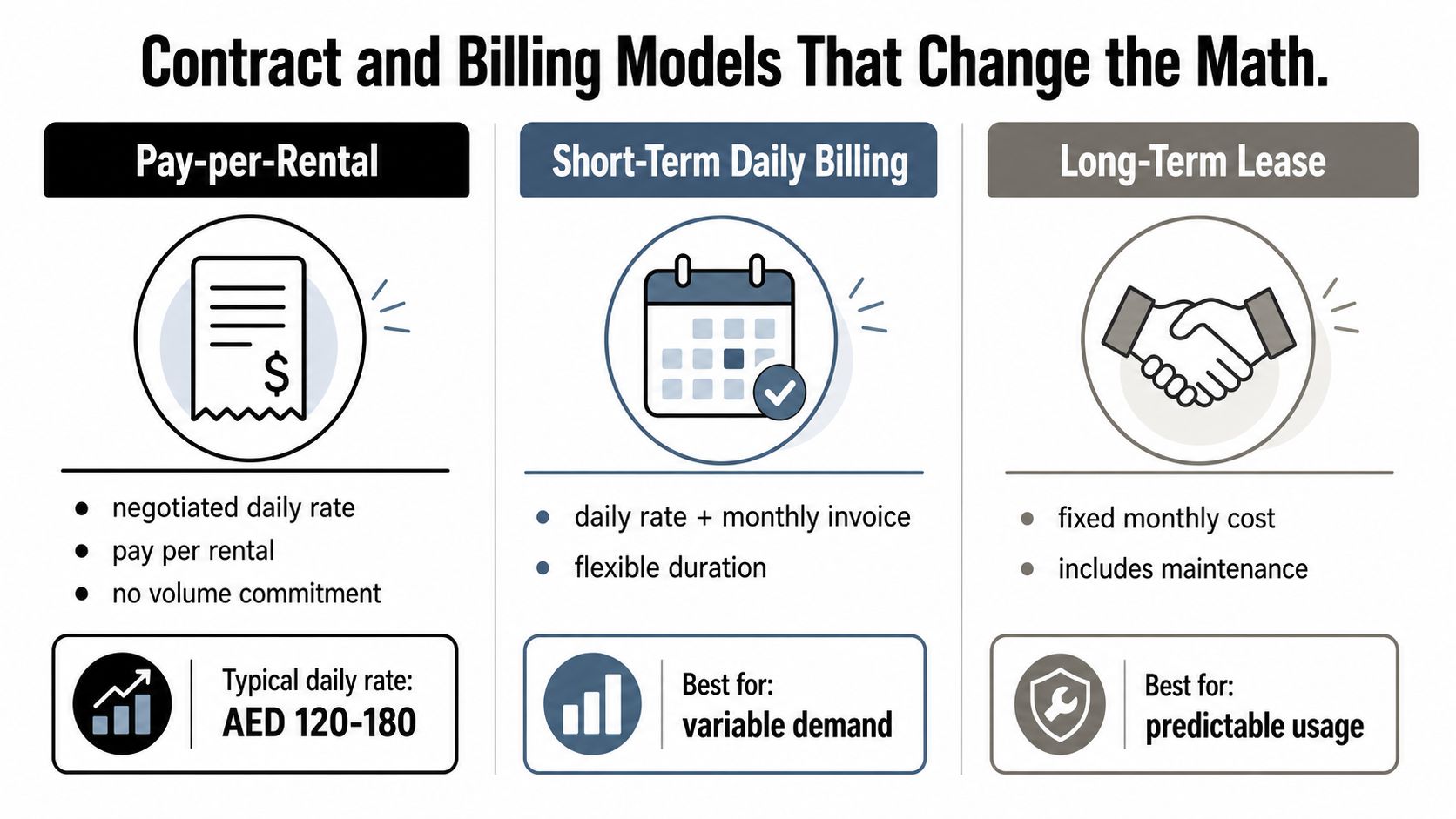
Pay-per-rental
This is the simplest model. You book per trip, agree a negotiated daily rate, and pay per rental with no volume commitment. It works for sporadic travel, visiting executives, or teams that only need occasional city movement.
Short-term daily billing with monthly invoicing
This is the model many Dubai buyers should prefer for active business travel. The vehicle is billed daily, but the supplier invoices monthly, which keeps admin clean without forcing a full lease. It suits short assignments, project mobilisation, and frequent travellers who still need flexibility.
Fully managed monthly contracts
This is for sustained usage. The supplier locks in a fixed monthly cost, often with maintenance bundled in, and the buyer commits to a term. That works when a team needs a car every day and can't afford frequent re-booking.
The math is not linear, and that's the point. U.S. government short-term rental ceilings show daily sedan rates in the $63 to $67 band, while weekly and monthly structures scale to only 6x and 24x the daily rate for some classes, and enterprise summaries show monthly multipliers as low as 20x or 22x daily after a 2024 update (GSA short-term rental ceiling rates). Long-stay pricing is discounted because suppliers want utilisation, not idle fleet.
If you're assessing deposit policy alongside billing structure, the terms matter as much as the rate itself. A practical reference on that point is car rental security deposit, because the cash tied up in deposits can distort your effective trip cost.
Don't buy the cheapest-sounding day rate if the contract punishes you on duration. Monthly structure often wins once usage is predictable.
Hidden Costs That Push the True Rate Higher
The advertised daily rate is where suppliers start the conversation. The invoice is where they finish it. If you're managing corporate travel in Dubai, the danger isn't a high base price, it's a low base price wrapped in charges that turn a “good deal” into a weak one.
The most common add-ons are not exotic. They're routine. Insurance waivers, extra-driver fees, mileage limits, fuel policy penalties, cancellation terms, and airport handoff charges all change the effective AED-per-day cost. Corporate buyers who only compare the base number end up approving a quote that looks efficient and behaves badly on the invoice.
Airport convenience is not free
Global benchmark data shows airport rentals are often about 18.3% more expensive than downtown or offsite locations, and one analysis found the average seven-night airport rental cost $86 more than a downtown rental (NerdWallet travel pricing statistics). That's the trade-off Dubai teams need to model properly. DXB pickup may save time, but if the schedule is flexible, a Downtown or Business Bay handoff can be the cheaper play.
The all-in question matters more than the brochure rate
Base rate is not the final cost. Taxes, insurance waivers, extra-driver fees, mileage limits, fuel rules, and cancellation charges can all shift the effective price. For finance teams, the right question is not “what's the rate?” but “what's the expected landed cost for this route, this driver profile, and this duration?”
For a useful discussion of how company-car style cost logic is treated in another market, the breakdown in AutoProv's car tax guidance is a solid reminder that the nominal price is rarely the operating cost.
Dubai makes this worse because executive buyers often compare premium vehicles on sticker price alone. That's a mistake. If a supplier's base quote is low but the airport premium, insurance, and mileage policy are rigid, the final number can land well above a cleaner, more transparent offer.
How to Negotiate Better Corporate Rates
Negotiate the structure first, then the price. If you try to squeeze the daily rate before you define volume, mileage, and billing shape, you're bargaining blind. Procurement teams get better outcomes when they anchor the deal in usage, not vanity discounts.
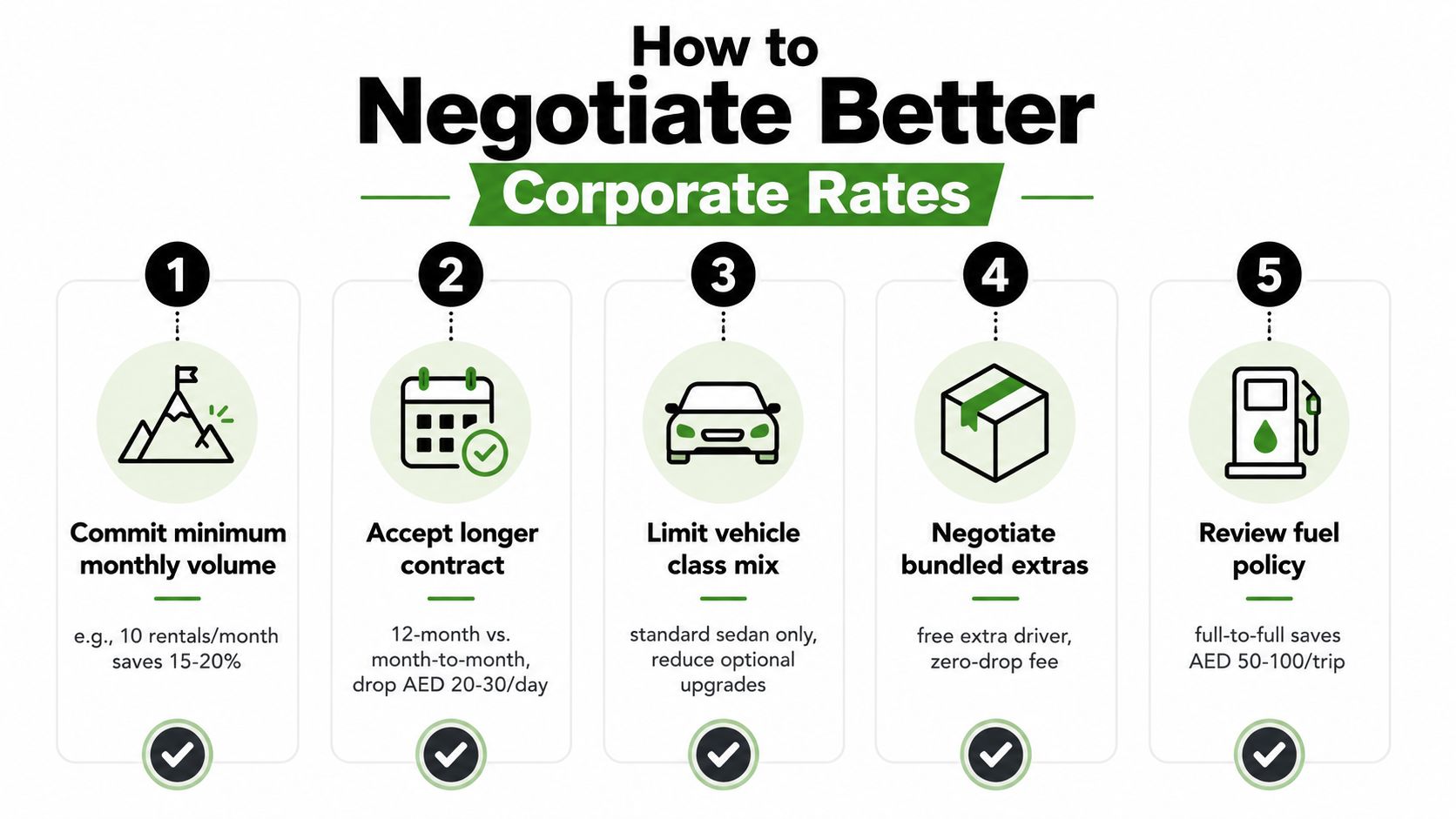
Lead with volume and duration
Minimum monthly volume is the cleanest lever. So is a longer contract term. Suppliers price certainty, and they'll often trade margin for predictable utilisation. If your team books repeatedly, ask for the rate that applies after a committed threshold, not the casual one-off price.
Benchmark the multiplier, not just the day rate
A 30-day agreement shouldn't be judged by multiplying the daily price by 30 and calling it fair. Check the monthly multiplier, the mileage policy, and the insurance line item. Those are the terms that show whether the supplier is really giving you duration value or just packaging the same economics differently.
Ask for a written rate card with effective dates. If the rate changes after a quarter, you need that in writing before the first car leaves the bay.
Time the deal to demand, not convenience
Corporate car rental pricing has been volatile, and one industry report showed corporate base rate increases in every quarter since Q3 2023, with Q1 2025 jumping to 7.5% and pushing the average base rate above $46 (Business Travel Executive). That tells you exactly why spot buying is weak. If your travel pattern is predictable, lock the terms before demand tightens.
For buyers negotiating a corporate program rather than a one-off booking, a practical starting point is corporate car hire. Use it as a benchmark for supplier conversations, not as a substitute for contract discipline.
The checklist is short. Commit volume. Ask for monthly maths. Push for bundled extras. Fix the effective date. If the supplier won't put those terms in writing, they're not offering you a corporate deal, they're offering you a retail rate with a polished label.
Sample Cost Scenarios for Dubai Corporate Travel
A good CFO doesn't want theory. They want the trip cost that will land on the card or invoice. These scenarios use Uptown Rent A Car's AED 250 per day starting point as the premium anchor and then layer on the typical add-ons you need to budget for.
One-day executive airport transfer
A same-day airport pickup and return is the easiest trip to overpay for. Start with AED 250 for the premium vehicle. Add insurance, delivery or airport convenience, and a toll or fuel allowance if the route is busy, and you're already beyond the quoted rate.
For a short trip like this, the daily rental can still beat a chauffeur if the executive needs private control of the car for meetings between terminals, hotels, and a client site. If the car sits unused for most of the day, though, you're paying for convenience, not utilisation.
One-week project deployment with two drivers
The contract structure starts to matter. A week of repeated movement across Dubai and nearby business districts usually justifies a tighter rate card, especially if the team needs an extra driver or higher mileage. The base daily rate still begins at AED 250, but your effective rate depends on whether the supplier gives mileage headroom and whether the second driver is bundled or billed separately.
Here, a negotiated weekly structure usually beats seven separate day rentals. If the team is on-site every day, treat this as a managed booking, not a string of ad hoc reservations.
Monthly contract for a visiting team
Daily thinking breaks down here. A monthly contract should be priced on utilisation, not on repeated retail logic, because the supplier benefits from guaranteed occupancy. If your visiting team has a consistent schedule, ask for the monthly multiplier and compare it with the daily alternative before approving anything.
A corporate buyer should favour the monthly structure when the car is used most days, the route pattern is stable, and the vehicle category won't change. If the team's schedule is erratic, the flexibility of a shorter billing model may still win, even at a slightly higher headline price.
Decision Checklist and Frequently Asked Questions
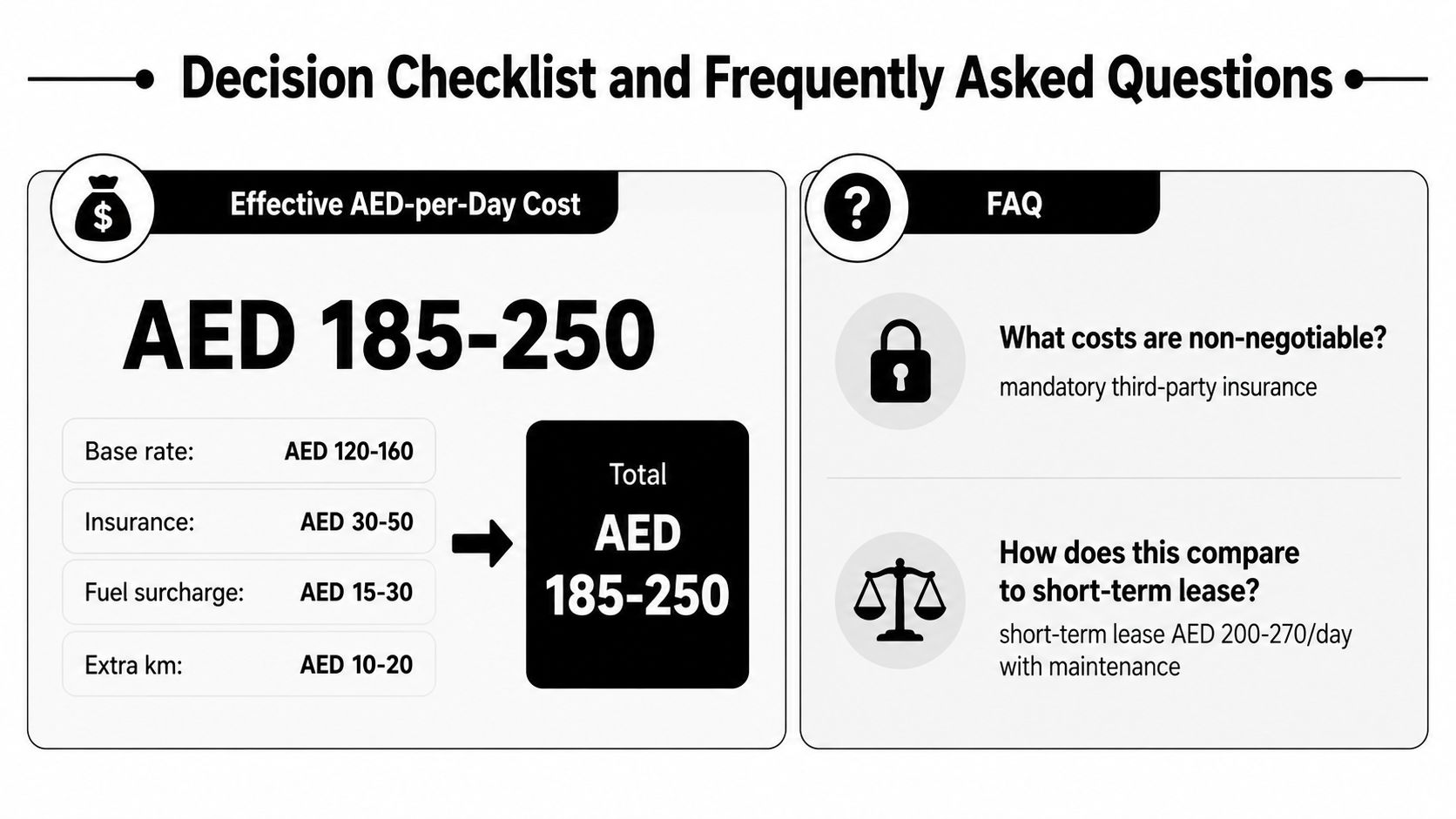
If you want the answer to the CFO question, calculate the effective AED-per-day cost after base rate, insurance, mileage, fuel policy, and pickup location. In practice, that's the number that matters, not the number on the first line of the quote. The cheapest paper rate can still be the most expensive trip.
| Check Item | What to Confirm | Why It Matters |
|---|---|---|
| Rate card | Daily rate, monthly multiplier, effective dates | Tells you whether the quote is stable or volatile |
| Contract shape | Pay-per-rental, daily billing, or monthly commitment | Stops you from buying the wrong pricing model |
| Insurance | Included cover, waiver cost, excess terms | Often changes the landed cost quickly |
| Mileage | Included allowance and overage policy | Prevents surprise charges on executive routes |
| Pickup point | Airport, downtown, or office handoff | Determines whether convenience is worth the premium |
FAQ
What costs are mandatory? Mandatory insurance and some location-based fees usually are. Treat them as part of the landed cost, not optional extras.
How does this compare to a short-term lease? A short-term lease can look similar on paper, but the value depends on maintenance inclusion, mileage policy, and how much flexibility your team needs.
How do I verify a corporate rate is genuine? Ask for the written rate card, the effective dates, the mileage terms, and the insurance detail. If the supplier won't give those in plain language, the discount isn't real.
If you need a premium Dubai rental programme that's built around transparent pricing, flexible duration, and executive-grade vehicles, visit Uptown Rent A Car and compare the live rate structure against your next trip pattern. Get the quote in writing, test the landed cost, and negotiate from the full number, not the headline.