
You've just collected a luxury rental in Dubai. The cabin still smells new, the roads look immaculate, and the first instinct is to settle into the left lane, enjoy the skyline, and let the car stretch its legs.
That part is easy. The part many first-time visitors underestimate is how radars in Dubai work.
Dubai doesn't rely on a simple network of old speed cameras. It uses a broader enforcement system that can monitor speed, lane behaviour, red-light violations, phone use, seat belts, and even excessive vehicle noise in some areas. If you're visiting for business, a celebration, or a high-end holiday, that matters for one reason above all others. A fine attached to a luxury rental can quickly turn a smooth trip into an administrative headache.
The good news is that Dubai's system is organised and learnable. Once you understand what the cameras look for, where drivers get caught off guard, and what happens if a fine is issued, the city becomes much easier to drive with confidence.
Your Guide to Confident Driving in Dubai
A typical first drive starts the same way for many visitors. You leave the hotel, join a major road, and notice that traffic flows quickly but still feels controlled. Then you begin spotting camera poles, overhead gantries, and junction monitoring systems, and one question takes over everything else. What exactly are all these radars watching?
If you're driving a premium car for the first time in the city, that uncertainty can make you overreact. Some drivers brake too sharply near every camera. Others assume only highway speed matters and overlook behaviour at junctions or in quieter neighbourhoods. Both approaches create stress you don't need.
Why luxury renters need a different mindset
Luxury rental drivers often face a slightly different risk profile. The cars are powerful, very refined, and easy to drive faster than intended. A smooth V8 or turbocharged SUV can make legal speed feel slower than it is. Add unfamiliar roads, multiple exits, and navigation prompts in busy areas, and small mistakes become more likely.
That's why it helps to treat Dubai driving as a system, not a gamble. You don't need to be anxious. You need to be deliberate.
Practical rule: In Dubai, calm driving beats reactive driving. Hold your speed steady, watch road signs early, and assume every major junction deserves your full attention.
A lot of visitors also plan scenic drives, hotel transfers, marina dinners, and desert-edge routes around a broader luxury itinerary. If that's your trip, these exclusive Dubai luxury itineraries can help you plan where to go without rushing between stops.
For first-time visitors, a useful companion is this guide to driving in Dubai for tourists, especially for understanding local road habits, signage, and lane discipline.
Decoding Dubai's Radar Arsenal
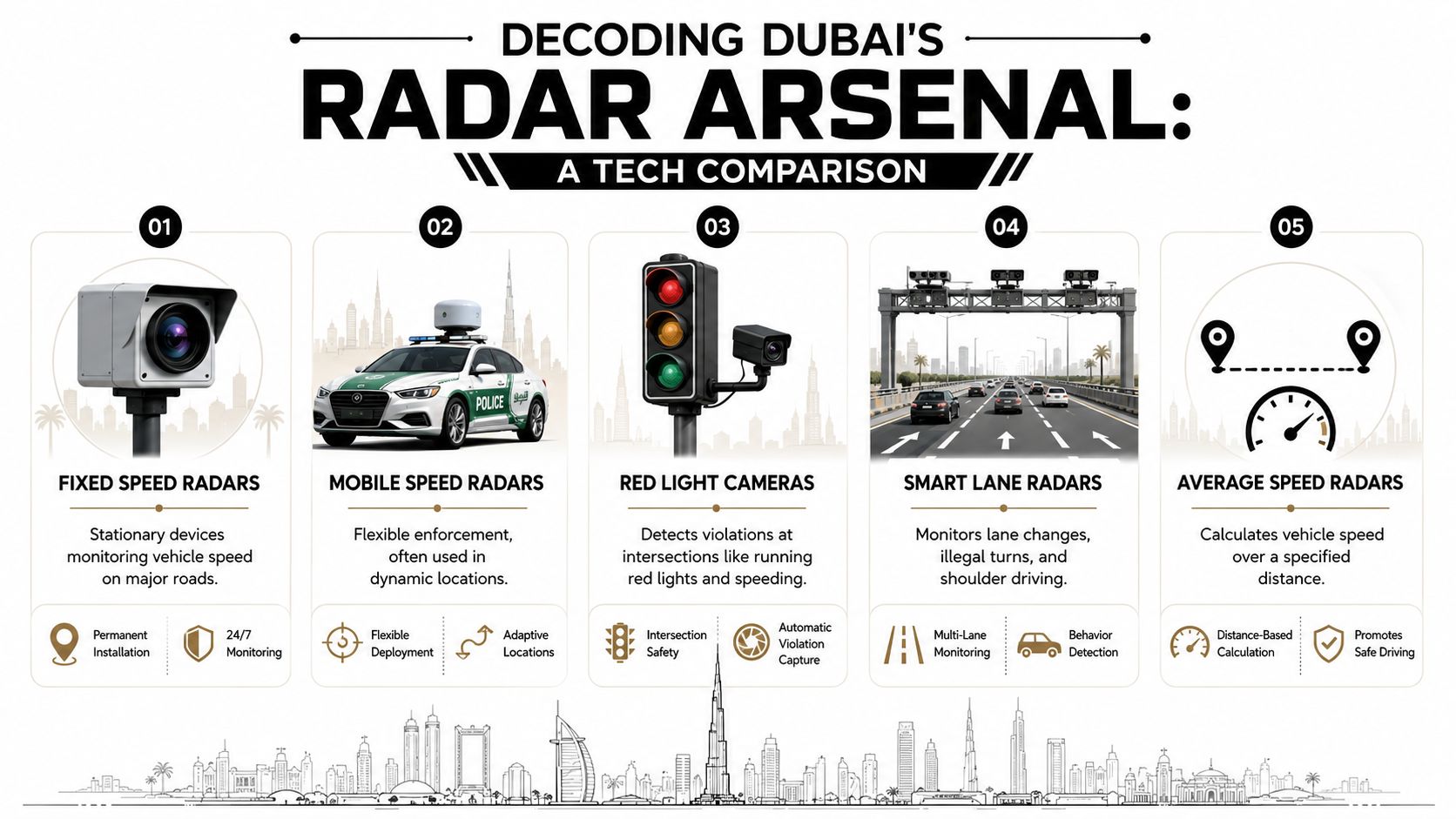
You collect your rental from Uptown Rent A Car, ease onto Sheikh Zayed Road, and assume the main risk is simple: do not speed past a camera. Dubai's system is broader than that. Different radars look for different mistakes, and a luxury car can make some of those mistakes easier to commit without noticing.
Some devices measure speed on open roads. Others watch what happens at junctions. Newer camera systems can pick up behaviour such as phone use or missing a seat belt. Separate noise-monitoring devices can flag cars that are louder than the legal limit.
The radar types most drivers meet first
The easiest place to start is the fixed speed radar. These are the familiar roadside or overhead cameras on major roads and larger city routes. Their job is narrow and predictable. They check how fast the vehicle is moving in that stretch of road.
Intersection radars are different. They watch the whole event at the junction, not just one number on your dashboard. That means they may capture red-light violations and other actions around the signal phase or lane use at the intersection.
Then there are AI-supported enforcement cameras. A useful way to understand them is to treat them less like a speed trap and more like an extra set of eyes at busy roads and junctions. Dubai Police has publicly said these systems can detect multiple offences, including mobile phone use, failure to wear a seat belt, sudden swerving, unsafe lane-related behaviour, and illegal turns, as reported by Khaleej Times on Dubai Police's AI traffic monitoring system.
That difference matters if you are renting a high-end car for a few days. In a quiet, insulated cabin, it is easy to glance at a message, drift slightly while following navigation, or roll into a turn too casually. The car feels calm. The road system is still recording what happened.
Noise radars matter more than some luxury renters expect
Dubai also uses noise radars aimed at vehicles that exceed the permitted sound level. This is especially relevant for visitors driving performance cars, tuned SUVs, or rentals with sport exhaust settings. A sound that feels normal on a holiday night drive can still attract enforcement if it crosses the legal threshold. Arabian Business highlighted Dubai's rollout of these devices and the penalties tied to excessive vehicle noise in this Arabian Business LinkedIn post on Dubai's new noise radars.
For Uptown Rent A Car clients, the practical point is simple. Avoid hard revving, unnecessary acceleration in built-up areas, and any assumption that a premium exhaust note gets a free pass because the car is expensive.
For readers who want a general technical explainer on speed detection devices and what can affect accuracy, this piece on understanding radar gun errors for drivers is a useful background read. It's not Dubai-specific, but it helps clarify how enforcement technology differs from common driver assumptions.
Dubai radar types at a glance
| Radar Type | What It Catches | Common Fine Range |
|---|---|---|
| Fixed speed radars | Speed-related violations on major roads | Varies by offence |
| Intersection radars | Red-light jumps and some junction-related violations | Penalties depend on the offence recorded |
| AI radars | Behavioural offences such as phone use, missing seat belts, illegal turns, and unsafe lane-related actions | Varies by offence |
| Noise radars | Vehicles exceeding the permitted noise level | Penalties depend on the offence recorded |
| Mobile and temporary enforcement setups | Enforcement in changing locations | Varies by offence |
If you want a clearer picture of the penalties attached to specific offences, this Dubai traffic fines list for rental drivers helps connect each radar type to the consequences you may face.
What this means in practice
Treat Dubai's radars like a layered safety net across the road network. One layer watches speed. Another watches junction conduct. Another checks what the driver is doing inside the car. For non-residents in a rental, that matters because the issue is not only the fine itself. It can also affect deposit handling, admin charges, and, in serious cases, impound-related problems tied to the registered vehicle.
The safest approach is calm, boring precision. Hold a steady speed, put the phone away before moving off, follow lane markings early, and resist the temptation to “test” a luxury car just because the road looks open.
How Radar Enforcement and Fines Work
You return your Uptown Rent A Car vehicle after a weekend in Dubai and everything feels fine. Then a traffic charge appears later through the rental process, even though no officer stopped you on the road. That catches many first-time visitors off guard.
Dubai's enforcement system often operates in the background. A radar or camera records the suspected offence, the incident is matched to the vehicle, and the penalty is processed through the official system. For a luxury rental driver, the practical point is simple. Silence at the roadside does not mean the incident disappeared.
From detection to review
The process works a bit like a hotel minibar check after checkout. The charge is not always settled in front of you at the exact moment of use, but the record still exists and can be added later.
For radar-detected offences, the system can capture the event automatically, including conduct such as phone use, seat belt violations, or an illegal turn. The case is then reviewed and attached to the vehicle record before the financial side reaches the registered owner. With a rental, that usually means the rental company is notified first, and the cost can then be passed to you under the rental agreement. This overview of Dubai traffic fines and penalties for rental drivers gives a useful summary of how different offences are typically handled.
That delay is what confuses visitors. You may drive away with no flash, no conversation, and no paperwork in hand, then hear about the offence later.
What serious offences can mean in a rental
Some violations are treated as major safety offences, especially at junctions. Red-light offences can lead to a fine, black points, and vehicle impoundment consequences under UAE traffic rules, while mobile phone use also carries a financial penalty and black points, as reported by the UAE government's official traffic fines and violations guidance.
For someone renting a high-value car, that distinction matters. A standard speeding fine is one problem. An offence linked to impoundment or serious penalties can create a second problem between you and the rental company, because the car is registered to them and your contract usually allows them to recover fines, admin fees, and related costs from you.
The safest habit is boring and effective. If a light is changing, stop early. If navigation is confusing, keep moving safely and reroute later instead of grabbing the phone at the junction.
How black points affect non-residents
Black points are part of the offence record, but visitors usually feel the effect through the rental file before they feel it in any licensing system. In plain terms, you should not assume that being a tourist shields you from the consequences.
What usually matters first is the chain attached to the vehicle. The offence is logged against the car, the rental company is alerted, and charges may then be applied according to your agreement. For Uptown Rent A Car clients, this is why prevention matters more than trying to argue after the fact. Once the offence is properly recorded, your strongest position is usually to understand what happened, confirm the charge, and settle it quickly if it is valid.
Radar Hotspots and Common Traps to Know
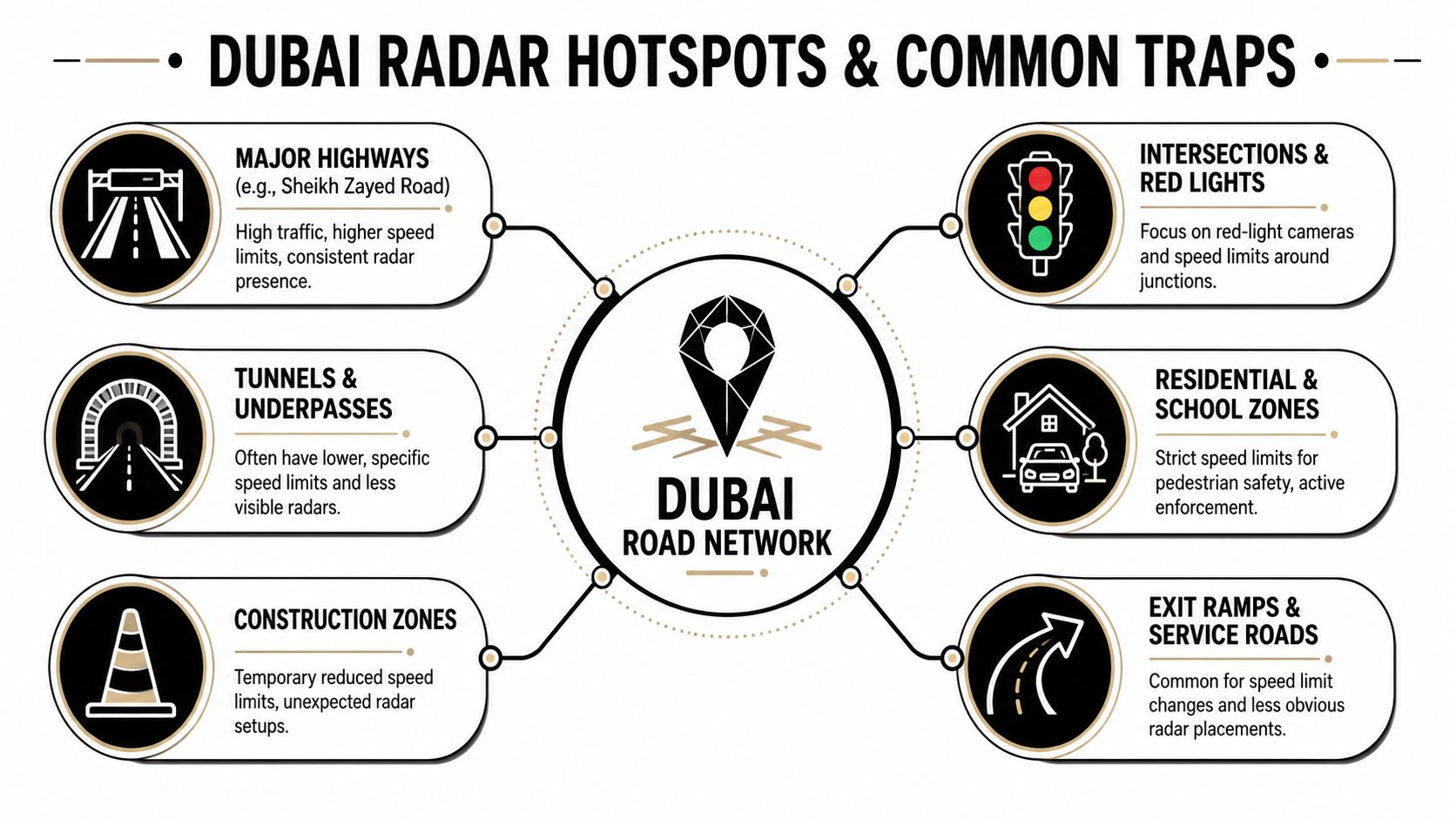
A lot of fines don't happen because the driver was reckless. They happen because the road changed character faster than the driver expected.
That's especially common when someone is comfortable on a broad highway and then carries the same rhythm into a junction, service road, exit ramp, or residential corridor.
Where visitors get caught off guard
On major roads, most drivers are already alert. The surprises tend to happen in transition zones.
A common example is the fast approach to an exit where the road begins to curve, the speed expectation changes, and your attention shifts to lane positioning. Another is a large signalised junction where the temptation is to glance down at navigation just as the system is watching for phone use or signal compliance.
There's also a quieter category of risk that matters more to tourists than many realise. A major challenge for drivers is the lack of specific location data for new silent AI radars in residential zones like Al Barsha or Jumeirah, which detect mobile phone use and excessive noise without flashing, catching many drivers, especially tourists, unaware, according to this write-up on how to identify Dubai's silent radars and the fines.
Residential areas feel relaxed, but enforcement doesn't
This catches luxury renters in a very specific way. On a broad arterial road, you expect enforcement. In a villa district or upscale residential pocket, you may feel like you're cruising between cafés, beach clubs, and hotels. That false sense of ease is exactly why these areas matter.
A grey or black striped roadside pole may not flash. You may not even register it as enforcement equipment. Yet the behaviour being monitored can be as simple as a phone in your hand or an overly loud engine note on a quiet evening drive.
To orient yourself better while moving between districts, a practical tool is this Dubai maps app guide, which can help visitors understand road layout changes before they become last-second lane decisions.
A quick visual overview helps too:
The safest habit in hotspot zones
Use a slower mental tempo than the car invites. Luxury vehicles often isolate you from noise and road texture so well that speed, distraction, and abrupt manoeuvres feel smaller than they are.
That's why the most reliable strategy is simple:
- Read ahead early: Look for lane and speed signs before the road splits.
- Treat neighbourhood roads seriously: Don't assume enforcement is limited to Sheikh Zayed Road or other famous corridors.
- Keep your phone untouched: Even a quick glance at a message can become an expensive mistake.
- Drive discreetly and smoothly: If the car is sporty, resist showing it off in residential streets.
The Illegality of Radar Detectors in the UAE
Drivers from Europe, North America, and other regions sometimes arrive with the wrong instinct. They assume a radar detector is a clever safety net.
In the UAE, that's the wrong approach. It also reveals a misunderstanding of how road enforcement is framed. Authorities treat the issue as an attempt to bypass safety enforcement, not as a harmless gadget for enthusiasts.
Why trying to beat the system is the wrong play
Even without quoting extra penalties here, the practical takeaway is clear. Bringing, using, or relying on a radar detector or jammer creates legal risk you don't need. It also won't solve the bigger problem, because modern enforcement in Dubai goes beyond the classic “speed trap ahead” mindset.
AI systems, junction monitoring, and behaviour-based detection mean your real protection is lawful, disciplined driving. Technology in the car can help. Cruise control, speed warning settings, and navigation prompts are useful. Concealed detector hardware is not.
The smartest luxury driver in Dubai isn't the one trying to outsmart the cameras. It's the one who never gives them a reason to act.
What to use instead
A much better toolkit looks like this:
- Cruise control on longer roads: It helps hold a steady legal pace.
- Navigation with alerts: Waze or Google Maps can improve situational awareness.
- Passenger assistance: If someone is with you, let them handle route changes and messages.
- Simple cabin discipline: Phone away, seat belt on, both hands available when traffic thickens.
That approach is legal, calmer, and more effective.
Fined in a Rental Car A Step-by-Step Guide
Getting a fine in a rental car feels worse than getting one in your own vehicle because there's an extra layer between you and the record. The main thing to remember is that this is usually an administrative process, not a crisis.
What matters is acting clearly, keeping records, and understanding how rental companies usually handle the issue.
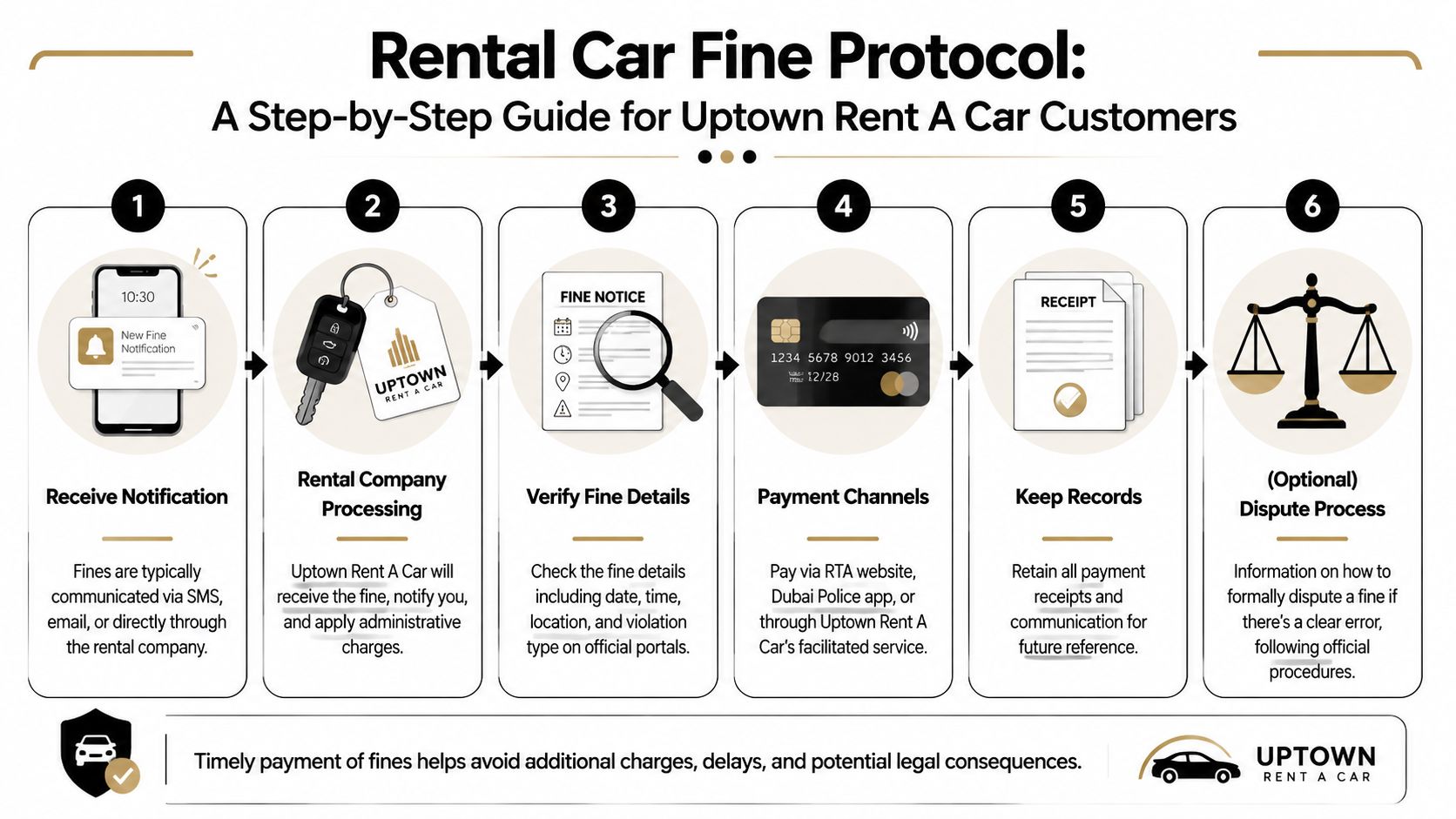
The practical sequence most renters should expect
First, the fine is linked to the vehicle registration rather than to your travel itinerary. That means the registered owner of the car, which is the rental company, is typically the first party that can see or process the issue.
Second, the rental company usually contacts you once the fine is confirmed and allocates the charge according to the rental agreement. In many cases, the amount is charged to the card held on file, often together with an administrative handling fee if your contract allows for it.
Third, you should ask for documentation. That normally means the violation details, date, time, and offence category.
What you should do immediately
Use this simple checklist:
- Read the notice fully: Don't react to the amount alone. Check the alleged offence and when it occurred.
- Match it to your rental period: Make sure the timing aligns with when the vehicle was in your possession.
- Request the record: Ask for the official fine report or copy of the notice.
- Keep your paperwork: Save the rental agreement, payment receipt, and all related emails.
- Ask about disputes calmly: If there's a clear mismatch, raise it quickly and politely with supporting documents.
A rental fine is usually easiest to resolve when you handle it like an invoice review, not an argument.
For broader high-end travel habits around rentals, valet use, documentation, and trip planning, this article on Approved Lux car rental expertise is a sensible companion read.
If you believe the fine is wrong
Disputes should be based on something concrete. Good examples include the vehicle being outside your rental window, a mismatch in identifying details, or an obvious processing inconsistency. “I didn't notice a camera” is not a strong basis for challenge.
If the record is accurate, paying promptly and retaining proof is the cleanest outcome. If there's a genuine error, present the timeline and supporting documents without delay.
Proactive Prevention Your Ultimate Strategy
The best way to deal with radars in Dubai is to make them almost irrelevant to your trip. Not by ignoring them, and not by trying to outsmart them. By building driving habits that keep you comfortably inside the rules.
That's especially important in a luxury rental, where the car's smoothness can make speed, noise, and distraction feel smaller than they are.
Build a low-stress driving routine
Think in layers rather than single tips.
Start before you move. Set your destination while parked, choose your route, and glance at the lane pattern if the destination is in a busy district. During the drive, use the car's comfort features intelligently. Cruise control is excellent on longer stretches because it removes the slow drift upward that often happens in quiet, powerful cars.
Then focus on the three behaviours that most often create avoidable trouble:
- Keep your phone out of your hand: If you need navigation, mount it and leave it alone.
- Respect every signal change: Don't rush amber lights or force last-second turns.
- Drive the car with minimal noise in neighbourhoods: Save the theatre for legal, appropriate settings, not residential streets.
Read the road, not just the dashboard
Visitors often stare at the instrument cluster after spotting a camera. That's too late. The better habit is to scan far ahead for signs, lane arrows, merging traffic, and the feel of the road changing around you.
Roads that widen, narrow, split, dip into tunnels, or lead into service roads demand extra attention. If you miss an exit, keep going and reroute safely. A missed turn costs time. A rushed correction can cost much more.
Calm rerouting is one of the most underrated skills for driving well in Dubai.
Make the experience feel premium for the right reasons
A premium drive in Dubai shouldn't mean testing limits. It should mean arriving relaxed, parking without stress, and never wondering whether a notification will land later.
That mindset changes everything. You stop chasing the road and start managing it well. The city becomes easier to enjoy, and the car becomes what it should be: part of the experience, not the source of a problem.
If you want a luxury car experience in Dubai that feels smooth from booking to handover, browse the fleet at Uptown Rent A Car. It's a practical place to compare premium vehicles, choose a model that suits your trip, and drive Dubai with more confidence from the start.