
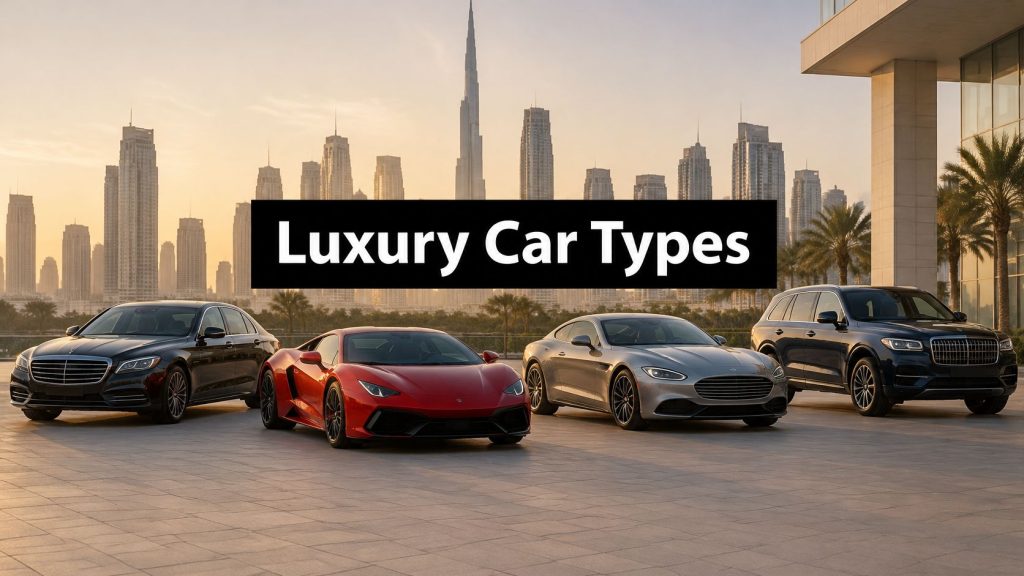
Which luxury car should you book for a week in Dubai? The answer often starts with a badge: Rolls-Royce, Bentley, Porsche. That answer skips the part that decides whether the trip works. A car that feels extraordinary on a 20-minute run to a hotel can be the wrong choice for a 5am airport collection with four suitcases, or for a long loop that ends at a desert lodge after dark.
The category matters more than the logo, and a category describes the job a car was built to do: carry a passenger in silence, reward a driver on an empty road, swallow luggage and still clear a rough track. Learn the five groups, and the badge becomes the last decision rather than the first.
Luxury Car Types at a Glance
Most readers who search انواع السيارات الفخمة arrive with a version of the same question: which type of luxury car suits the trip in front of me? Start there, because a luxury category describes a car's purpose, not its price. A two-door coupé and a long-wheelbase saloon can sit within a few thousand dirhams of each other and still be completely wrong for each other's passengers.
Here are the five groups that cover almost every luxury vehicle you'll be offered in Dubai.
| Category | Typical models | Core strength |
|---|---|---|
| Executive sedan | Mercedes-Benz S-Class, BMW 7 Series, Audi A8 | Rear-seat comfort and a calm, refined ride |
| Sports car | Porsche 911, Ferrari F8 Tributo, Lamborghini Huracán | Acceleration, handling and driver focus |
| Grand tourer | Bentley Continental GT, Aston Martin DB12, Mercedes-AMG GT | High-speed stability with long-distance comfort |
| Luxury SUV | Range Rover, Porsche Cayenne, Mercedes-Benz G-Class | Space, height and road or off-road capability |
| Ultra-luxury saloon | Rolls-Royce Ghost, Mercedes-Maybach S-Class | Hand-finished interior and maximum rear comfort |
Why one emirate supports so many types
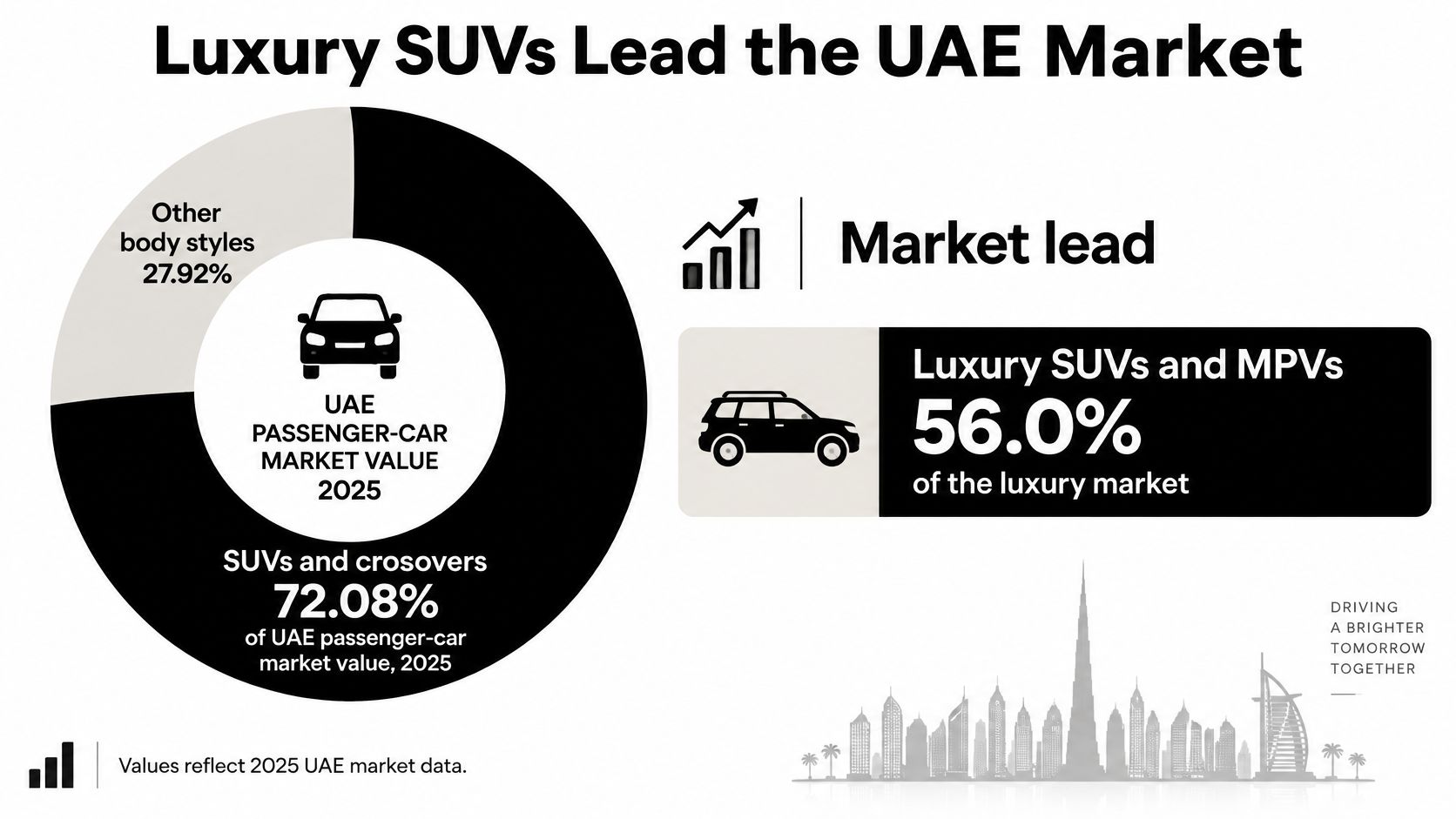
Dubai's luxury fleet is wide because the demand behind it is wide. One industry estimate values the UAE luxury-car market at USD 4.47 billion in 2025, forecast to reach USD 7.81 billion by 2035, with Dubai accounting for approximately 51.0% of that value, about USD 2.28 billion, according to Credence Research's UAE luxury car market report. The same estimate identifies SUVs and MPVs as the largest luxury body-style category, at 56.0% of market value in 2025 and growing at roughly 6.0% a year.
That structure reflects who is travelling. Affluent residents, international visitors, corporate accounts and event organisers want different things from the same brand name, and a fleet built on a single definition of luxury leaves most of them underserved.
Three typical trips show how quickly the answer changes:
- Airport collection into Downtown: two passengers, four cases, a 7am meeting. Rear space and a quiet cabin beat horsepower every time.
- A weekend drive toward Hatta or the desert edge: taller seating, luggage room and the ability to handle a gravel approach matter more than a low, stiff chassis.
- A wedding arrival at a Palm Jumeirah resort: the car is part of the photographs, so presence and a hand-finished interior carry real weight.
Convertibles and coupés don't form a separate class. A convertible is a body style that can sit on a sports car or on a grand tourer, so read those sections with the roof question in mind rather than treating open-top cars as their own category.
A Rolls-Royce Ghost and a Mercedes-Benz S-Class are both luxury saloons, and their jobs differ. The S-Class is the working executive car that fits an underground car park without drama; the Ghost is a chauffeur-driven statement with a hand-finished cabin and a footprint that changes where you can stop.
Treat the table as a shortlist, not a verdict. Find the row that matches the main purpose of the trip, then read the section that follows for the trade-offs that only appear in daily use.
Executive Sedans for Comfort and Chauffeur Travel
A visitor lands at Dubai International at 6am, clears immigration with two suitcases and a garment bag, and has a 9am meeting in DIFC. The car that solves that morning is an executive sedan: a full-size four-door saloon built around the rear seat, a hushed cabin and a ride that flattens expansion joints on Sheikh Zayed Road.
The models to know are the Mercedes-Benz S-Class, BMW 7 Series and Audi A8. In long-wheelbase form, which is what most chauffeur-driven fleets specify, the extra length goes into rear legroom rather than the boot, and that distinction matters when a passenger wants to work on a laptop.
What the passenger notices in the first ten minutes
Three uses justify the category: airport transfers, corporate meetings and formal events. In all three, the passenger judges the car by how it feels rather than how quickly it reaches 100km/h. Four practical criteria separate a good executive sedan from an ordinary one:
- Rear legroom: the measurement that matters is knee room with the front seat set for a tall driver, not the brochure figure.
- Ride comfort on long motorway runs: a car tuned softly for city speed can float and wallow at 120km/h, so ask how it behaves on a longer highway leg.
- Boot space for luggage: two large cases plus hand luggage is the realistic test for an airport collection.
- Ease of parking in dense districts: length and turning circle decide whether a hotel valet can slot the car into a tight basement bay.
The trade-off is real and worth stating plainly. Sedans sit lower than SUVs, so entry is harder for older passengers and for anyone in a long dress, and they carry less cargo than a luxury SUV of similar price. If the trip includes a stroller, golf clubs or three large cases, the saloon stops being the comfortable option.
The ten-minute test: sit in the rear seat for ten minutes before you commit. If the cabin still feels calm at the end of it and the ride still feels smooth over a poor surface, the car will work for a two-hour transfer.
Ultra-luxury saloons sit at the top of this family rather than outside it. The Rolls-Royce Ghost and Mercedes-Maybach S-Class put hand-finished interiors and maximum rear comfort first, and they suit chauffeur-driven travel where the rear seat is the entire point of the journey. Their extra length makes city parking harder than a standard S-Class, so check the destination before booking one: a hotel with a low, narrow ramp is not the place to discover this.
Sports Cars and Grand Tourers Explained
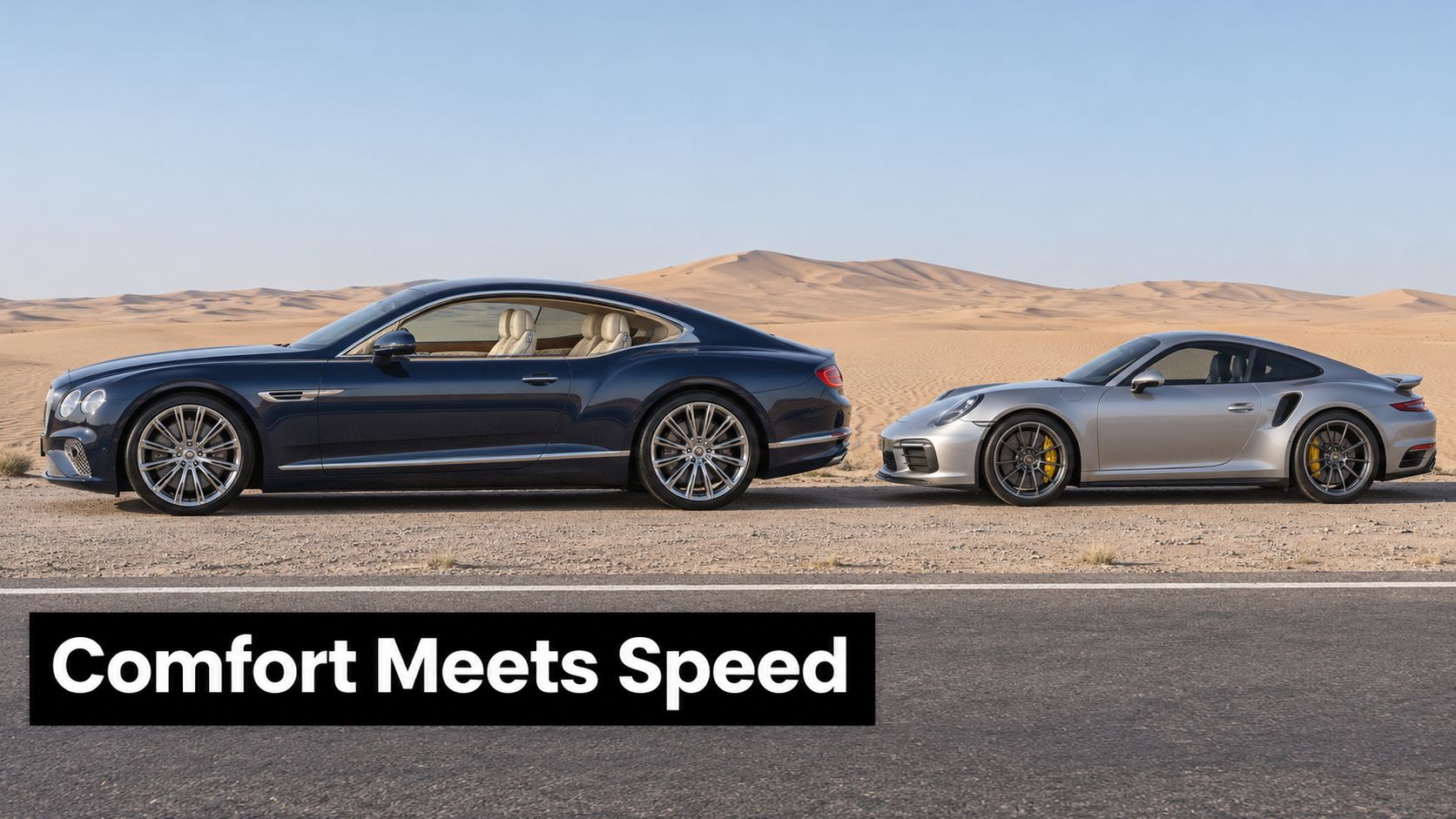
A sports car and a grand tourer both look fast standing still, which is where most of the confusion begins. A sports car puts handling, acceleration and low weight first, and accepts a firm ride as the price of that focus. A grand tourer trades some of that edge for high-speed stability, supportive seats and luggage space that survives a long drive.
The modern sports-car shortlist is familiar: Porsche 911, Ferrari F8 Tributo, Lamborghini Huracán. On the grand-touring side you'll meet the Bentley Continental GT, Aston Martin DB12 and Mercedes-AMG GT. They overlap in price and presence, and they don't overlap in how a four-hour drive feels.
Two cars parked side by side make the distinction easier to see than any specification table.
Three checks before you book a sports car
- Seating position: a low cabin with a high sill can be awkward to enter and hard to see out of in traffic. Sit in it before you plan a day's driving.
- Ground clearance: speed bumps, ramps into hotel car parks and steep garage entries are the everyday obstacles, not racetrack kerbs. A front lift system helps; a very low nose without one does not.
- Running costs: tyres and brakes on a heavy, fast car wear faster and cost more than on a saloon, and low-profile rubber is sensitive to both heat and kerbs.
Grand tourers answer a different set of questions. Ask whether the boot takes two large suitcases, whether the cabin stays quiet at highway speed with the roof closed, and which suspension setting you would leave it in for a 250km run. Those three answers predict satisfaction better than a 0-100km/h figure.
The Bentley Continental GTC shows what the open-top version adds and costs. Dropping the roof turns a quiet coupé into an event, and it gives up some structural rigidity and boot space in return. On a Dubai winter evening along the Marina, that's a fair trade. On a summer afternoon with the air conditioning working hard, the closed coupé is the calmer car.
Supercars sit at the extreme end of the sports-car group, with limited daily usability. A mid-engined car with a very low nose, a stiff chassis and almost no luggage room is magnificent for a morning and tiring by the third stop. Book one for the experience it provides, not as the family support vehicle.
Choose a sports car for weekend driving and special occasions, and a grand tourer for road trips. Confusing the two is the most common booking mistake in this price bracket.
Luxury SUVs and Why They Lead the Market
The numbers settle the argument about what buyers and renters choose. SUVs and crossovers accounted for 72.08% of UAE passenger-car market value in 2025, according to MarqStats' UAE passenger car market analysis. The same analysis finds that luxury and ultra-luxury vehicles costing more than approximately AED 400,000 generated 20.61% of total market value from just 6.16% of units, which is a precise way of saying that a small number of very expensive cars carry a large share of the money.
The practical reasons are easy to spot on the road. A luxury SUV combines a premium interior and strong performance with passenger capacity, luggage room and the ride height that makes long drives and desert-edge routes comfortable. It also copes with the everyday reality of speed humps, valet ramps and gravel car parks without the careful angle of approach a low saloon needs.
What separates one luxury SUV from another
The badge tells you the price band. The specification tells you what the car will do on a given route, and three differences matter most.
Ground clearance and off-road hardware. A Mercedes-Benz G-Class is engineered for rough ground; a Porsche Cayenne is engineered to feel like a tall sports saloon that happens to have all-wheel drive. Both are excellent, and only one of them is the right car for a track that turns to sand.
Seating layout. Some models offer a third row, others are strictly five-seat. A family of six in a five-seat SUV is a problem no amount of leather solves.
Fuel use. Weight and aerodynamic drag cost fuel, and a large V8 or V12 SUV is thirstier than a comparable saloon. On a long inter-emirate day, that difference shows up at the pump.
If part of the itinerary heads toward the dunes, it's worth understanding which vehicles are used for desert safari routes in Dubai before assuming any SUV qualifies. Sand is a different surface from tarmac, and a luxury SUV with road-biased tyres and low ground clearance is not automatically a desert vehicle.
The range runs from the Range Rover and Audi Q8 through the Porsche Cayenne and Mercedes-Benz G-Class to the Rolls-Royce Cullinan at the ultra-luxury end, where the SUV shape carries a hand-finished cabin and the same presence as a flagship saloon.
Here's how that range behaves in motion, from the city streets to the open highway.
Two edge cases catch people out. A very large SUV can be difficult to park in older districts and tight basement garages, where width and length matter more than height. And a single business passenger with one briefcase is often better served by a sedan, which is quieter at speed and easier to step out of in a formal suit. Choose an SUV when space, height and road quality matter more than handling, and don't apologise for the choice.
Petrol, Hybrid and Electric Luxury Cars Compared
Start with the itinerary, not the powertrain. Map the actual days first: a hotel-to-meeting loop inside Dubai, a dinner run to the Marina, an Abu Dhabi day trip, a desert-edge excursion. That map decides whether an electric luxury car is a pleasure or a logistics exercise, and it decides it faster than any comparison of badge prestige.
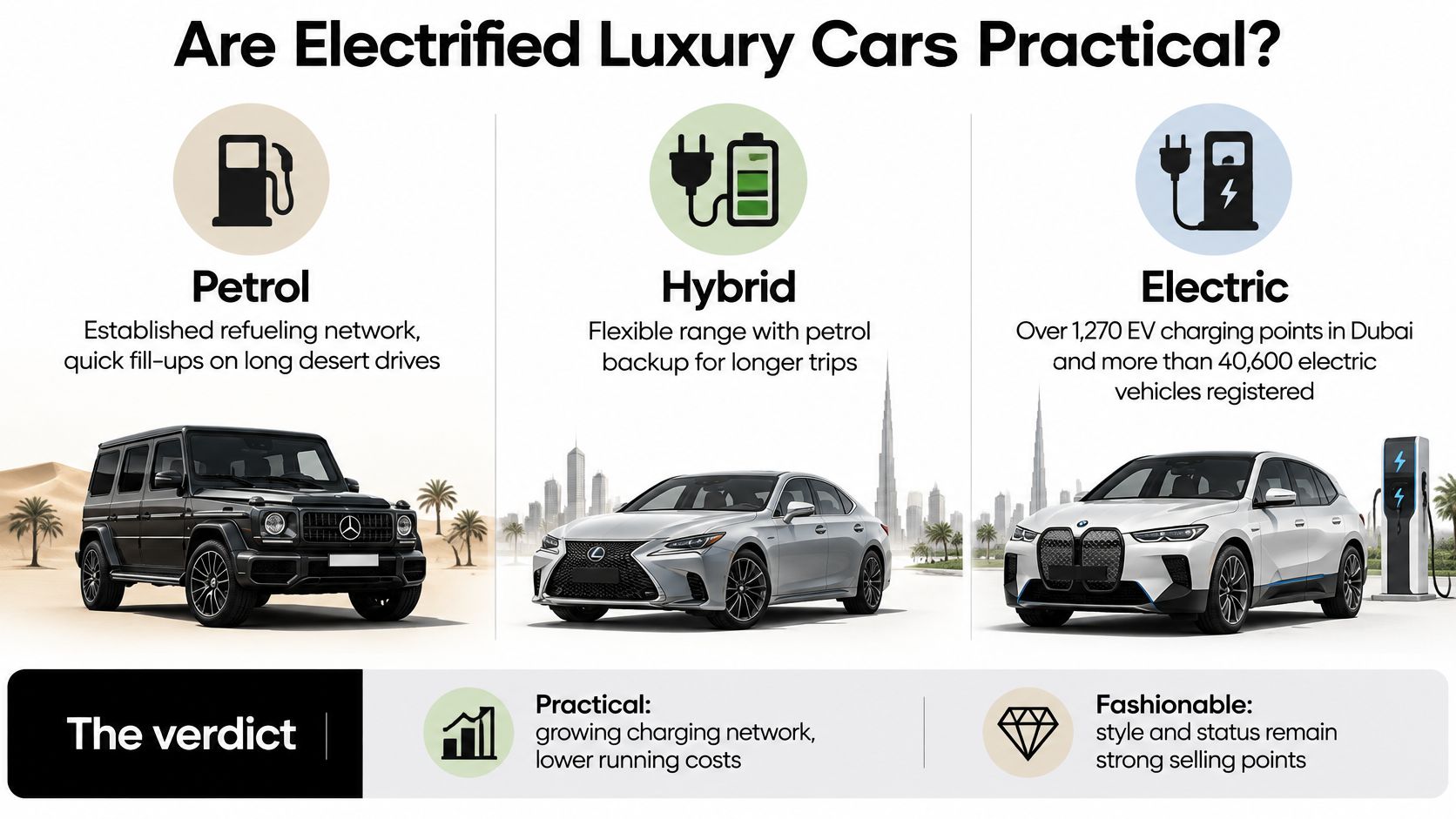
The infrastructure has improved quickly. Dubai had more than 1,270 EV charging points and over 40,600 electric vehicles by mid-2025, and electrified vehicles accounted for roughly 12.5% of 2025 passenger-car units nationally, while battery-electric cars represented about 7.85% of market value, according to Ken Research's GCC luxury car market analysis. Those figures describe a market where premium electric use is feasible, not a market where it's universal.
| Factor | Petrol | Hybrid | Battery-electric |
|---|---|---|---|
| Refuelling or charging | Quick refuel at any station | Quick refuel, with short electric runs | Depends on charger access and hotel charging |
| Long inter-emirate trips | Strongest fit | Strong fit | Needs a charging plan along the route |
| City and hotel routes | Higher fuel use in town | Lower urban fuel use | Strong fit where charging is available |
| Desert excursions | Strong fit with fuel planning | Strong fit | Uncertain charging, higher risk |
Why zero emissions doesn't mean a cheaper trip
Tourists and executives pay for time as well as fuel. A battery-electric luxury car can be the smoothest, quietest vehicle in the fleet on a short city route, and still cost more in practice if it needs a 40-minute charging stop inserted between a hotel checkout and an airport departure. Route planning has a value, and it belongs in the comparison.
Practical check: confirm hotel charging before you book an electric car. A charger at the property turns an EV into the obvious choice; no charger turns every morning into a search.
Hybrids sit in the useful middle. They refuel like a petrol car, which keeps long routes and remote stretches simple, while reducing fuel use in stop-start city traffic where a large engine is at its least efficient. For a visitor who wants a lower-consumption car without planning around chargers, that combination is hard to beat, and it's worth comparing hybrid cars available in the UAE against the petrol versions of the same models.
The decision test is short. If the itinerary includes Abu Dhabi, the Northern Emirates or remote desert routes with uncertain charging, choose petrol or hybrid. If the days are city-bound with hotel charging and a known airport timing, an electric luxury car is practical and costs nothing in comfort. What it does demand is honesty about the route before you commit.
Heat and Upkeep Checks That Matter in the UAE
UAE heat changes the reliability profile of a luxury car, and it does so in ways that don't show up until something fails. Reported UAE service data indicates 25–35% more battery-related service requests during summer than during cooler months, because high temperatures accelerate electrolyte evaporation, internal corrosion and battery degradation, as Zigwheels' report on what UAE summer heat damages explains.
Tyres carry a compound risk. Heat raises inflation pressure while hot road surfaces, sustained motorway speeds, incorrect inflation, overloading and ageing rubber all increase the chance of failure. Overinflation shrinks the tyre's road-contact patch and reduces grip; underinflation increases sidewall flexing, which generates more heat. Neither extreme is safe in August.
Run this sequence before any peak-summer deployment:
- Verify cold tyre pressure against the door placard. Check before the car has moved that day, not after a motorway run when pressures read high.
- Inspect sidewalls and tread. Look for bulges, cracking, embedded debris and uneven wear across the width of the tyre.
- Run a battery load test. A battery that starts a car at 30°C can fail to start it after a hot soak in an open car park.
- Check coolant level and cooling-system condition. Air conditioning and engine cooling work hardest exactly when the car is idling in traffic.
- Review thermal management and range on electrified models. Extreme temperatures raise cooling demand, can temporarily reduce driving range and affect rapid-charging performance.
How the checks change by vehicle type
The same checklist applies differently across categories. Luxury SUVs carry heavier loads and put more stress through their tyres, so pressure and wear checks matter more often. Sports cars run low-profile rubber that heats quickly and offers less sidewall to absorb a kerb or a pothole edge. Electric and hybrid models deserve extra attention to the thermal-management system, because the battery is doing more work in a hotter environment than it was designed around.
Paint and trim need their own attention in this climate, and the detailing tips for extreme desert sun from APEX NANO – Titan Coatings cover the protection side that mechanical checks miss. Sun exposure fades trim, dries leather and dulls clear coat, which is why a car used daily in Dubai benefits from a protection routine rather than an occasional wash.
"The checks that matter are the boring ones, done before the heat arrives rather than after a warning light."
A written walk-around before each handover turns all of this into a habit. A vehicle inspection checklist gives the process a fixed order, so tyres, fluids, battery and cooling get checked the same way every time instead of being noticed when something goes wrong.
These checks protect three things at once: safety, uptime and a predictable experience. A car that starts cold, holds pressure and manages heat properly is also a car that arrives on time for an airport collection and comes back from a desert-edge run without a warning light.
Choosing the Right Luxury Car for Your Trip
Choose the car by trip, not by badge. The badge decides how the photographs look; the trip decides whether the day runs smoothly. This table maps the common needs to a category and the reason behind it.
| Trip need | Best type | Why |
|---|---|---|
| Airport transfers and business meetings | Executive sedan | Rear-seat comfort and easy city parking |
| Weekend drives and special events | Sports car or convertible | Driver focus and an open-top experience |
| Family travel with luggage | Luxury SUV | Passenger space, boot room and height |
| Long highway trips | Grand tourer | High-speed stability with comfortable seats |
| Desert-edge routes | Luxury SUV | Ground clearance and suitability for rough roads |
Work through three steps before you compare prices:
- List the passengers and the luggage. Count people, large cases and anything awkward such as golf clubs or a stroller.
- Map the route. Note whether it includes Abu Dhabi, a long highway leg or a desert-edge stretch, because each one changes the answer.
- Check access at both ends. Charging or refuelling, plus parking height and width at the hotel, decides more bookings than performance figures do.
The most common mistake is a mismatch in confidence rather than in budget. A sports car booked for a family trip with luggage fails on the second day, and an SUV booked for a single driver who wanted a weekend of open-road driving feels like a compromise from the first kilometre.
Uptown Rent A Car organises its fleet into Cars, Sport Cars, Luxury Cars, Exotic Cars, SUV (4×4) and Convertible, which maps closely onto the categories in this guide. Confirm the model year and colour on the booking form so the car you collect matches what you chose, and note that high-end luxury cars, either sport cars or exotic cars, arrive with a full tank of fuel.
Shortlist two types rather than one. Put each against the route you've mapped, and the decision usually makes itself before you reach the price.
Uptown Rent A Car keeps a Dubai fleet that spans executive saloons, sports cars, SUVs and convertibles, with rates starting from AED 250 per day and an online booking process that confirms your chosen model without paperwork delays. If this guide has narrowed your trip down to two categories, the next step is to see which models are available for your dates and match one to the route. Visit Uptown Rent A Car to compare the current fleet and reserve the car that fits the journey rather than the photograph.